
Compassion and a fighting spirit
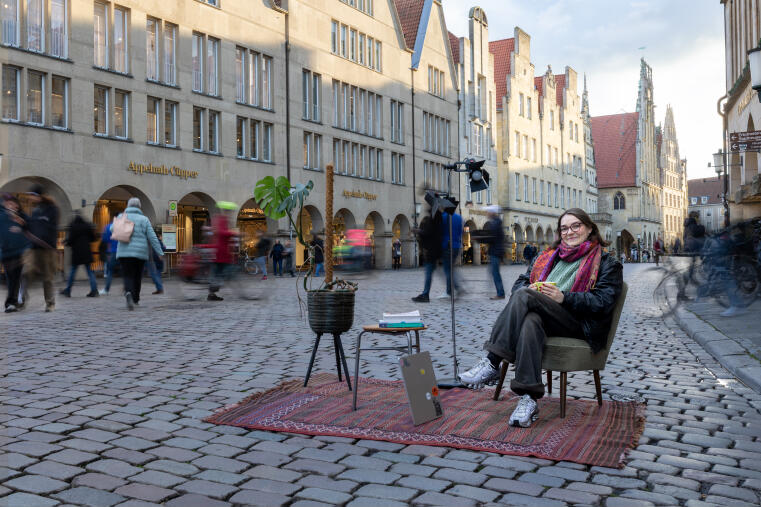
Rosa Herzog has a big heart, and she shows it when she fights for other people’s interests. Although only 21 years old, she is the longest-serving member of the General Students’ Committee (AStA) – heading the Social Affairs and Student Accommodation department – and leading any fight on behalf of people and against grievances.
It’s important to her, though, that the focus is not only on her. “I’m glad that our work is being seen – but all the others who work at least as hard as I do would have deserved the award just as much,” she says. As the co-organiser of the “Homeless Freshers” camp in October 2024 she was in demand with local, regional and national media, all wanting to know why the AStA had transformed a sports hall into a dormitory for freshers. “Every day we recited our demands for better accommodation.” She knows what it’s like to suddenly be without a roof over her head. As a 13-year-old, she and her parents had to find somewhere to live in the highly competitive Berlin housing market after their landlord told them he needed their flat for his own use.
After a year of voluntary work in Israel, Herzog moved from Berlin to Münster – and was lucky: “A girlfriend I met during my voluntary work had been offered a place at the University of Applied Sciences earlier than most other people, and she found a place in an HMO. I was also able to live there after my semester began,” she recalls. And another stroke of luck: in the introductory week she became friends with a student who soon got involved in the AStA and became its chair – and she recruited Rosa.
Rosa Herzog has been fighting for students’ interests for almost two years now. Why? “Injustice and inconsistencies are a driving force,” she says. “When politicians claim young people don’t do nything, I have to disagree: every day I see students who spend 50 hours and more on their studies, part-time jobs, caring for family members, and commuting. It breaks my heart to see how studying and finding accommodation have become a privilege.” There are no easy answers to the problem of housing, she says, and she knows that the initiative in the sports hall was only tackling the symptoms. “We wanted, and want, to fulfil our responsibility and offer help. It’s frustrating that nothing much changes overall,” she says. To ward off any resignation, she thinks with pleasure of the praise from freshers who, because of the opportunity to use the sports hall, missed neither the introductory week nor, therefore, contacts with other students.
For the first sports hall camp, and for a protest camp, Rosa Herzog and her then colleague Till Pauly were awarded the Rectorate’s Student Prize on behalf of the whole team in January 2025. “We’re delighted that the University has recognised this engagement,” says Herzog, who is studying Politics and Law. “But the University and the city shouldn’t just try and attract people – they must also help solve the problems,” she says with feeling. She attracted the attention of the German public broadcaster ZDF, which invited Rosa and Co. to Berlin to take part in a discussion programme with politicians just before the elections to the Bundestag. “After the phone call from ZDF we ran round the flat whooping our heads off,” she recalls. With millions of viewers watching, one of the students from the freshers’ camp put a question to Chancellor Olaf Scholz on the housing crisis.
Meanwhile, Rosa Herzog carries on with her work. Every day she wakes up with new ideas, she says. However, such a degree of engagement leaves its mark. She remarks, probably unconsciously, that “she also studies on the side”. But it is not only the workload. She and her team have to deal with difficult situations such as when students need emergency financial help or psychological counselling. Quietly, and a little despondently, she talks about the limits to her work. “I see the problems every day, but I can’t let 30 people sleep in my living room. Sometimes I have to look after my own mental health.” Despite the challenges, she wants to continue working at the AStA for a while. “There's still more work to do”, she says. She also wants to complete her bachelor’s course and become a lawyer so that she can continue to fight against injustice and for other people’s interests.
Author: André Bednarz
This article is from the brochure "Twelve months, twelve people", published in March 2026.
Download the entire brochure as a pdf file
To the other articles in the brochure "Twelve months, twelve people".