
© SAFIR

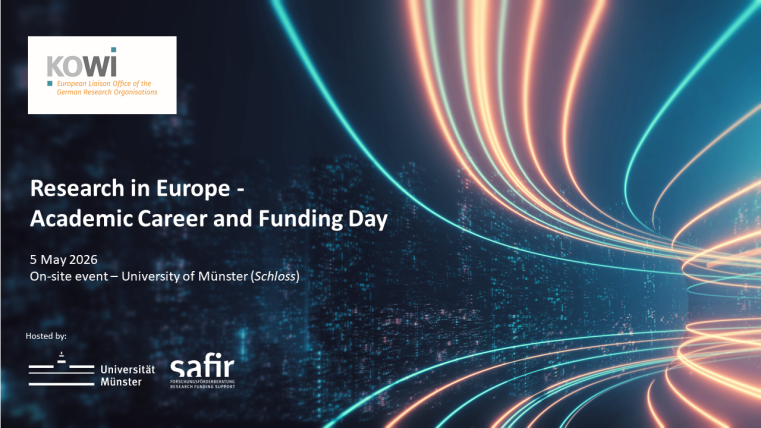
The info day "Research in Europe" provides a concise overview of academic career und connected funding opportunities in Germany and the EU. Gain first-hand insights into diverse career paths, suitable funding programmes and get tips for successful applications. Major funding organisations will present their programmes and be available to answer your individual questions at information booths during our Research Career Forums.

Organised by the EU Liaison Office of the German Research Organisations (KoWi) and Research Funding Support (SAFIR) of the University of Münster, the event will take place on 5 May 2026, 9am–4.15pm, at the Schloss (main University building) in Münster.

Attendees from outside the University of Münster are also warmly welcome in this regional event. All talks will be held in English. Please note that this an on-site event which takes place in Münster, Germany.

"Research in Europe" is aimed at students of higher semesters and graduates who wish to pursue a doctoral project, doctoral and post-doctoral researchers as well as multipliers.

Registration

Participation is free of charge, a registration is required. 

Please register via one of the following links:
If you are interested in funding/career options for doctoral candidates, please register here:
https://indico.uni-muenster.de/event/4084/  

If you are interested in funding/career options for postdocs, please register here:
https://indico.uni-muenster.de/event/4015/ 
  • Programme, "Research in Europe", 5 May 2026

    Research in Europe
    Tuesday, 5 May 2026

    Welcome from 9am onwards
    Moderation: Research Funding Support SAFIR

    9.30am Joint welcome
    Rectorate of the University of Münster and Head of KoWi Office
    9.45am Opening address: Careers in Research ‒ Financing including funding, structure of the research system, career paths
    Centre for Emerging Researchers at the University of Münster and testimonials
    10.45am Coffee and Research Career Forum  ‒ Funding organisations and University services  
    Doctoral candidates Postdocs
    11.15am Structured doctoral programmes: German Research Foundation (DFG), Research Training Groups 11.15am Funding options for postdocs: European Research Council, MSCA Postdoctoral Fellowships
    11.30am Structured doctoral programmes: European Research Council, MSCA Doctoral Networks
    11.45am Funding options for doctoral candidates: German Academic Exchange Service (DAAD) 11.45am Funding options for postdocs: German Research Foundation (DFG)
    12.15pm Funding options for doctoral candidates: German Federal Environmental Foundation (DBU)
    12.45pm Lunch
    Coffee and Research Career Forum ‒ Funding organisations and University services
    Career options in non-university research
    1.45pm Leibniz Association (WGL)
    2.05pm German federal departmental research: Bundesanstalt für Materialforschung und -prüfung (BAM)
    2.25pm Max Planck Society (MPG)
    2.45pm Room change (for doctoral candidates)
    Doctoral candidates Postdocs
    2.50pm Funding options for doctoral candidates: German Academic Scholarship Foundation (Studienstiftung) and Testimonials 2.50pm Funding options for postdocs: Alexander von Humboldt Foundation (AvH)
    3.20pm Funding options for postdocs: German Academic Exchange Service (DAAD)
    3.50pm Coffee and Research Career Forum ‒ Funding organisations and University services
    4.15pm End


  • The following organisations have confirmed their participation so far:

    • Alexander von Humboldt Foundation
      The Alexander von Humboldt Foundation sponsors academic collaborations between foreign and German researchers by granting research fellowships and awards, tailored to your individual career situation and depending on whether you want to come to Germany or carry out a research project abroad. It sponsors scientists and scholars, irrespective of academic discipline and nationality.
    • Bundesanstalt für Materialforschung und -prüfung (BAM)
      The Federal Institute for Materials Research and Testing (BAM) is a federal institute which tests, researches and advises to protect people, the environment and material goods. It works in close co-operation with universities, industry, and as part of international networks to conduct research and development activities and engage in knowledge and technology transfer.
    • German Academic Exchange Service (DAAD)
      The DAAD is one of the most important funding organisations in the world for the international exchange of students and researchers. It can support you if you are interested in studying, researching or teaching in a foreign country – as well as international applicants who would like to come to Germany.
    • German Federal Environmental Foundation (DBU)
      The DBU is one of the largest foundations in Europe. It promotes innovative, solution-oriented projects for the protection of the environment and supports creativity in small and medium sized businesses regarding practical solutions to environmental problems. The DBU scholarship programme for doctoral students serves to promote qualified young scientists in applied environmental research.
    • German Research Foundation (DFG)
      The DFG is the largest research funding organisation for the sciences and humanities in Germany. It primarily funds knowledge-driven research projects developed by the researchers themselves. The DFG places particular emphasis on supporting researchers, especially in the early stages of their careers, and supports international cooperation in all its funding programmes.
    • KoWi (European Liaison Office of the German Research Organisations)
      KoWi sees itself as a dynamic information hub on all aspects of European research funding. With their established formats, they support stakeholders in the German science community who want to apply for EU funding for their projects. KoWi also advises researchers of German institutions on all funding lines of the European Research Council and the Marie Skłodowska-Curie Actions, from application to implementation.
    • Leibniz Association
      96 non-university research institutes are part of the Leibniz Association. The fields range from natural science to ecology, economics, social sciences and humanities. They conduct basic and applied research and collaborate with universities as well as with industry and other partners at home and abroad.
    • Max Planck Society
      The 85 Max Planck Institutes and facilities conduct basic research in the natural sciences, life sciences, social sciences, and the humanities. Max Planck Institutes focus on research fields that are particularly innovative, or that are especially demanding in terms of funding or time requirements.
    • Münster Centre for Emerging Researchers (CERes) (University of Münster)
      The CERes offers training and advice for doctoral and postdoctoral researchers at the University of Münster. It takes different career paths into account and offers various workshops and event series.
    • SAFIR Research Funding Support (University of Münster)
      SAFIR supports you in identifying suitable funding opportunities for your research project at the University of Münster, offers advice on national and international funding programmes and assists you in preparing and optimising your grant applications. SAFIR also offers tailored advice for early career researchers as well as workshops and information events on research and doctoral funding.

    • Studienstiftung
      The German Academic Scholarship Foundation awards scholarships to outstanding doctoral students, irrespective of their political, ideological or religious convictions and affiliations. The Studienstiftung’s academic support includes summer academies, research groups, language courses, workshops and supervision by liaison professors.

    Contact

    Linda Dieks
    Dept. 6.1 - SAFIR Research Funding Support
    T: +49 251 83-21083
    Linda.Dieks@uni-muenster.de

Supporting KoWi members:

© SAFIR / KOWI