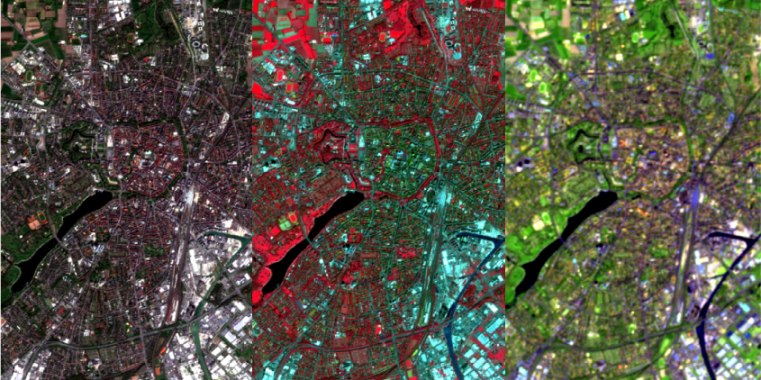
The Research Group of "Remote Sensing and Spatial Modelling" is part of the Institute of Landscape Ecology (ILOEK) [en] of the University of Münster. We study and teach the acquisition and analysis of spatio-temporal environmental dynamics in a board spectrum of landscape-ecological topics. We combine multi-scale remote sensing data with methods of spatial modelling in order to obtain continuous spatio-temporal information from limited ecological field samples.
The complexity of environmental systems requires the use of modelling strategies that take complex relationships into account. For this reason, we focus on the application of machine learning methods. In addition to their application for research questions in the context of landscape ecology, we also develop new modelling strategies for spatial and spatio-temporal data. Thus, the research group is at the interface between Geoinformatics and Landscape Ecology [en] and has the aim to contribute to an increase in knowledge in ecosystem research via drone data acquisition, satellite data processing, modelling and simulation.
| Our group contributes to new book: R Coding for Ecology
We are pleased to announce that R Coding for Ecology (Springer, 2025) has now been published with contributions from our group! The book features our CAST package, which implements key methods for spatial predictive modeling developed by our group. These methods are illustrated in a reproducible way using the example of mapping plant species richness. In addition, Jakub authored several other chapters, including contributions on landscapemetrics, cblindplotR, and cartogram.
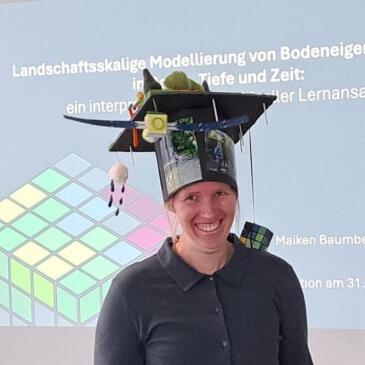
Maiken Baumberger successfully defended her dissertation on 31.10.2025 and was awarded a doctorate in natural sciences. The title of her thesis is: „Landscape-scale modelling of soil properties in space, depth and time: an interpretable machine learning approach”. Congratulations from your working group!
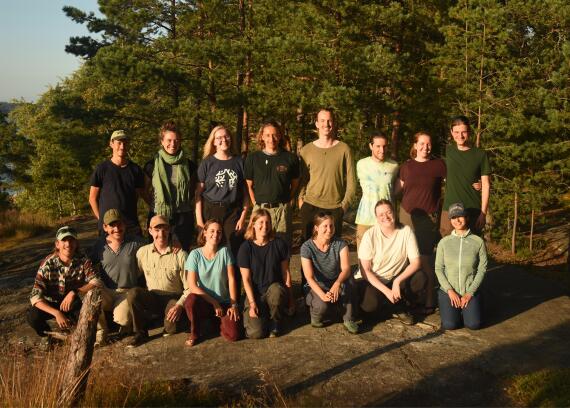
With 14 students from Landscape Ecology in Münster and Physical Geography in Frankfurt, we spent 17 days on excursion – from Helsinki to Hamningberg in Varanger and back through western Finland. Along the way, we explored various topics in physical geography. We examined the omnipresent traces of the Ice Age, studied Finland’s agriculture and forestry, got to know Aapa and Palsa mires, and visited peatland restoration projects. In Lapland, we focused on cultural and ecological aspects of reindeer grazing as well as the traditions of the Sámi. The impacts of climate change on these ecosystems were a recurring central theme. We spent most of the trip camping, which allowed us to experience and enjoy the landscape with its numerous lakes particularly intensively, alongside the scientific program.
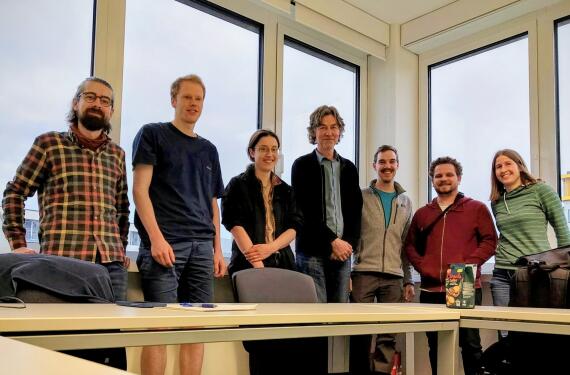
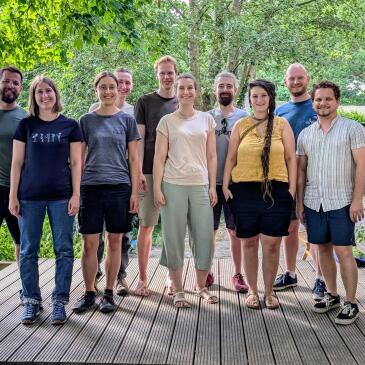
On July 3, our working group day took place at the Wersehaus. We discussed and developed the strategies and content of the working group together and then paddled, barbecued and had a great day in a convivial atmosphere.
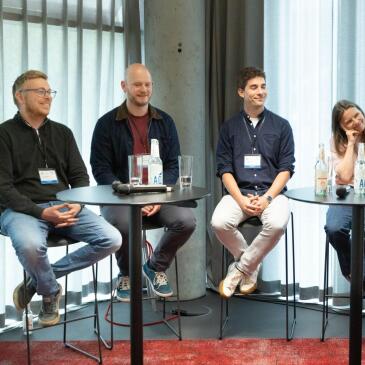
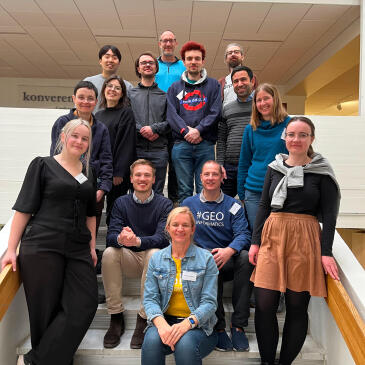
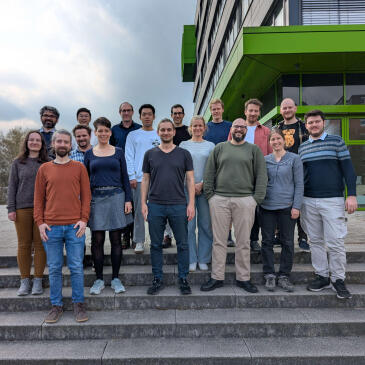
From March 24th to 25th, we hosted an international workshop at our institute, focusing on advances in spatial machine learning (see https://jakubnowosad.com/advsml_2025/). Seventeen colleagues from various institutions joined us to discuss key topics such as model validation, uncertainty assessment, and interpretability. The event was inspiring, and we look forward to continuing the discussions with follow-up activities.
In April, Jan Steen starts as our new working group member and as a PhD student in our new project "Ready for Take-Off?!". Funded by the DBU and with our projects partners, we will utilize and develop new usecases of drone remote sensing for an improved habitat monitoring.
In our new projekt Sensorlök, we want to integrate environmental sensors into teaching at the Institute of Landscape Ecology in order to train students to implement innovative methods of environmental monitoring in practice. Led by Marvin Ludwig, a sensor network will be set up by students in our teaching and research area “Lüntener Wald” in the summer term '25 that automatically measures, transmits and evaluates groundwater levels, microclimate and soil parameters.
| New project evaluates UAV for practical environmental monitoring
Our new project “Ready for Take-Off!?” starts in April. Together with the Biologischen Station Zwillbrock, the LWL and the Nationalpark Vorpommersche Boddenlandschaft, we are developing and evaluating drone remote sensing methods to support the flora-fauna-habitat monitoring of grassland and heath habitat types. The focus is on the reliable estimation of habitat quality criteria and the applicability of the methods for users in practice.
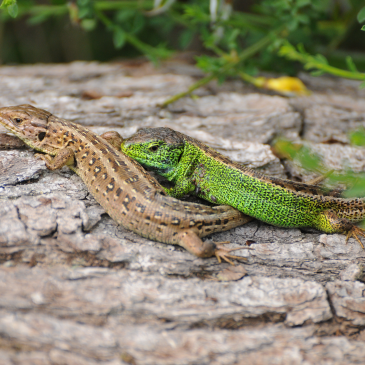
In a joint publication by the Animal Ecology working group and ourselves, and led by our former Master's student Alina Krämer, we modelled the habitat suitability of the sand lizard at its north-western distribution limit. The results have now been published in the Journal of Biogeography: https://doi.org/10.1111/jbi.15099
From Januray on, Darius Görgen will join our research team as a scientific assistant and PhD student.
He will work in our new project "Deep learning in Space and time", which is part of the Transregio 391 - Spatio-temporal Statistics for the Transition of Energy and Transport (https://trr391.tu-dortmund.de/).
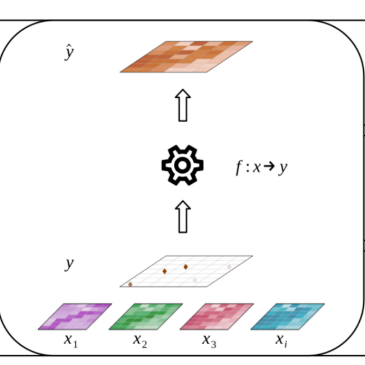
In our subproject, we will explore new methods for using deep learning in the context of spatio-temporal earth observation data.
We are looking for a PhD student (3 years, 65%) for our research project ‘Ready for Take-Off! - Integration of drone-based remote sensing into the monitoring of open land FFH habitat types'. Details can be found in the job advertisement here.
This workshop is aimed at anyone interested in gaining practical insights into agent-based modeling of ecological systems using the software NetLogo, without requiring any prior modeling or programming experience.
Date: 20.12.2024, 10:15 – approx. 16:30
Location: StudLab 130
Instructor: Katrin Meyer (University of Göttingen)
Language: German
Please send registrations to hanna.meyer@uni-muenster.de (no registration required for participants of module M8).
| New study reveals significant moisture changes in European peatlands
Led by Laura Giese, our team recently conducted a study examining trends in moisture conditions across European peatlands based on satellite time-series data spanning the last four decades. The results reveal a significant increase in moisture in the boreal and oceanic regions of Europe, while peatlands in the temperate and continental regions show intensified drying trends. Particularly noteworthy is the high spatial heterogeneity of moisture trends on a local scale, which highlights not only the impacts of climate change but also the effects of management practices.
The study can be found here: https://doi.org/10.1016/j.rsase.2024.101385.
We published two new papers within the Carbon4D project, both led by Maiken Baumberger. The papers are advancing high-resolution soil temperature and moisture modeling on a landscape scale. The first paper, published in Geoderma, introduces a novel approach to predict soil temperature and moisture patterns in four dimensions (space, depth, time) for the Fichtelgebirge in Germany, using random forest models. The second paper, published in Environmental Modelling & Software, presents the use of Gated Recurrent Units to take lag effects into account, required to predict time series of moisture and temperature. Both studies offer crucial insights into soil dynamics and will be used by our team to estimate soil respiration in space, time and depth (see Carbon4D).
Read more: https://doi.org/10.1016/j.geoderma.2024.117049 and https://doi.org/10.1016/j.envsoft.2024.106245
Laura and Nele from our Reversal Team successfully conducted fieldwork at the peatland site 'Bagno Kusowo' in Poland and visited our project partners at Adam Mickiewicz University in Poznań. Over four days of intensive fieldwork, we carried out multiple UAV flights using our RGB, multispectral, and Lidar sensors, in addition to measuring surface moisture and conducting vegetation surveys. We are very grateful for the support from the research team in Poland and all the helping hands involved. It was a wonderful field campaign at this beautiful site, with pristine conditions and a high abundance of stunning Sphagnum magellanicum!
We offer an excursion to Finland and Varanger from 30. Juli – 15. August 2025, covering various topics from landscape ecology and physical geography.
Please let us know if you are interested.
Our research group is gaining new strength! Since mid-August, Jakub Nowosad has joined us for two years. Jakub is well known for his book Geocomputation with R and various R packages, such as landscapemetrics. He has successfully secured a Marie Curie Postdoctoral Fellowship, and over the next two years, we will be collaborating on the analysis of spatial patterns in machine learning models. Additionally, Jakub will surely enrich our teaching in the field of spatial data analysis with R from time to time.
Laura, Jan, and Hanna took part in the annual conference of the German Ecological Society from September 9 to 13 in Freising. Laura gave a talk on satellite-based monitoring of moisture conditions in peatlands, Jan presented his work on using the long-term plots of the Biodiversity Exploratories to model species richness across larger areas, and Hanna showcased the latest methodological developments in spatial prediction modeling. We also took the opportunity to connect with other researchers, meet colleagues, and develop new research plans.
| Earth Observation Summer School in the Harz mountains
We had a great week in the Harz mountains (1.09.24–6.09.24), where students from our institute came together with students from HAWK Göttingen and the University of Marburg. Together, we discussed current challenges in forestry and the Harz National Park and learned about methods to support forest monitoring using remote sensing. The interdisciplinary nature of the group (students of landscape ecology, forestry, and physical geography) was a valuable experience. During our Walk & Talk through the national park, we had the opportunity to exchange ideas between the groups and combine the different focus areas in a joint project. We are already looking forward to the next collaborative event next year!
More News...
Older news can be found in the archive [en] of the Remote Sensing and Spatial Modelling Research Group.