
News archive
2025
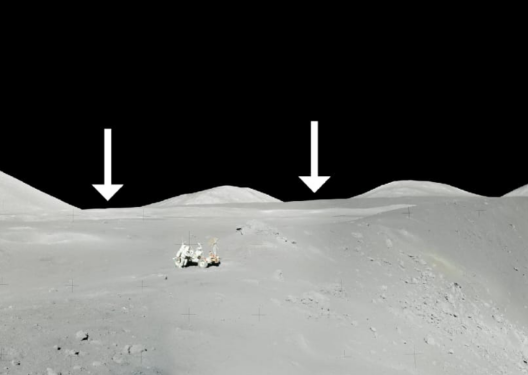
© T. Frueh Compression and extension tectonics on the moon
Cooperative Master's thesis leads to scientific publicationOur Moon was formed through a massive collision with a Mars-sized protoplanet. In the aftermath of its formation, the Moon was largely molten and has been slowly cooling ever since. As it contracts, its volume decreases, leading to tectonic deformations on its surface. This process is particularly visible through the formation of thrust faults, known as lobate scarps – some of the Moon’s youngest geological structures.
In his master’s thesis, Thomas Früh studied small, meter-sized graben that appear on these lobate scarps. By comparing them to similar structures in Australia and Africa, he helped identify potential formation mechanisms. The work was carried out on his own initiative and in collaboration with the Institute of Geology & Palaeontology and the Institute of Planetology. It has now been published in the international journal Icarus.
"Small graben on large thrust faults indicate that tectonic activity on the Moon is ongoing. This is an important clue that other moons and planets could still be geologically active as well," Frueh explains.
© DSK Annual meeting of the German Stratigraphic Commission in Münster
On February 20 and 21, the annual meeting of the German Stratigraphic Commission (DSK) will take place in Münster for the first time. The event is being organized by the AG Paläontologie under the direction of Prof. Becker, the current DSK chairman.
Further information on the DSK and the annual meeting in Münster can be found here.

© unsplash.com/@simonppt Geowissenschaften für die Zukunft
17 Professor*innen des FB14 nehmen in offenem Brief Stellung zum Schulfach GeographieBaden-Württembergs Ministerpräsident Winfried Kretschmann sorgte im Januar für Gesprächsstoff im Fachbereich Geowissenschaften (FB14). In einem Online-Artikel zur Schulpolitik wurde er mit einer Aussage zitiert, die das Schulfach Geographie auf Kartenlesen reduziert. Als Reaktion auf diese Aussage positionieren sich 17 Professor*innen des FB14 in einem offenen Brief: "Geographie bleibt entscheidend, um globale Zusammenhänge zu verstehen" und um "Antworten auf die drängendsten Fragen unserer Zeit liefern zu können".
Der offene Brief wird in der neusten Ausgabe der Unizeitung wissen|leben vorgestellt. Hier finden Sie den Artikel zum offenen Brief in der wissen|leben.
2024

© Till Söte How stony corals have survived for millions of years
New Nature paper with contribution from MünsterStony corals can survive in nutrient-poor, tropical seas because they form a special symbiosis with photosynthetic microorganisms. This partnership has a long history - but it was previously unclear how far back in Earth's history it goes. An international research team has now shown that some coral species already hosted photosymbionts 385 million years ago.
Dr. Till Söte contributed to the current Nature paper during his doctorate at the Institute of Geology and Palaeontology at the University of Münster.
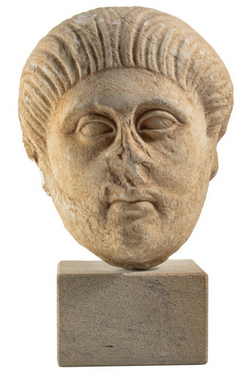
© Archäologisches Museum Münster Archaeology meets Geology
Scientists from the Institute of Geology and Palaeontology are involved in the return of an ancient art objectThe University of Münster has now returned a marble head of unknown origin to the Greek state. The University's Archaeological Museum was given the head from a private collection in Essen in 1989, but it remains unclear how the donors obtained the ancient piece, who removed it from its original location and when it was removed.
Prof. Dr. Laura Stutenbecker and Prof. Dr. David De Vleeschouwer examined the composition of the marble and compared it with analyses carried out last year on selected marble objects in the Archaeological Museum in Thessaloniki.
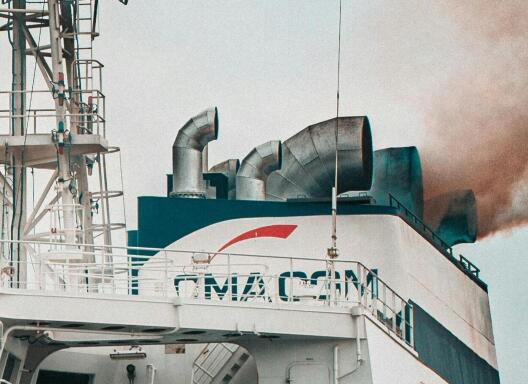
© Unsplash, Mika Baumeister Pollutants in shipping: researchers recommend stricter regulations
New study on the toxicity of ship waste water from the working group Applied GeologyThe international maritime shipping industry contributes to air pollution, particularly in coastal areas and port cities. A research team led by Prof. Dr. Christine Achten has analysed the wastewater from exhaust gas cleaning systems for their contamination with polycyclic aromatic hydrocarbons and their toxicity. This is one of the most comprehensive studies on this topic.

© Steffen Trümper Dr. Steffen Trümper receives Hans Cloos Prize 2024
Award for outstanding research in the field of geosciencesResearch associate and museum curator Steffen Trümper has been awarded the Hans Cloos Prize, endowed with 10,000 euros. The German Geological Society thus honors Dr. Trümper's “groundbreaking findings in the reconstruction of terrestrial habitats”.
The interdisciplinary approach with which he reconstructs fossil ecosystems in exceptionally high resolution was particularly emphasized. His work on continental fossil communities in the late Palaeozoic and on fossil forests is considered groundbreaking for research. In addition, Dr. Trümper's successes in teaching and popular science communication were highlighted and honoured.
2023
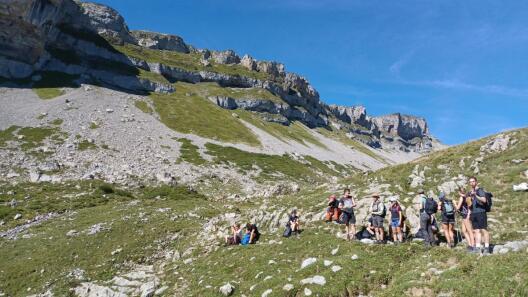
© Torsten Prinz "We experience the geosciences directly"
Dr. Torsten Prinz describes the long-standing excursion tradition to Kleinwalsertal valleyFor more than 20 years, students from the Department of Earth Sciences at the University of Münster have been going on excursions to Kleinwalsertal. Now the time has come again: at the end of August, they will be going for eleven days to the Austrian village about 700 kilometres away at an altitude of 1,400 metres in the Allgäu Alps. 15 students, two excursion leaders and a tutor will explore the geological, geobotanical and geographical features of the region. Kathrin Kottke spoke to Dr Torsten Prinz, who is leading the excursion with Prof. Dr Harald Hiesinger, in the run-up to the trip.
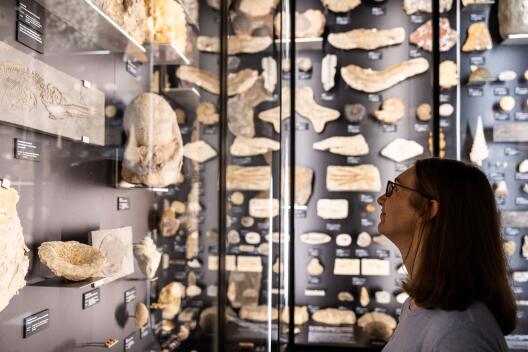
© Uni MS - Peter Leßmann The Geomuseum: a treasure trove of superlatives
Opening on 10 August: The Geomuseum displays 2,300 exhibits from 13.8 billion years of Earth's history.Descending twelve steps and going through 200 million years, experiencing the 13.8 billion years since the Big Bang in about an hour, retracing two billion years of Earth's history in a single room using 700 original exhibits - the new Geomuseum at Münster University is a museum of superlatives. With the opening on 10 August, Münster's museum quarter around Pferdegasse is complete. In addition to the LWL Museum of Art and Culture, it includes the Bible Museum and the University's Archaeological Museum. The team of the Geomuseum gave the editorial staff of wissen|leben the opportunity to take a detailed tour in advance.