

At Home in the Darkness
No matter how vigorously Professor Nicolas Rohner waves his hands in front of his aquarium at the Institute of Integrative Cell Biology and Physiology to startle the fish, the animals remain unimpressed. No wonder: they have no eyes and cannot see who is moving on the other side of the glass.
In their natural habitat – caves in Mexico – complete darkness prevails, making vision unnecessary. Evolution has effectively ‘done away with’ their eyes, and their skin is pale rather than the silvery-grey of their relatives. Mexican cavefish have also developed numerous other adaptations to life underground. Understanding exactly what these are, how their metabolism has changed, and what differences exist in their genomes and gene activity is what interests Nicolas Rohner. At the heart of his research group is an aquarium facility comprising 160 individual tanks, which are home not only to the cave fish but also to their above-ground relatives and hybrids produced through cross-breeding.
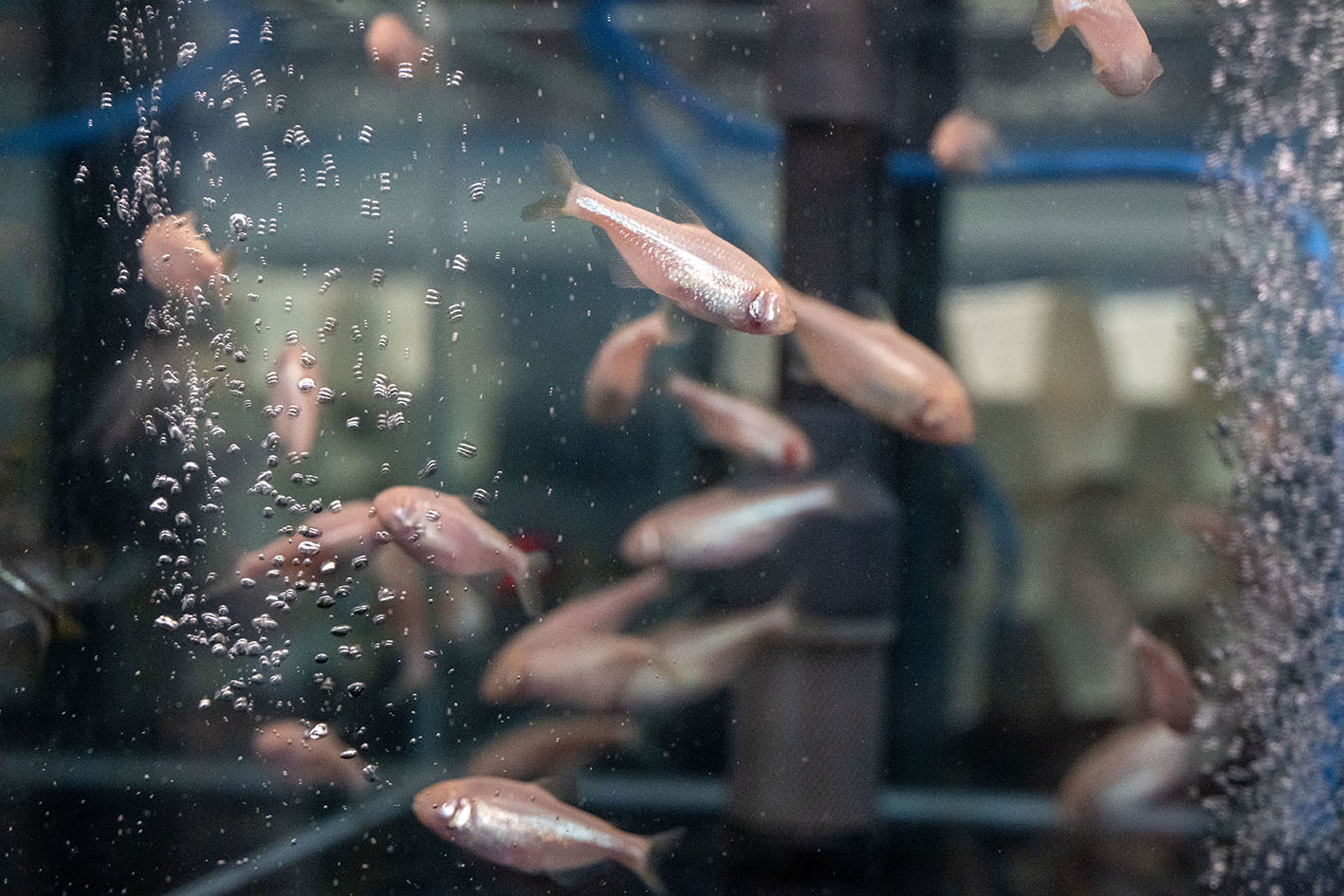
Anyone who observes the fish closely will also notice differences in their behaviour. Surface fish occasionally accelerate seemingly without warning, darting around energetically. Cave fish, which have no predators to fear in their dark habitat, swim at a consistently calm pace. The fish’s muscles reflect these behavioural differences – something that PhD student Kelly Dooling is particularly interested in. A former doctoral student of Nicolas Rohner at the Stowers Institute for Medical Research in Kansas City, USA, had the fish swim in a flow channel and demonstrated that, in terms of endurance, the cave-dwelling fish can keep up with their relatives. “They shouldn't really need this ability anymore, as the waters in the caves are very calm,” says Kelly Dooling. Nevertheless, there are many differences at the molecular level, which she has now revealed through comprehensive sequencing of muscular RNA. For example, she identified numerous differences in gene activity and in the types of cells present. The cave fish’s muscles, it appears, contain more slow-twitch muscle cells and slightly fewer fast-twitch ones.

Kelly Dooling hopes that one day she will be able to visit ‘her’ cave fish in the wild. Few people have had this opportunity. Nicolas Rohner, however, has already had this experience. During his time as a postdoctoral researcher at Harvard and later as a professor at the Stowers Institute, he participated in several cave expeditions. Inside the caves, it is not only pitch black, but also warm and humid. In some places, the ground is covered in meters-deep layers of mud and bat guano, through which the researchers had to crawl—wearing FFP2 masks throughout because of potential pathogens in the droppings, long before such masks became a familiar part of everyday life during the COVID-19 pandemic. It wasn’t pleasant, recalls Nicolas Rohner. Nevertheless: “Seeing the fish right there in front of me was fantastic; it made all the hardship worthwhile.”
Mexican cave fish (Astyanax mexicanus)
- Fish of the species Astyanax mexicanus are native to Texas and New Mexico (USA) as well as northern and central Mexico.
- The cave-dwelling forms of this freshwater fish species live in isolation in various caves in central Mexico.
- The fish have various physical adaptations, including atrophied eyes and a lack of skin pigmentation.
- The life expectancy of the cave-dwelling fish, at around 30 years, is roughly twice that of their surface-dwelling relatives.
- Food is scarce in the pitch-black caves, where no plants grow.
- The cave fish are adapted to this and can survive for around 20 months without food.
- By comparison, surface-dwelling fish can survive ‘only’ three months without food.
- Cave fish perceive odours 100,000 times more intensely than their relatives.
- Increased fat consumption does not lead to signs of inflammation in cave fish, whereas it does in their relatives – just as it does in humans.
Original publication
Emma Y. Roback, Maggs X, et al. (2026): A pangenome framework uncovers the role of deletions in repeated evolution of cave-derived traits. Genome Research; DOI: 10.1101/gr.281719.125
This article is taken from the university newspaper “wissen|leben”, issue no. 7, 11 November 2026.