
New Emmy Noether Groups to research organ development and controllable nanoparticles
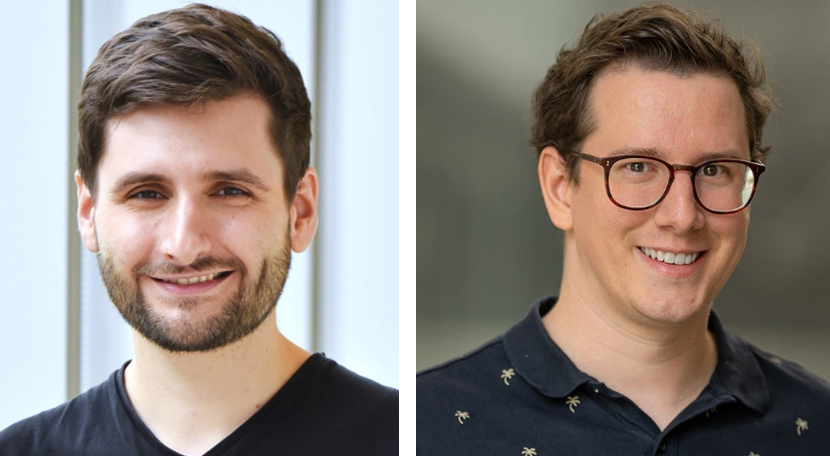
Good news for two young researchers at the University of Münster: the German Research Foundation (DFG) has accepted Dr Maik Bischoff (Faculty of Biology) and Professor Marcel Rey (Faculty of Chemistry and Pharmacy) into the ‘Emmy Noether Programme’. Their induction comes with an award of around 3.1 million euros in funding to establish their own research groups over the next six years.
Maik Bischoff has been an independent junior research group leader at the Institute of Integrative Cell Biology and Physiology since 2025 and is a researcher in the Collaborative Research Centre ‘Dynamic Cellular Interfaces’. With his group, he aims to elucidate the mechanisms underlying the ‘handedness’ (chirality) of organs. Anatomical handedness is widespread in nature. Examples include the human heart and the intestine. The form an organ takes is determined during embryonic development, but how this determination works is not yet understood. What is known is that so-called mesenchymal cells – which include connective tissue and muscle cells – can reshape tissue through compression and cell movement. Using the testicles of fruit flies as a model, Maik Bischoff will investigate how such cells can control the chirality of organs and elucidate the underlying subcellular mechanisms. To this end, he intends to analyse the behaviour of individual cells and develop biomechanical models to show how the interactions between these cells and surrounding tissues define the shape and handedness of organs. The aim is to understand how organ shape and handedness are controlled.
Marcel Rey has held an assistant professorship in physical chemistry at the University of Münster since 2024. As part of the Emmy Noether Programme, his group is developing nano- and microparticles whose geometry can be specifically and reversibly controlled using polarised light. The polymer particles contain specific molecular building blocks (azo groups) which align when exposed to light, thereby triggering a controlled deformation of the particles. For example, spherical particles can be specifically transformed into irregular shapes such as rods. The shape of the particles thus becomes a programmable material property. The group aims to understand how this can be used to control interactions and self-organisation at the nano- and micro-scale, and how such particles can be utilised as building blocks for adaptive nanomaterials. The long-term aim is to develop materials whose structure and properties can be specifically programmed, modified and erased using light. Potential applications range from the targeted production of complex nanostructures to adaptive materials and concepts for micro- and nanorobotics.
The ‘Emmy Noether Programme’ offers exceedingly qualified, early-career researchers the opportunity to qualify for a professorship by independently leading a research group over a period of six years.