
Water level determines how sensitive peatlands are to warming
Peatlands store large amounts of carbon. However, when they are drained, they can become substantial sources of the greenhouse gas carbon dioxide (CO₂). An international research team led by the University of Münster has now used the largest international dataset on CO₂ budgets of northern peatlands to show how water level and temperature effects are linked. The lower the water table, the more strongly CO₂ emissions respond to rising temperatures. A higher water table can therefore dampen this effect. The results have been published in the journal Nature Communications.

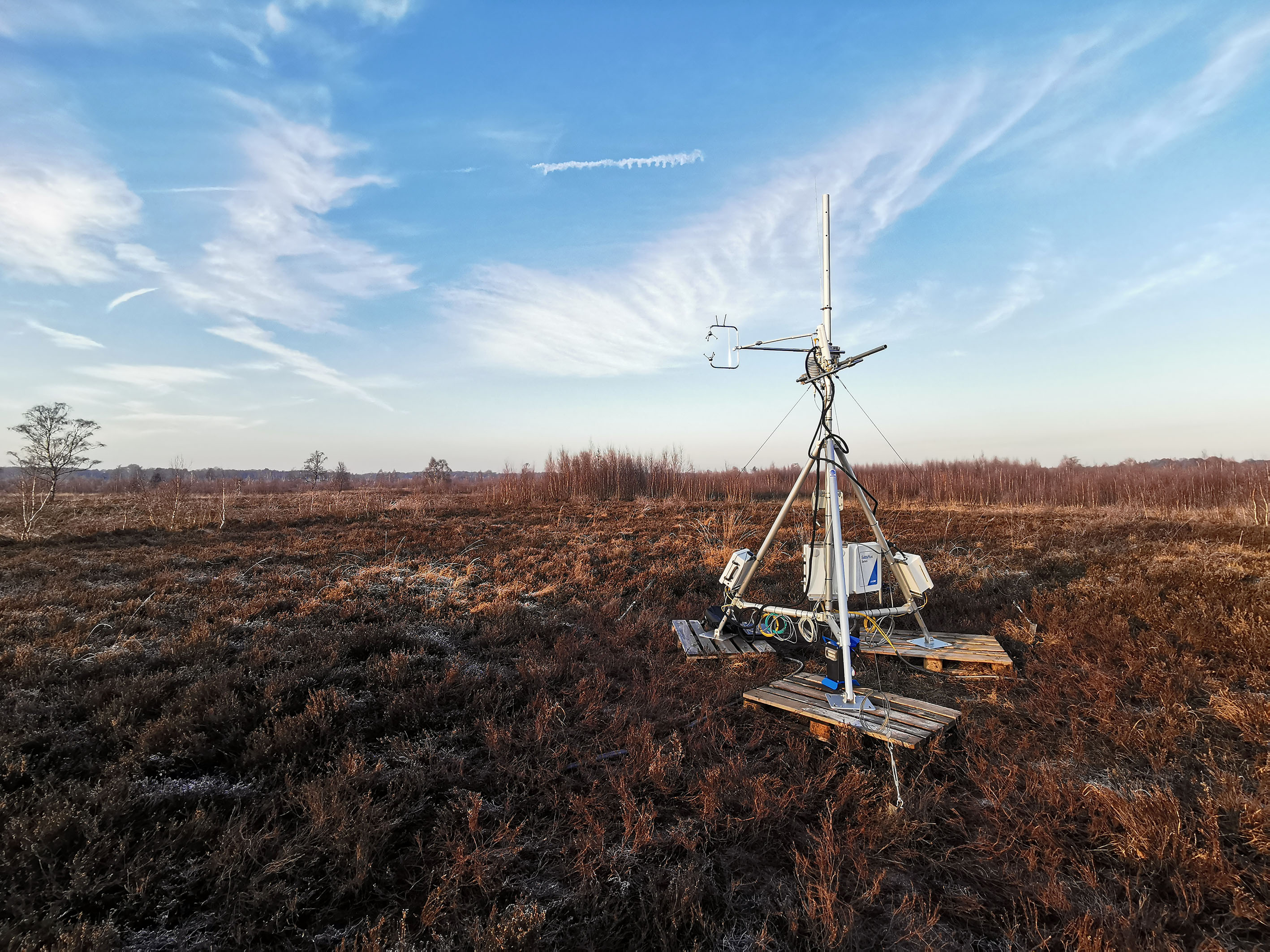
For the study, the team analysed measurements from 276 so-called site-years covering a total of 114 peatlands in temperate and boreal regions. These were located, among other places, in Germany, Estonia, France, the United Kingdom and North America. A site-year refers to measurements from a particular site over the course of one year. The researchers examined both natural fens and bogs as well as croplands, grasslands and former peat extraction sites.
Because the relationships are non-linear and other factors such as vegetation and solar radiation also play a role, the research team used explainable machine-learning methods. This made it possible to disentangle non-linear interaction between annual CO₂ fluxes, water table depth and temperature allowing the relationships to emerge from the data without imposing predefined relationships.
The annual budgets show how much CO₂ is released by a peatland at different water table depths. CO₂ emissions decline particularly when the water table is raised from very low levels – specifically, to less than 60 to 75 centimetres below the peatland surface. To reduce CO₂ emissions as much as possible, the study identifies water tables at 20 centimetres below the surface or higher. At the same time, the annual averages already show that at deep water tables, CO₂ emissions increase considerably more at higher temperatures.
The annual budgets show how much CO₂ a peatland releases over an entire year, but they do not reveal how water level and temperature interact over shorter periods. To investigate this, the team used a second, higher-resolution dataset comprising 113 site-years with daily CO₂ flux measurements. These data show how sensitive a peatland is to day-to-day temperature fluctuations depending on the current water table. “Using the daily data, we were able to show for the first time across many peatland sites that higher water tables reduce the effect of high temperatures on CO₂ emissions,” says Nicolas Behrens. When the water table is low, by contrast, the influence of temperature increases. The daily analysis therefore confirms, using an independent level of data, what was already indicated by the annual budgets.
The study provides a further piece of the puzzle in understanding carbon–climate feedbacks. As the climate changes, processes in peatlands can also change. These processes, in turn, affect the release or uptake of greenhouse gases.
For peatland protection, this means that rewetting drained peatlands as a climate mitigation measure is likely to become even more important as warming progresses, in order to slow the temperature-driven increase in CO₂ emissions.
The researchers concentrated in their current study exclusively on CO₂. A complete climate balance of peatlands must also take into account other greenhouse gases such as methane and nitrous oxide, whose emissions can likewise change as a result of rewetting.
Original publication
Nicolas Behrens, Christian Brümmer, Kuno Kasak, June Skeeter, Ian B. Strachan, Ype van der Velde, Chris D. Evans, Ross Morrison, Carole Helfter, Guillaume Bertrand, Sébastien Gogo, Adrien Jacotot, Carsten Schaller, Karen Yeung und Mana Gharun: Drivers of northern peatland CO₂ fluxes revisited: interacting water level-temperature dependency. Nature Communications (2026). DOI: 10.1038/s41467-026-77456-6.