

New approaches against fungal infections discovered
They are the cell’s ‘gatekeepers’: specialised proteins, known as transporters, selectively control which substances enter a cell and which do not. Researchers at the University of Münster and the National and Kapodistrian University of Athens have investigated these transporters in a specific case: the UapA transporter of the model fungus Aspergillus nidulans. The findings are not only relevant to cell biology but could also offer new approaches to treating fungal infections.
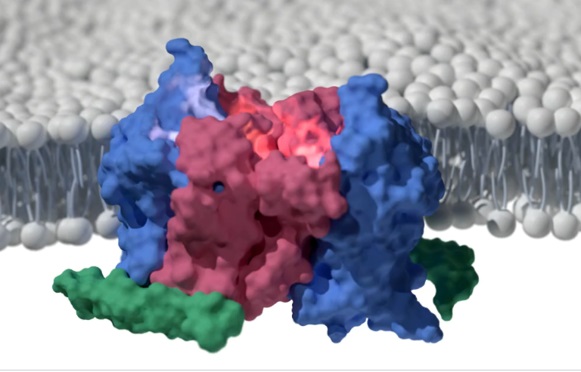
The research findings suggest that UapA functions via a specialised ‘elevator-type’ transport mechanism. In this mechanism, the protein consists of a relatively rigid scaffold domain (the ‘shaft’), which is embedded in the membrane, and a mobile transport domain (the ‘elevator’), which binds the substrate. During transport, this ‘elevator’ moves along the scaffold, carrying the substrate from the outside of the cell into the cytoplasm. This process requires precise coordination with membrane lipids and surrounding water molecules. Until now, the molecular basis of this process was poorly understood due to a lack of structural information.
With its new study, the research team has made a significant advance in elucidating this transport mechanism. The research group led by Prof. Christos Gatsogiannis at the Institute of Medical Physics and Biophysics and the Centre for Soft Nanoscience at the University of Münster achieved a decisive breakthrough: using state-of-the-art cryo-electron microscopy, they succeeded in imaging UapA in two different states. The structures were determined at an exceptional resolution of 2.05 Å – one of the highest resolutions ever achieved using a structural determination method for a eukaryotic membrane transporter. This level of detail allows the visualisation of the protein’s architecture, as well as individual water molecules and the surrounding membrane lipids. One of the most striking findings concerns the N-terminal region of the protein: until now, it was assumed that this region had no fixed structure. However, the new data show that the region fulfils a dual function: it helps the transporter to fold correctly and reach the cell surface. It also plays a role in regulating how the transporter functions.
The findings are fully consistent with genetic and functional studies carried out by the research group led by Prof. George Diallinas at the Institute of Biology, National and Kapodistrian University of Athens. They thus expand our understanding of how UapA functions. Transporters such as UapA can be used, amongst other things, for antifungal drugs – that is, medicines used to treat fungal infections – to enable them to enter fungal cells. A deeper understanding of their structure and function could therefore contribute to the development of new therapeutic strategies against fungal infections.
Original publication
Broutzakis G, Pyrris Y, Akrani I, Neuhaus A, Mikros E, Diallinas G, Gatsogiannis C. Cryo-EM of the eukaryotic purine transporter UapA demonstrates intramolecular and lipid regulation of transport. Proc Natl Acad Sci U S A. 2026 Jun 30;123(26): e2513585123. doi: 10.1073/pnas.2513585123