
New study provides insights into the control of photosynthesis
A research team at the University of Münster has discovered a previously unknown regulatory mechanism in plant photosynthesis in the unicellular green alga Chlamydomonas reinhardtii. It helps plants adapt to changes in light conditions. The results published in the journal Nature Plants show how a crucial protein interaction at the interface between the two photosystems I and II controls the photosynthetic machinery.
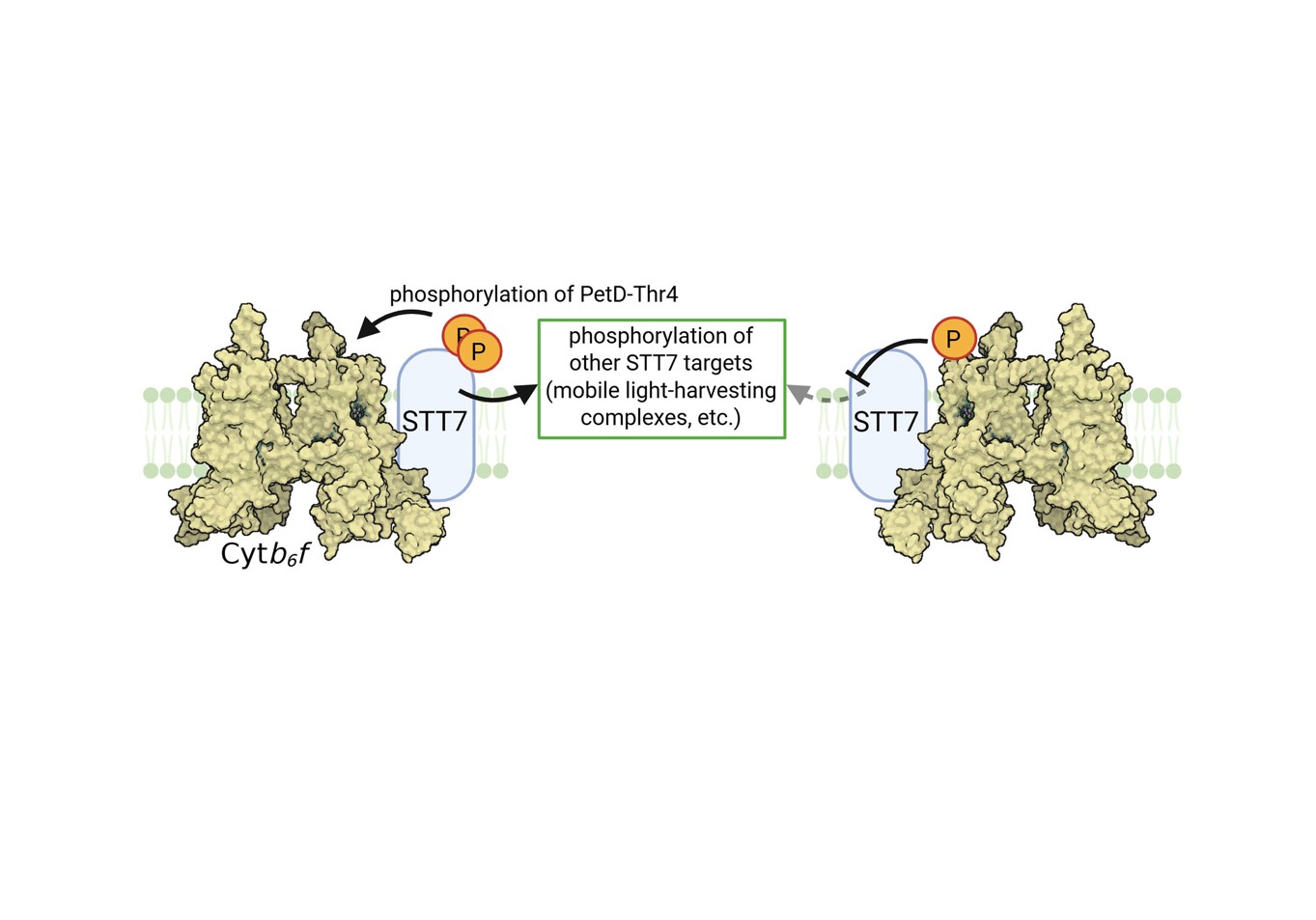
The team led by Professor Michael Hippler and Dr Felix Buchert from the Institute of Plant Biology and Biotechnology at the University of Münster investigated the interaction between the cytochrome b6f complex, which is important for photosynthesis in chloroplasts, and the protein kinase STT7 – a central step in the process of so-called “state transitions”. These enable plants to balance the light-harvesting capacities of both photosystems, so that chemical energy for growth can be efficiently provided even under dynamic sunlight conditions. This acclimation is preceded by STT7-dependent phosphorylation of mobile light-harvesting complexes, which can be reversed by other phosphatases.
Background: Photosynthesis takes place in the chloroplasts – the “power plants” of plant cells. There are two photochemical reaction centres (photosystems I and II) that work optimally under light of different wavelengths. The absorption of light energy into the two photosystems enables electron transport within the molecular “photosynthetic machine”. It thus drives the conversion of light energy into chemical energy.
For the study, the researchers combined genetic methods with measurements of photosynthetic performance and biochemical analyses. They showed that various disruptions of the so-called N-terminal region of PetD can impair both the function of the cytochrome b6f complex and the activation of STT7 – an indication of its central role in this process.
In addition to the group from Münster, researchers from Stanford University (USA) and Sorbonne Université (France) were involved.
The research was funded by the German Research Foundation (DFG FOR 5573 – GoPMF). The open access publication was made possible by the DEAL initiative to strengthen open access publishing in Germany.
Original publication
Zaeem A. et al. (2026): The amino terminus of PetD is essential for cytochrome b6f function and the negative feedback control of STT7 kinase. Nature plants; DOI: 10.1038/s41477-026-02310-y