

The University of Münster establishes Germany’s first ‘Faculty of Islamic Theology’
On 1 July 2026 the University of Münster will be the first higher education institution in Germany to establish a Faculty of Islamic Theology. This will significantly increase the visibility and importance of the discipline. ‘The establishment is a milestone for Islamic theology, of which we are proud,’ says Professor Johannes Wessels, Rector of the University of Münster. ‘At the same time, it represents a call for more tolerance in society and politics, which will be noticed far beyond Münster.’
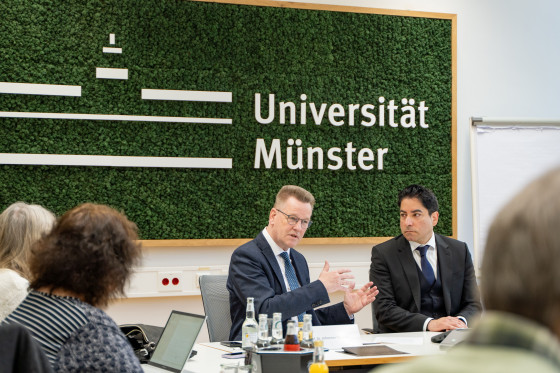
The Centre for Islamic Theology (CIT) currently operates as a central research facility at the University of Münster. With the establishment of the new faculty, the CIT will be dissolved and its activities integrated into an independent faculty of the University of Münster. The founding dean is the managing director of the CIT, Professor Mouhanad Khorchide, who has held the chair for Islamic religious education since 2010. ‘The new faculty will strengthen the profile of the University of Münster as a place of theological diversity,’ says Mouhanad Khorchide. ‘This step is an impressive signal of recognition for many Muslims in Germany.’
Years of preparation preceded what is now the founding of the University’s sixteenth faculty. Following the establishment of the CIT in 2012, a “theologies taskforce” was appointed three years later to develop initial ideas for further development. In 2019 the Rectorate decided to convert the CIT into a faculty. The process involved negotiations between the NRW State Ministry for Culture and Science, the University’s Senate and Board of Governors, the Confessional Advisory Board for Islamic Theology at the University of Münster and the faculty board of the Faculty of Philology. Students in the corresponding departmental student body and the General Students’ Committee (AStA) are also involved.
Converting an institute into a full-fledged faculty brings a significantly greater degree of independence. The Faculty of Islamic Theology will be able to develop its research profile and curriculum independently, draw up its own examination regulations and award doctorates and post-doctoral qualifications. The faculty also plays a key role in the appointment process for professors and other academic posts.
In addition to its new rights, the faculty must also comply with a wide range of obligations. For example, it must independently ensure the completeness and studyability of the curriculum, have its degree programmes accredited, conclude target agreements with the Rectorate and offer study advice. Moreover, despite its extensive autonomy, the faculty is bound by higher-level laws and regulations, e.g. the Higher Education Act, the Statutes of the University of Münster, the resolutions of the Senate and Rectorate, structural and development planning policies, budgetary and employment regulations, and equal opportunity and data protection obligations.
The Faculty of Islamic Theology will be one of the central institutions alongside the Protestant and Catholic theological faculties in the new “Campus of Theology and Religious Studies”, scheduled to open in the coming months. The unique campus promises to become a place of understanding between the fields of science, politics, religion, media, culture and the arts in the city of the Peace of Westphalia. At the same time, it will be home to one of the world’s largest research libraries on the topic of religion.
The last time a faculty was established at the University of Münster was 22 years ago in 2004, when the University of Music (FB 15) emerged from the Münster branch of the Detmold University of Music.