

Strong together – strong for others
At the New Year’s reception held at the Schloss in Münster, around 400 guests attended the presentation of the Rectorate Awards which recognised outstanding teaching, exemplary equality initiatives and exceptional student engagement. Dr Marie Ghanbari received the €30,000 Teaching Award for the Sports Mentoring Project, while the Münster chapter of the Feminist Law Clinic was awarded the €7,500 Student Prize. The €20,000 Gender Equality Award was shared by the SUN – Office Network and the BEAM project run by the Women+ in Information Systems team. In the following, we introduce you to the award winners.
Teaching Award
Good teaching does not end with the transfer of knowledge
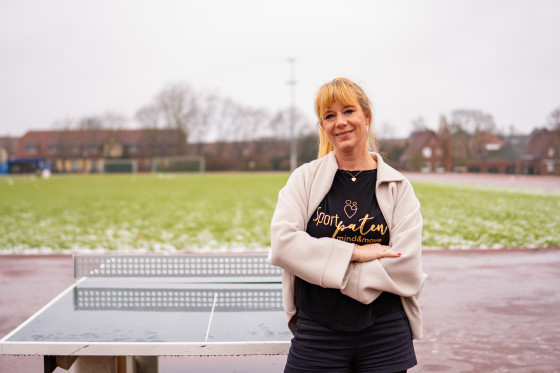
The project grew from a single-subject seminar into a ‘research-based teaching concept that demonstrates how university teaching can have a lasting impact,’ as Marie Ghanbari describes it. And rightly so, as the figures speak for themselves. Across 46 interdisciplinary Sports Mentoring seminars, more than 1,000 students have been trained, who in turn have supported the same number of children. The project is interdisciplinary, now involving the Faculties of Psychology/Sport and Exercise Sciences, Medicine, Business and Economics, Law and Educational and Social Sciences. ‘With six cross-faculty seminars per year, the Sports Mentoring Project is an outstanding example of problem- and case-based teaching that strengthens the development of both students and children,’ praised the Rectorate Awards jury.
For Marie Ghanbari, the project is a true labour of love. ‘This award means a great deal to me. It recognises a form of teaching that brings together science, practice and social responsibility. We have been pursuing this path for many years with strong conviction and passion.’ For the sports psychologist, good teaching does not end with the transfer of knowledge; it should move people, create relationships and have a real impact. ‘It is particularly significant that empathy, responsibility and personal development are visibly recognised as core educational objectives.’
Author: Hanna Dieckmann
Student Prize
Commitment to a feminist legal practice
For non-lawyers, the legal system can be confusing. However, it can also become highly relevant quite suddenly when they experience injustice. To provide easily accessible legal assistance, students at the University of Münster founded a local chapter of the Cologne-based Feminist Law Clinic (FLC) at the end of 2024. The Rectorate has now honoured their commitment to counselling, organisation and communication with the Student Award. ‘We applied for the award because we are doing important work and wanted to show that we are here,’ says Charlotte Nocker, one of the award recipients.
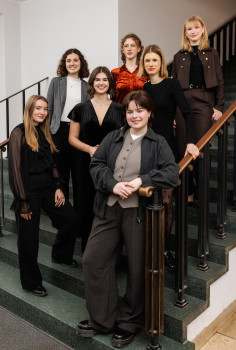
The volunteers receive support from fully qualified lawyers to ensure that those seeking advice are assisted as effectively as possible. The Münster chapter is mainly run by law students, who benefit at the same time through further training – particularly in everyday areas of law that are currently not part of the law curriculum, such as sexual criminal law. ‘Something has to change institutionally,’ says Florentine Dreßler, one of the Münster organisers. For this reason, the FLC is also engaged in raising awareness and visibility of these legal areas and of social issues, such as violence and discrimination. The organisation not only welcomes aspiring lawyers to participate, but also students of all disciplines and individuals from outside the University.
Author: André Bednarz
Gender Equality Award
More visibility for a key professional group
They organise work processes, ensure smooth operations and often serve as the first point of contact for students and researchers. Nevertheless, the work of administrative secretarial staff often happens behind the scenes. With Administrative Professionals Day, the SUN – Office Network is putting a spotlight on this important professional group at the University of Münster.
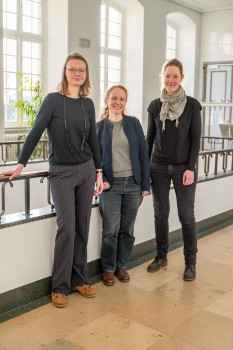
At the same time, the project is pursuing long-term goals. Workshops, mentoring programmes and training opportunities are designed to provide targeted support for professional development. ‘Appreciation is not only cultivated through words, but also through fair development and qualification opportunities,’ asserts Daniela Bornträger, who has been active in the SUN network for two years. Especially in a professional field dominated by women, this is also a question of equality.
In addition to individually empowering its employees, the University also stands to benefit as a whole. ‘Well-connected and qualified employees ensure knowledge, continuity and quality. This makes the University an attractive employer,’ explains Maria Kock, who is also a member of the network. The continuation of “Administrative Professionals Day” and accompanying offers is therefore intended not only to promote recognition, but also to create long-term loyalty. The project shows that appreciation begins with visibility and has an impact far beyond a single day of action.
Author: Kathrin Kottke
Staying together, growing, moving forward
Information systems is considered a discipline of the future, but surveys show that many female students feel alone in this field. At the University of Münster, a disproportionately high number of women drop out of their bachelor's degree programmes in this field. This is precisely where the BEAM (Belonging, Empowerment, Access & Mentorship) project comes in. The aim is to empower female students at an early stage, help them network and show them perspectives so that they stay in their degree programmes.
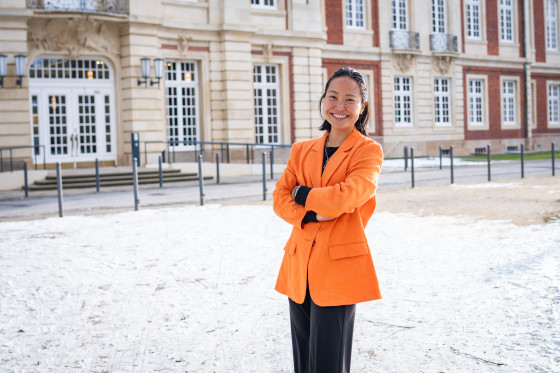
Mentoring and networking formats are at the heart of the project. Through visits to joint events, informal meetings, workshops and panel discussions, first-year students are brought together with advanced female students, academics and women from the professional world. ‘Visible role models are extremely important,’ explains Fumi Kurihara. ‘Many female students ask themselves: “Does someone like me belong here?” BEAM aims to show them: Yes, absolutely.’
The programme is supplemented with presentation workshops, in which female students can develop confidence for their oral exams and presentations in a safe and supportive environment. A digital and analogue “suggestion box” as well as surveys also help to identify problems early on. ‘We don't want to talk about female students, we want to talk with them,’ says Fumi Kurihara. BEAM sees itself as a learning project and an invitation to collaboratively work together to make information systems engineering more diverse.
Author: Kathrin Kottke
This article is from the University of Münster newspaper wissen|leben No. 1, 4 February 2026.
Further information
- News from the New Year's reception with photo gallery (in German)
- Sports Mentoring Project (in German)
- Feminist Law Clinic (in German)
- SUN – Office Network (in German)
- The BEAM project
- The February issue of the university newspaper as a PDF file (in German)
- All issues of the university newspaper at a glance (in German)