
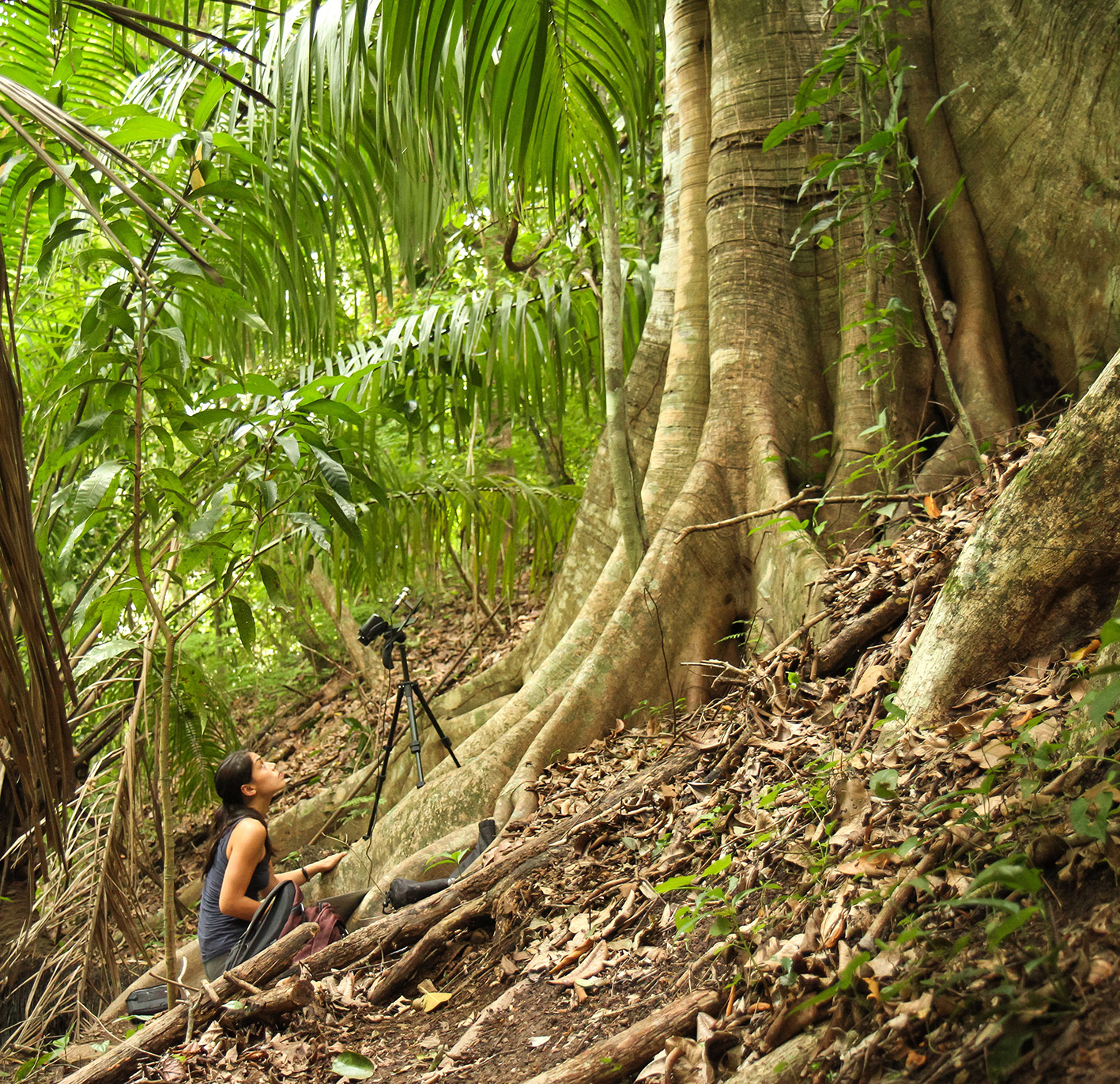
Second home in the rainforest
Dr Ahana Aurora Fernandez's working day begins before the sun rises in Panama. When she is in the rainforest conducting her research, usually once a year for a few months, the behavioural biologist sets off early in the morning for the daytime quarters of 'her' bat colony. When the animals return home at sunrise, she listens to the male bats begin to sing and the mothers "talk" to their young. Ahana Fernandez doesn't just listen to the lively activity with her ears. She also uses special microphones, because the animals communicate a lot in the ultrasonic range, which humans cannot perceive. In other words, the 37-year-old, who has been working as an Emmy Noether group leader at the Institute for Neuro- and Behavioral Biology at the University of Münster since September 2025, is researching the acoustic communication of bats.
The greater sac-winged bat in Panama, for example, seeks out hollow trees or the outer walls of buildings as its daytime roost. The animals are active at night. When returning home, the territorial male signals to his females that there is no danger by singing. Ahana Fernandez discovered that the "conversation" between the young animals and their mothers shows parallels to human communication. The young animals babble like babies for several weeks, while the bat mothers use a kind of baby talk when interacting with their offspring. Among other things, this interaction is important for the young males to learn the complex songs correctly. "I am interested in how and why animals communicate and how vocal systems develop, including at the neuromolecular level," emphasises Ahana Fernandez, who has published her research findings in the journal Science, among others.
The Swiss scientist grew up bilingual in German and Spanish; her father is Ecuadorian. She studied biology in Bern before completing her doctorate at the Free University of Berlin and then working as a postdoctoral researcher at the Museum of Natural History in Berlin from 2020 to 2024. After a stint at the Ernst Strüngmann Institute in Frankfurt am Main, she moved to the University of Münster. "In the Department of Behavioural Biology, I have an exciting environment in which I can acquire new expertise, for example on the role of hormones and individualised strategies," she says. Just a few weeks ago, she received the German Wildlife Foundation's research award, which will enable her to undertake a new research project on bats native to Germany.
She particularly enjoys working outdoors; Gamboa has become her second home. The small settlement is located in the centre of Panama, surrounded by tropical rainforest. During her stays there, Ahana Fernandez is a guest at the Smithsonian Tropical Research Institute (STRI), with which she has a scientific affiliation as a research associate. She first visited STRI for research in 2015. She now knows the forest and the people there and knows where to find the bats. With the help of markings, she can distinguish between the animals, some of which she has been observing for years.
Since the interactions between the animals are extremely fast, she makes film recordings that she can view in slow motion and in enlarged sections. However, she would never consider foregoing direct observation and relying solely on an evaluation of the recordings. "You have to sit in front of the colony to understand the big picture. I learn a lot about the animals through my observations in the field. I want my students to have this experience in the field too," she emphasises. Her second topic, research into communication in hummingbirds, appeals to her because it is a completely new field. "Communication in hummingbirds, which live as solitary creatures, has hardly been researched. But they communicate with a repertoire of vocalisations when they meet at feeding sites."
There are many challenges when working in the rainforest. Heavy rainfall sometimes makes work impossible. Climate change is intensifying the dry seasons and heavy rainfall, which is affecting the animals. Ahana Fernandez's animals have become accustomed to her, but predators can drive the colony away – then she has to find another colony during her next research stay and carefully start her observations all over again. "I observed a colony in an empty house for years. Unfortunately, aggressive driver ants built their temporary nest there and drove the bats away," she reports.
When asked why she is so fascinated by animal communication, Ahana Fernandez recalls her childhood. Back then, she loved the children's books about the adventures of Doctor Dolittle, the doctor who understands the language of animals.
Author: Christina Hoppenbrock
This article is taken from the university newspaper wissen|leben No. 1, February 4, 2026.