

Mathematical model to describe rotating black holes
Gravitational wave astronomy has developed rapidly since the first direct measurement of gravitational waves in 2015. However, it is still a challenge to develop precise mathematical models for the gravitational wave signals that encode information about the physics of black holes and neutron stars. Dr Johannes Pirsch (now at Humboldt-Universität zu Berlin), Dr Domenico Bonocore (now at TU Munich) and Prof Anna Kulesza from the Institute of Theoretical Physics at the University of Münster have proposed a new model to describe rotating black holes and neutron stars, which takes into account the rotational effects more precisely than in previous approaches. The work has just been published in the journal Physical Review Letters.
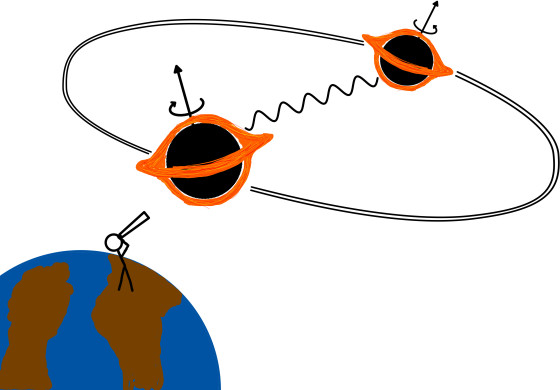
The team uses theoretical methods from quantum field theory and general relativity, in particular so-called worldline models with supersymmetry. Thanks to the significant extension, this approach now works for rapidly rotating astrophysical objects such as black holes and neutron stars. The group has thus overcome a limit of theoretical physics that was considered insurmountable, as experts previously only considered supersymmetry to be suitable for describing slowly rotating objects.
The results help to better understand gravitational wave signals and predict them more precisely. International research projects such as the gravitational wave observatories LIGO (USA), Virgo (Italy) and KAGRA (Japan) as well as the gravitational wave detectors LISA and the Einstein Telescope, which are currently being planned, stand to benefit from this.
Funding
The work received financial support from the German Research Foundation (DFG) as part of the Research Training Group GRK 2149 “Strong and Weak Interactions – from Hadrons to Dark Matter”, from the Cluster of Excellence ORIGINS (Grant No. EXC-2094-390783311) and from a DAAD research fellowship for doctoral students.
Original publication
Domenico Bonocore, Anna Kulesza, Johannes Pirsch (2025): Higher-spin effects in black hole and neutron star binary dynamics: worldline supersymmetry beyond minimal coupling. Physical Review Letters 135 (2025) 21, 211404; DOI: 10.1103/58z2-rypz