
Duckweed: an ideal object of research
PhD student Alexandra Mireya Chávez Argandoña looks concentrated. She sits in a laboratory at the Institute of Evolution and Biodiversity (IEB) at the University of Münster. Small closed plastic dishes are piled up on the white table in front of her. Behind them is a laptop, with its screen showing a long Excel spreadsheet. On the right there is a brightly lit box, open at the front, containing a camera. On the left of the lab table are two polystyrene boxes containing liquid nitrogen.
Alexandra Chávez opens the first small dish. Inside it is water with small round plants floating on top. These are specimens of duckweed – or, to be precise, the common duckweed variety. Chávez places the dish in the camera box and takes a photo. The remaining dishes follow one by one, with each photo appearing on the laptop screen. Two or three of the dishes have a noticeable green shimmer. “Tiny algae have grown here,” says Chávez. “That sometimes happens, although the water is actually sterile. I note down which of the samples are affected and I’ll have to take that into account later during my evaluations.”
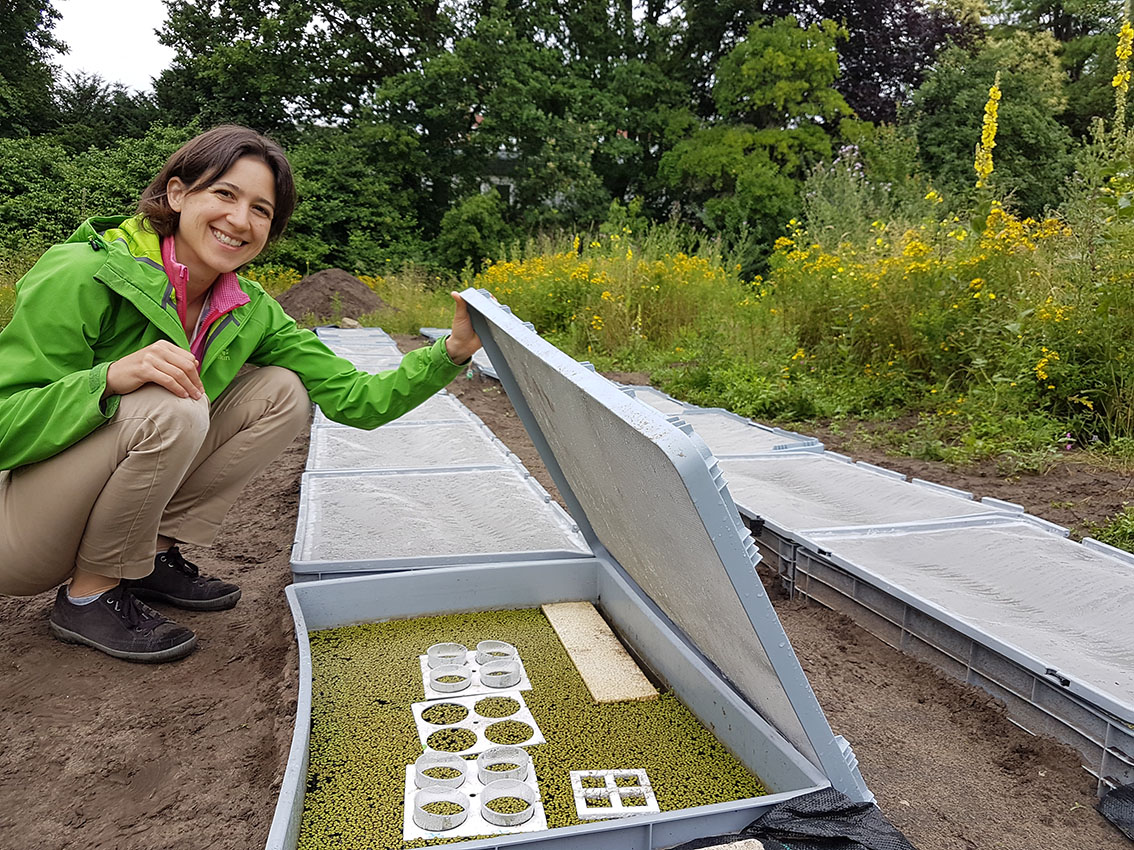
Flashback to a few weeks earlier: On the site of the former garden of medicinal plants at the Institute of Pharmaceutical Biology and Phytochemistry in Hittorfstraße, Dr. Meret Huber is kneeling in front of a row of small water tanks, all full of duckweed from one single genetic line. “What interests us,” she explains, “is whether plants without any genetic modifications can, over generations, adapt to stress factors such as an excess of copper.” Huber heads a team of researchers at the Institute of Biology and Biotechnology of Plants and is supervising Alexandra Chávez’ PhD dissertation together with Prof. Shuqing Xu from the IEB.
Meret Huber opens the lid of one of the tanks in which duckweed is growing in water with an increased concentration of copper. She points to some marked areas: here, it always the first offspring of each plant which is propagated – generation by generation, irrespective of how well this offspring grows. “These plants are not subject to any pressures of selection,” Huber says, “but they can influence the stress resistance of their offspring through non-genetic inheritance. In the lab we have already seen that growing in water with a higher copper content can modify resistance to this and other stress factors over at least ten generations. Genetic modifications play no role in this.”
“Uncovering the underlying molecular causes is a challenge.”
Selection and genetic inheritance are mechanisms which play a key role in evolution theory. They contribute to future generations adapting to environmental conditions and reproducing as successfully as possible. What has now become a focus of attention among researchers, however, is thinking about how important non-genetic inheritance is.
Meret Huber points to the other plants in the water tank. “These are the offspring of the duckweed which was particularly good at growing in the copper-bearing water. By comparing the copper-resistance in these plants with that in the duckweed propagated individually, we can find out whether selection for non-genetic characteristics can lead to the building-up of resistance.”
In this case, the genetic make-up which is passed on can be ruled out as the basis of the adaptations, because the genetic material is identical and exceptionally stable over generations. So what non-genetic factors might play a role? Is it microbes, or substances which are passed on to offspring? Or is the DNA accessibility modified, thus modulating the activity of individual genes? “Uncovering the underlying molecular causes is a challenge,” says Huber.
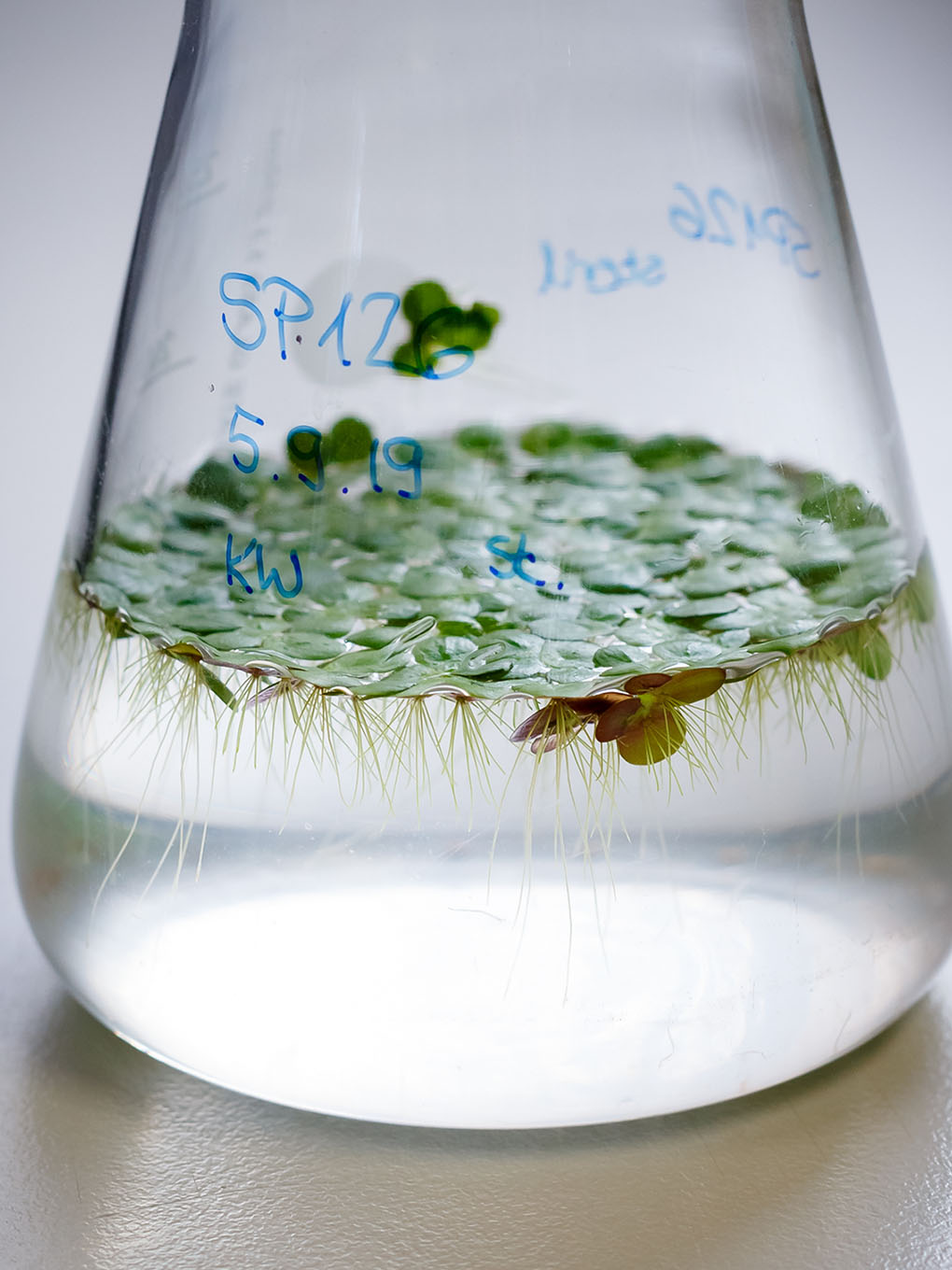
Alexandra Chávez uses primarily lines from south-east Asia for her laboratory experiments because these plants have displayed clear non-genetic adaptation effects over generations in response to increased copper concentrations. “One thing that interests me is the question of what effects can be demonstrated at the molecular level,” says Chávez. “It might be a DNA methylation, for example.” A methylation is a chemical marking of the DNA which can direct the activity of genes.
Back in the lab: after Alexandra Chávez has photographed the duckweed, she takes the plants out of the dishes, carefully dabs them dry, and then puts them into small sealable vessels. In doing so, she carefully notes which generations are involved and how high the copper content in the water was. She weighs every specimen and then freezes them in liquid nitrogen in one of the polystyrene boxes so that they can be examined again at a future time. She will also make a close study of the photos in order to be able to assess how well the plants have grown. Now, however, she first has to go to the lab next door, to the laminar flow cabinet, where she prepares the new duckweed samples. In a week’s time each offspring will have produced two following generations – and the next “harvest” will be pending in the lab.
Christina Hoppenbrock
This article first appeared in the University newspaper “wissen|leben” No. 6, 6 October 2021