
FAQ
Below you will find answers to the most common questions about our psychological counselling services.
How do I make an appointment for Individual Psychological Counselling?
Individual Psychological Counselling takes place in person on site and only by prior appointment. Appointments can be arranged in the regular consultation hours and virtual office hours, through the telephone advisory service or by using the contact form.
The wait time can vary greatly depending on the semester phase. Please note: the ZSB offers psychological counselling exclusively to students and doctoral candidates of the University of Münster.
Our Consultation hours/appointments
Contact form [DE]
How does Individual Psychological Counselling work?
In an initial consultation, we clarify your concerns and agree on the next steps, which may include additional counselling sessions. During this first meeting, we begin to explore potential solutions with you. In some cases, we can provide immediate guidance and recommendations. In others, it may be beneficial to schedule further appointments, particularly if there are multiple topics to discuss or if we are supporting you through a process. Typically, our consultations last 45-60 minutes, allowing us to dedicate sufficient time to addressing your needs.
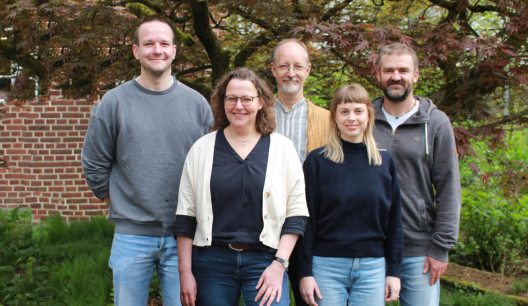
Our psychological counsellors (l-r): Jonatan Buhl, Bernadett Greiwe, Volker Koscielny, Julia Kleinau and Martin Droste (not shown in this picture: Mascha Fantuzzi)© Uni MS - ZSB Who advises me during Individual Psychological Counselling?
The psychological counselling service of the ZSB is offered by psychologists with relevant counselling credentials or special psychotherapeutic qualifications and years of experience advising students. The members of our psychological counselling team are Bernadett Greiwe, Volker Koscielny, Martin Droste, Jonatan Buhl, Julia Kleinau and Mascha Fantuzzi.
All our psychological counsellors offer general academic advising as many students who seek counselling deal with psychological problems which are tied to study-related matters.
How does the ZSB handle the topics of confidentiality and data protection?
As psychologists and psychological psychotherapists, we are obliged by law to maintain confidentiality (§ 203 StGB). This means that we are prohibited from sharing any information gained or concerning our counselling sessions to third parties – unless you grant us your explicit consent. The obligation to maintain confidentiality naturally extends to all parties at the University. The only exception to the rule is if there exists an acute risk of self or third-party endangerment.
During consultation, we collect personal data which we process and store in accordance with the General Data Protection Regulation (GDPR). Before psychological counselling can even take place, you must grant us your written consent to the data protection policy of the psychological counselling service. You can do this at the start of the initial meeting at our office. The counsellor will give you a copy of the consent form to sign.
In order to optimally conduct the consultation process, we draft protocols of the counselling sessions. These serve as orientation for preparing and following up the counselling sessions and ensuring quality control. The protocols are pseudonymised to make it impossible to determine your identity based on the content of the protocol. More information is provided in the data protection policy of the psychological counselling service.
Will I have to pay for psychological counselling?
The psychological counselling is – just like all services offered by the ZSB – free of charge and is financed by the University of Münster.
I´m not sure whether psychological counselling is right for me. How can I find out?
If you’re unsure whether psychological counselling might be right for you, please don’t hesitate to contact us. We can discuss your initial thoughts and considerations via email or phone, and if needed, we’ll arrange an appointment for an initial consultation. Our conversations are open-ended, meaning that they can also lead to the conclusion that further psychological support is not necessary or that another service might be more suitable for you.
What is the difference between psychotherapy and counselling?
Psychotherapy is a curative treatment that is regulated by the Fifth Book of the German Social Code. The prerequisite for treatment is the existence of a mental illness which is normally diagnosed at the start of therapy. Because such treatment addresses both the causes and symptoms of the illness, psychotherapy usually lasts longer and involves in-depth exploration of various areas of life. Psychotherapy may only be carried out by people that have completed additional training. These include medical psychotherapists, psychological psychotherapists and child and adolescent psychotherapists.
Psychological counselling, on the other hand, does not aspire to treat mental illnesses. The purpose of counselling is to address and discuss everyday troubles and problems which are not classified as illnesses. In contrast to psychotherapy, psychological counselling aims to provide thematically defined support to deal with specific burdens.
If you are unsure which of these is right for you, please make an appointment with us for an initial consultation. Our psychologists are trained to recognize indications of a mental illness and can therefore make a recommendation for or against psychotherapy.
I think I need psychotherapy. Can the ZSB help me?
You can find detailed information on finding a therapist on our website Information on finding a therapist. If you are feeling unsure or have additional questions, please make an appointment with us.
I’m already in psychotherapy. Can I still make use of psychological counselling?
Supplementary psychological counselling in addition to psychotherapy can be useful if you are dealing with problems during your studies that you cannot adequately address in your psychotherapy.