

Creativity as Resistance in Ukrainian Women’s Experiences of Imprisonment in the Gulag
Guest Lecture by Prof Dr Oksana Kis (Kyjiv/Jena), January 21 2026
In the 1940s through the mid 1950s thousands of Ukrainian women have been sentenced to long-term imprisonment in the Gulag camps for their real or alleged collaboration with the Ukrainian national anti-soviet resistance. Despite unbearable living conditions, backbreaking workload, hunger, lack of health care, omnipresent violence and humiliation, Ukrainian convicts continued to sing folk songs, versify poetry, stage improvised performances, embroider and engage in various crafts. What was the meaning of arts and crafts for those exhausted women exposed to total dehumanization far away from their families and homeland? Why didn’t severe penalties stop them? Why would they make an extra effort to find resources (materials) and spend however little time and energy was left on creative activities? What some of the artifacts can tell us about women’s survival strategies in camps? This lecture is based on the research presented in Oksana Kis' award-winning book “Survival as Victory: Ukrainian Women in the Gulag” (Harvard, 2021).

Oksana Kis is a feminist historian and anthropologist, a head of the National Research Foundation of Ukraine and a President of the Ukrainian Association for Research in Women’s History. Her book Ukrainky v GULAGu: vyzhyty znachyt' peremohty (Lviv, 2017; 2nd revised ed. 2020) was included in the Ukrainian Book Institute’s list of the 30 most significant books of the Ukrainian Independence in 2021. Its English version Survival as Victory: Ukrainian Women in the Gulag (Harvard Series in Ukrainian Studies, 2021) was awarded the Translated Book Prize from Peterson Literary Fund (2021). She also edited and co-edited several volumes on women’s history, most recently Women's Dimensions of the Past: Perceptions, Experiences, Representations (Lviv, 2023) and Women's Stories of Leadership in Ukraine in the late 19th - early 20th centuries (Kyiv, 2025). Dr. Kis is a recipient of several academic awards, including two Fulbright Research Fellowships (2003 and 2011). The areas of her expertise include women in pre-industrial Ukrainian society, women’s experiences of the Holodomor 1932/33, women’s participation in the Ukrainian national resistance in the 1940-50s, gendered experiences of the Ukrainian female political prisoners in the Gulag, and gender transformations in post-socialist countries. Currently Dr. Kis is a visiting research Fellow at the Imre Kertesz Kolleg Jena in Germany.
Cultures of Remembrance and Historical Change in Chernivtsi and Bukovina
Tuesday, 16 September 2025, 6.30 p.m.

The evening will present the results of the joint DAAD summer school organised by the Universities of Münster and Chernivtsi, Cultures of Remembrance in Bukovina. Pluricultural and pluri-religious life in the historical region of Bukovina was characterised in part by peaceful coexistence and in part by confrontation and extreme violence. Northern Bukovina, which belongs to Ukraine as part of the Chernivtsi Oblast, remains a heterogeneous region with several minorities to this day. The interdisciplinary summer school deals with ways of approaching the remembrance of these ways of coexistence in the past and present. It also takes into account current developments, reactions to and consequences of Russia's war of aggression, as reflected in Chernivtsi, for example, in the cityscape, in the removal and re-erection of monuments, and in the changed population structure resulting from the influx of many internally displaced persons. The travelling exhibition ‘Space, Time, People: Diversity and Change in the Cityscape of Chernivtsi’, which will open in the foyer, documents this change.
The summer school is funded by the DAAD with funds from the Federal Foreign Office (AA) and is part of Ukrainian Studies in Münster (USiM).
The exhibition is a project of the NGO ‘ Ukrainisch-Deutsche Kulturgesellschaft Tscherniwzi’ (Ukrainian-German Cultural Society Chernivtsi) at the Gedankendach Centre in cooperation with the Verein Begegnung in Falkensee e.V. (Association Encounter in Falkensee). The project was made possible by the support of the RAZOM/RHIZOM programme as part of the ‘ Zusammenarbeit mit der Zivilgesellschaft’ (Cooperation with Civil Society) initiative organised by the Federal Foreign Office. The programme was coordinated in 2024 by the Ukrainian Institute in Germany and the Artsvit Gallery.
Admission: free
Panel discussion: ‘Why should I care about Ukraine?’

German positions on Russia's war of aggression against Ukraine between pacifism and Russia sympathisers
9 July 2025, 6 p.m. – 8 p.m., Johannisstr. 4, J 101
Dr Franziska Davies, Co-President of the German-Ukrainian Society (DUG), and Dr Kateryna Rietz-Rakul, Director of the Ukrainian Institute in Germany, will discuss German positions on Russia's war of aggression against Ukraine, moderated by Prof. Dr Ricarda Vulpius. In addition to the failings of German society with regard to Ukraine, the discussion will also focus on the differences in perception between East and West Germany.
An event organised by the AOEG in cooperation with the DGO Münster branch and USiM (Ukrainian Studies in Münster).
Ukraine on its way to itself and to Europe. From perestroika to the present day
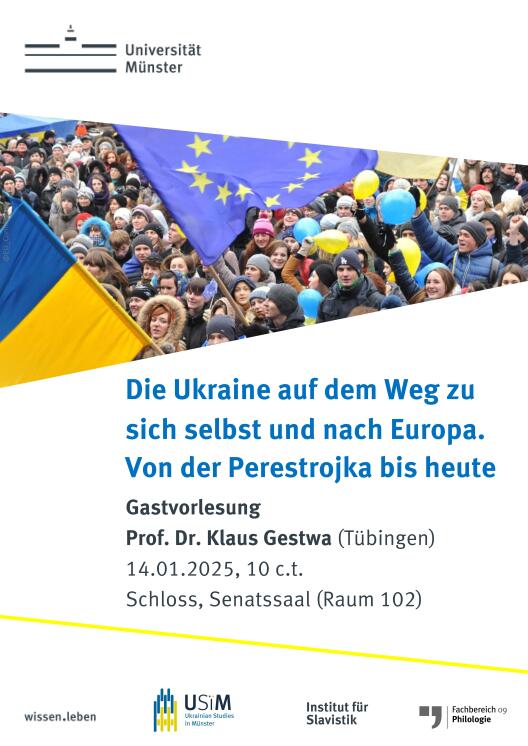
Guest Lecture
Professor Dr Klaus Gestwa (Tübingen):
Ukraine on its way to itself and to Europe. From perestroika to the present day
14.01.2025, 10 c.t. (10-12 h)
Schloss, Senate Hall (Room No. 102)
Klaus Gestwa is Professor of Eastern European History and Director of the Institute for Eastern European History and Regional Studies at the Eberhard Karls University of Tübingen. He has repeatedly addressed the general public with numerous contributions (interviews, videos, magazine articles and lectures) on the background, course and consequences of the Russian war of aggression against Ukraine in order to provide equally vehement and well-founded information and to identify false claims and narratives of Russian propaganda circulating in German debates. He was awarded the 2024 Prize for Science Communication by the University of Tübingen. The jury praised the tireless commitment with which he has used his extensive knowledge of the history, society and politics of Eastern Europe in recent years to educate the German public about the causes of the Russian war of aggression against the neighbouring country and to counter widespread assumptions and misconceptions. In doing so, he has shown courage and has not avoided public controversy and hostility.
In his contribution, Klaus Gestwa focusses on the recent history of Ukraine. By interweaving contemporary history and current events, he presents a problematic history of the present. The guest lecture is part of a General Studies seminar led by Elena Glökler (Institute for Slavic Studies at the University of Münster). It is aimed at students of all departments and an interested public!
You can download the poster for the event here.
Online webinar: "The Role of Religion in post-Soviet Ukraine and the Russo-Ukrainian War"
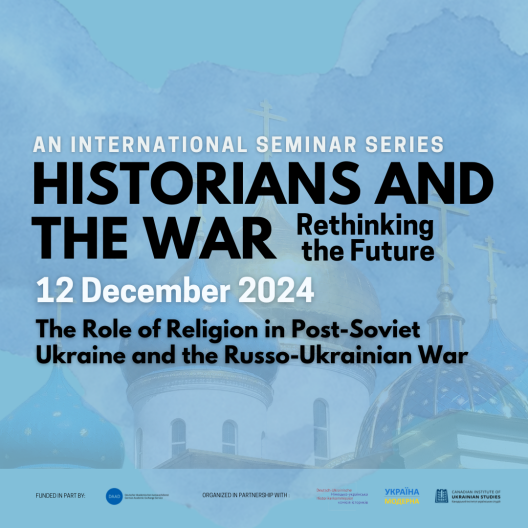

On Thursday, 12 December, a webinar on ‘The Role of Religion in post-Soviet Ukraine and the Russo-Ukrainian War’ will take place in English from 18:00 - 19:30. Regina Elsner (USiM, University of Münster), Oleksandr Lysenko (Academy of Sciences of Ukraine, Kiev) and Frank Sysyn (University of Alberta) will discuss the consequences of Russia's war of aggression on Ukraine for the Orthodox churches in Ukraine, the state-church relationship in Ukraine and the current disagreements between the Orthodox churches under the direction of Ricarda Vulpius (USiM, University of Münster).
Further information can be found on the website of the German-Ukrainian Historical Commission.
You can download the notice of the webinar in either English or Ukrainian.
Registration for the webinar is possible here.
Talk with the Holocaust survivor Dr Boris Zabarko (Kyjiv)
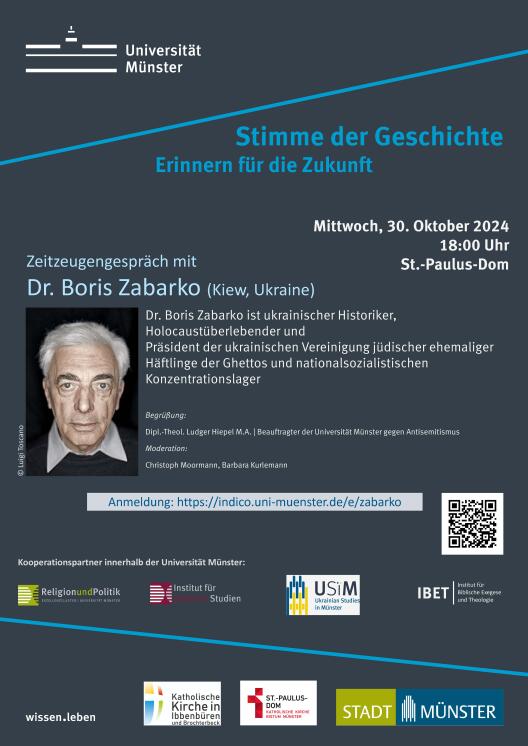
On the evening of 30 October 2024, the Ukrainian historian, recipient of the Order of Merit of the Federal Republic of Germany and Holocaust survivor Dr Boris Zabarko spoke at St Paul's Cathedral in Münster.
After a welcoming address by the University of Münster's representative against anti-Semitism, Ludger Hiepel, and a presentation by Prof. Dr Dr h.c. Hubert Wolf on the Jewish letters of petition that reached Pope Pius XII and the blatant failure of the Holy See to intervene despite internal church sources on the persecution of Jews in Eastern Europe, the audience was welcomed Dr Zabarko. He first greeted his large audience in German. In his address, he called for further support for the Ukraine in its struggle against the russian aggerssion, but also found warm words of thanks for the help already given and emphasised that, unlike the Jews during the Shoah, the Ukraine did not stand alone, but had strong allies at its side. He continued his report in Ukrainian, which was simultaneously translated into German. He told of his childhood in a Transnist village, a Jewish Shtetl, that was surrounded by the Wehrmacht and became a wall-less ghetto for the Transnist and Romanian Jews. He told of those who could no longer find room in the overcrowded houses and who had to freeze to death on the streets in winter, but also of how his family was spared because the Wehrmacht commander had chosen his family's house as his residence. In particular, he emphasised the violent murders of children by the German troops. However, most of the deaths were caused by an outbreak of typhus in the village.
The energy and willingness to tell his story to as many people as possible was palpable at every point in his talk.
Lecture and discussion on the situation at Münster's partner university in Ukraine

10 July 2024, 18h, BB 401
Research, teaching, voluntary service. The situation at Münster's partner university in Chernivtsi.
Lecture and discussion evening with Dr Oxana Matiychuk (Yuriy Fedkovyč University of Chernivtsi), moderated by Prof Dr Irina Wutsdorff
The University of Münster has maintained a partnership with the Jurij-Fedkovyč University of Černivci since 2023, with Dr Oxana Matiychuk playing a key role in its conclusion. She may be known to many as the author of a diary that she has published at irregular intervals in the Süddeutsche Zeitung since the beginning of the full-scale Russian war of aggression against Ukraine. Since February 2022, she has been a member of the volunteer staff at Černivci University and is committed to the internally displaced persons and frontline issues. She was and is also head of the ‘Ukrainian-German Cultural Society Chernivtsi’, which is based at the university's ‘Gedankendach’ centre and is dedicated to preserving the heritage of German-language and Jewish literature and culture in Bukovina and Chernivtsi. She is also co-editor of the Handbook of Literature from Chernivtsi and Bukovina, which will be published by Metzler Verlag in December 2023.
Dr Matiychuk will report on the current situation at the university between research, teaching and voluntary service and will talk to lrina Wutsdorff about the perspectives of Ukrainian Studies and the study of the German-speaking and Jewish heritage of Bukovina.
The Vice-Rector for International Affairs, Transfer and Sustainability, Prof Dr Michael Quante, will open the evening with a welcoming address.
An event organised by the USiM network (‘Ukrainian Studies in Münster’), the Cluster of Excellence ‘Religion and Politics’, the Institute for Jewish Studies and the Institute for Slavic Studies at the University of Münster
Lecture and panel discussion: ‘Ukraine and Europe. Prospects for EU accession’, 24.02.24
On 24 February 2024, the second anniversary of the Russian invasion, USiM is hosting a panel discussion on the prospects of Ukraine's future EU accession. Nathanel Liminski, NRW's Minister for European Affairs, will give an introductory speech before the panellists come together for a joint discussion. Other invited guests include Prof Dr Niels Petersen, Professor of European and International Law at the University of Münster, Dr Dariia Opryshko, media law expert and Prof Dr Irina Wutsdorff (USiM). Prof Dr Ricarda Vulpius (USiM) will moderate the event
The event will take place in the auditorium of the University Palace (Schlossplatz 2, Münster) and will begin at 19:00.
All interested parties, especially students and non-university members, are cordially invited!