


About the Project
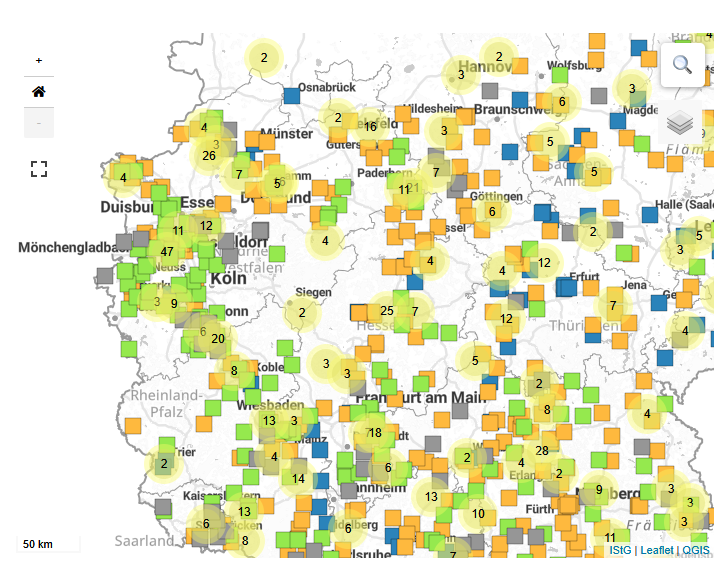
As part of the research conducted by the Gesellschaft für Leprakunde e.V. – GfL (Association for Leprosy Studies), a database of known leprosaria in Germany has been built up since 2013. The project was primarily based on the publications of Jürgen Belker-van den Heuvel in the journal Die Klapper. Since 2017, the database has been further developed by Klaus Henning (GfL) using current research findings. The collection now includes over 1,100 locations. With the recording of the leprosaria in the federal state of Bavaria, the project was completed in 2026. The results have been integrated into an interactive map, which provides the first comprehensive overview of all known medieval and early modern leprosaria in Germany. Detailed information on each site is currently being compiled and will soon be linked to the map's location markers.
Project Duration
2022–2026
Project Team
Gesellschaft für Leprakunde e.V.
Institut für vergleichende Städtegeschichte
Background
Leprosy and Leprosaria
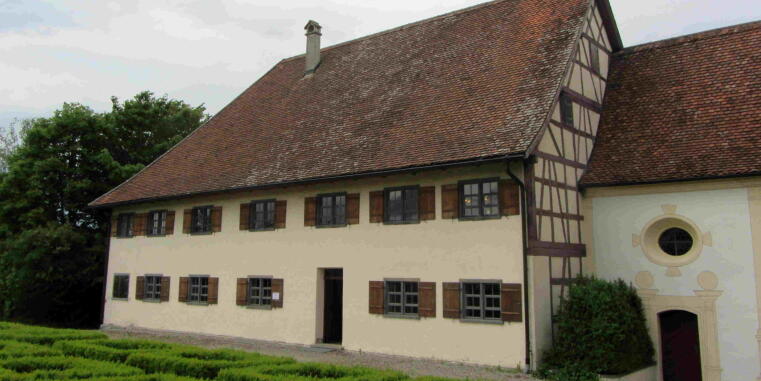
Between the 12th and 18th centuries, more than 1,000 institutions for the housing and care of leprosy patients, known as leprosaria, existed on the territory of what is now the Federal Republic of Germany.
Leprosy is a bacterial disease for which there was no cure during the Middle Ages and the Early Modern period, but it only led to death in rare cases. Nevertheless, due in part to the disfigurements associated with the disease, those affected remained dependent on support for the rest of their lives. This is where leprosaria came in, providing a place for sick people to live at a safe distance from urban centres. Since leprosy has never been highly contagious, usually affecting only 0.1% of the population, even a large town of 10,000 inhabitants had to care for a maximum of ten, and often far fewer, patients.
Leprosaria were a phenomenon found across Europe. The first urban leprosaria are recorded from the 12th century onwards. Depending on the region, these institutions began to be phased out as early as the 15th and 16th centuries, although late foundations in Germany occurred even after 1600. By the 17th and 18th centuries, leprosy had vanished from Germany.
Following canon law as established by the Third Lateran Council of 1179, leprosaria were to be situated outside town limits, typically along the busiest country roads and often at junctions. Both written testimonies and remaining building fragments, like chapels and other vestiges, are part of the cultural and historical heritage. Street and field names still bear witness to the existence of many of these former leprosaria.
Leprosaria were typically private or ecclesiastical foundations that functioned as religious communities where prayer was mandatory. The town council oversaw the finances and, in some instances, appointed the priest of the leper chapel. Medical treatment was not provided. Rather, the residents were meant to support each other. Larger leprosaria were run like farmyards, with staff including maids and labourers, and a warden (Amtmann) who managed the day-to-day operations.
Generally, only citizens of the respective towns were eligible for admission. In contrast, lepers living in the countryside had to rely on help from their families or neighbours. Situated outside settlements, their short-lived dwellings are largely unexplored because very few written accounts remain. For this reason, they will not be addressed by this project.
Whenever leprosy was suspected, the town authorities, i.e., either the mayor or the council, sent the sick person to a leprosarium, often far away, equipped to conduct a formal examination (procedure known as the Lepraschau). Once diagnosed, the person had to leave their life as a citizen behind and was provided with housing, clothes, firewood, food, and drinks by the well-equipped leprosaria.
Literature
In preparing these texts, particular consideration was given to local history literature, specifically publications that summarise and document the leprosy sites of a certain region. The regional studies utilised focused on the following territories:
Germany
Jürgen Belker-van den Heuvel, Dokumentation Mittelalterlicher Leprosorien, in: Die Klapper – Mitteilungen der Gesellschaft für Leprakunde e.V., Münster 1986 bis 2006.
Deutsches Städtebuch. Handbuch städtischer Geschichte, hg. v. Erich Keyser, 4 Bde. in 11 regionalen Teilbänden, erschienen 1939 bis 1974.
Städtebuch Brandenburg und Berlin, hg. von Evamaria Engel, Lieselott Enders, Gerd Heinrich und Winfried Schich, Redaktion Harald Engler (Deutsches Städtebuch. Handbuch städtischer Geschichte. Neubearbeitung), Stuttgart/Berlin/Köln (Kohlhammer Verlag) 2000.
Southwestern Germany
Dieter Staerk, Gutleuthäuser und Kotten im südwestdeutschen Raum. Ein Beitrag zur Erforschung der städtischen Wohlfahrtspflege in Mittelalter und Frühneuzeit, in: Die Stadt in der europäischen Geschichte, Festschrift Edith Ennen, Bonn 1972, S. 529–553.
Aachen
Hans Otto Brans, Hospitäler, Siechen- und Krankenhäuser im früheren Regierungsbezirk Aachen von den Anfängen bis 1971. Hospitäler und Siechenhäuser bis zum Ende des 18. Jahrhunderts, in: Studien zur Geschichte des Krankenhauswesens, Band 37, Herzogenrath 1995.
Brandenburg
Elif Cavus, Leprosorien der Mark Brandenburg im Spiegel des Novus Codex diplomaticus Brandenburgensis (Riedel). Hausarbeit zur Erlangung des BA-Grades, Münster 2022.
Hesse
Walburga Beck, Untersuchungen über die frühere Verbreitung des Aussatzes im heutigen Hessen. Eine erste Bestandsaufnahme, Bochum 1993.
Mecklenburg
Anke Huschner, Adlige Memorialkultur im Mecklenburg des 15. Jahrhunderts. Die Stiftungen des Ritters Mathias Axekow, in: Mecklenburgische Jahrbücher 135 (2020).
Johanna Patricia Menting, Die Leprosorien im spätmittelalterlichen Mecklenburg im Spiegel des Mecklenburgischen Urkundenbuchs. Masterarbeit, Münster 2021/2022.
Lower Rhine
Fritz Meyers, Lepra am Niederrhein. Kulturgeschichtliches Erbe als aktuelle Aufgabe, Würzburg 1985.
Pomerania
Leandra Celia Petersson, Ersterwähnung von Leprosorien des mittelalterlichen Pommerns im Spiegel des Pommerschen Urkundenbuchs, Bachelorarbeit Münster 2021.
Rhine region
Martin Uhrmacher, Lepra und Leprosorien im rheinischen Raum vom 12. bis zum 18. Jahrhundert, in: Beiträge zur Landes- und Kulturgeschichte, Band 8, Trier 2011.
Rhineland
Wilhelm Frohn, Der Aussatz im Rheinland, Sein Vorkommen und seine Bekämpfung, in: Paul Krause (Hg.), Arbeiten zur Kenntnis der Geschichte der Medizin im Rheinland und in Westfalen, Heft 11, Jena 1933.
Schleswig-Holstein
Wilhelm Schulze, St.-Jürgen. Lepra in Schleswig-Holstein und Hamburg, Hamburg 1993.
Westphalia and Lippe
Ute Weyand, Neue Untersuchungen über Lepra- und Pesthäuser in Westfalen und Lippe. Versuch eines Katasters, Wiesbaden 1983.
Württemberg
August Englisch, Über Leprosorien in Württemberg, Inaugural-Dissertation zur Erlangung der Doktorwürde in der Zahnmedizin, Johann Wolfgang-Goethe-Universität, Frankfurt 1951.
Cooperation
The Gesellschaft für Leprakunde e.V. (Association for Leprosy Studies) in Münster was founded in 1984 and operates the Leprosy Museum in Münster-Kinderhaus. The association is dedicated to researching and presenting the history of leprosy. This includes documenting and showcasing information about leprosaria in Germany, specifically the facilities where patients with leprosy lived and were cared for, as was the case in Kinderhaus.

© Gesellschaft für Leprakunde