


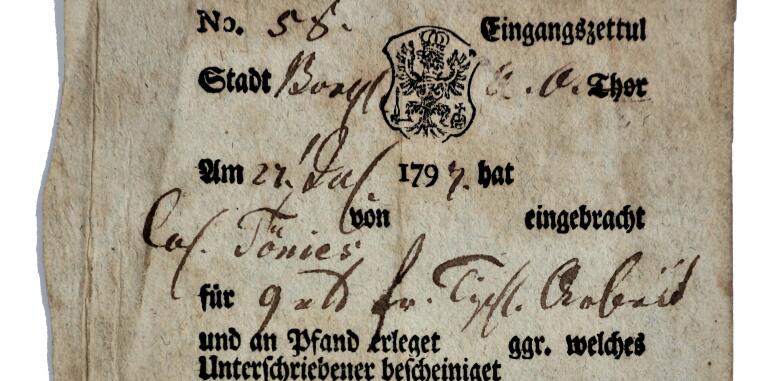
The King's New Tax
Practices of Prussian Organization of Governance Using the Example of the Westphalian Excise Towns in the First Half of the 18th Century (ca. 1700–1756)
About the Project
Even for contemporaries, taxes were the “nervus rerum” of early modern statehood, and older research also drew a connection between cameralistic ideas and the development of pre-modern statehood. However, while older studies described the tax-based emergence of pre-modern territorial states as a straightforward process, more recent studies emphasize that governance, and thus also the work of administrations in tax matters must be understood as a social and communicative process. Not only the “rulers” but also the “ruled” participated in this process.
Under King Frederick William I (1688–1740, reigned from 1713), the Prussian state elevated several former villages to cities in the first half of the 18th century in order to introduce excise duties as a form of indirect taxation. Its aim was to increase state revenues and at the same time expand the administrative structures of the sovereign. The “excise cities” can therefore be understood as an attempt by the Prussian rulers to implement a bundle of cameralistic ideas; the industrial settlements that were elevated to city status can, in a sense, be considered showcase projects of early modern statehood.
Research on Prussian urban and excise reforms, and in particular on excise towns, remains a desideratum not only for Westphalian regional and urban history, but also for the more recent administrative history of the Prussian state. Studies that understand tax payment as a social practice are completely lacking. Excise towns in particular represent a worthwhile field of research for investigating the procedures and forms of local governance based on tax practices, with administrations and the “ruled” vying for influence.
Project Duration
2020 – 2023
Project Team
Project Leader
Prof. Dr. Werner Freitag
Project Staff
Sebastian Schröder
Interactive map of the Westphalian Excise Towns
Interactive Map

© IStG About the Map
Publications
- Ernst Albrecht Friedrich Culemann, Die Rittergüter des Fürstentums Minden. Nachrichten von denen saembtlichen Ritter- und Adelichen Gütern, auch freyen Hoefen und Häußern in Städten und auf dem platten Lande des Fürstenthums Minden […] 1748, hg. v. Sebastian Schröder (Quellen zur Regionalgeschichte, Bd. 18), Bielefeld 2020.
- Werner Freitag, Städtegründung einmal anders: 300 Jahre Akzisestädte in Ravensberg. Vortrag anlässlich der Feier „300 Jahre Stadtrechte“ in Halle am 17. April 2019, in: Jahresbericht des Historischen Vereins für die Grafschaft Ravensberg 104 (2019), S. 37–50.
- Ders., Vergessene Zeiten? Das brandenburgisch-preußische Minden-Ravensberg im 17. und 18. Jahrhundert, in: Johannes Altenberend/Burkhard Beyer (Hg.), Akzisestädte im preußischen Westfalen. Die Stadtrechtsverleihungen von 1719 und die Steuerpolitik König Friedrich Wilhelms I. Beiträge der Tagung am 23. März 2019 in Bielefeld, Bielefeld 2020, S. 29–48.
- Ders., Westfalen. Geschichte eines Landes, seiner Städte und Regionen in Mittelalter und früher Neuzeit, Münster 2023.
- Sebastian Schröder, 300 Jahre „Akzisestädte“ in Ravensberg. Ein Rückblick auf Erträge und Ergebnisse eines „sperrigen“ Jubiläums, in: Westfälische Forschungen 70 (2020), S. 311–320.
- Ders., Neue Städte braucht das Land! Bünde, Enger und Vlotho erhalten 1719 Stadtrecht, in: Historisches Jahrbuch für den Kreis Herford 27 (2020), S. 222–235.
- Ders., Die preußischen Akzise- und Städtereformen in der Grafschaft Ravensberg zu Beginn des 18. Jahrhunderts, in: Johannes Altenberend/Burkhard Beyer (Hg.), Akzisestädte im preußischen Westfalen. Die Stadtrechtsverleihungen von 1719 und die Steuerpolitik König Friedrich Wilhelms I. Beiträge der Tagung am 23. März 2019 in Bielefeld, Bielefeld 2020, S. 29–48.
- Ders., Das „Stadterhebungsedikt“ vom 17. April 1719 und der Akzisetarif vom 9. Mai 1719, in: ebd., S. 49–102.
