
Indicators of Urbanity: Indicators and Manifestations of Urbanity in Time and Space (c. 800–1800)
About the Project
The study of urbanism can only be understood by looking at a large amount of data on different towns as a whole. To date, the distribution maps of earlier scholars (such as H. Stoob and E. Ennen) have been the only tool available for visualisation and research. Yet, these maps are highly limited in their evidentiary value and analytical potential. Moreover, the use of an ideal-type medieval definition of the town obstructs comparisons across different regions and eras.
Drawing on the criticism raised by archaeologists and East (Central) European scholars, this project incorporates current research trends of digital history and spatial humanities to establish a new methodological approach in this field. At its core is an everyday-life-oriented concept of urbanity asking about physical and social phenomena in settlements and whether they can be seen as markers of urbanity. The focus shifts away from the strict definition of the “town” and the question of whether a settlement has crossed the threshold to become a town or, in contrast, has lost its “urban quality”.
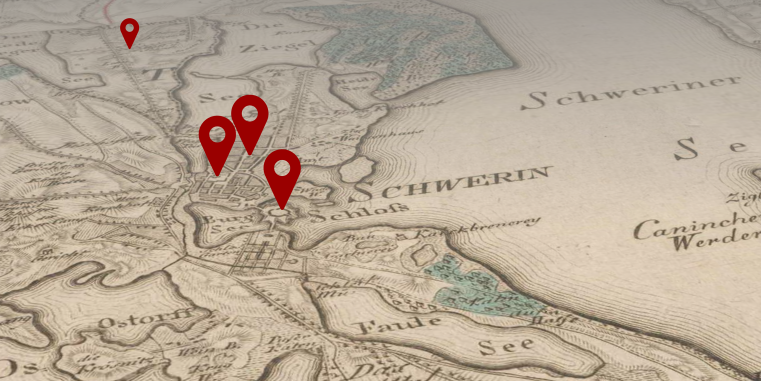
Data from settlement studies in Westphalia and Mecklenburg are gathered in a complex database to create a catalogue of observable indicators of urbanity. Instead of approaching the data with a predefined notion of what a town is, the study analyses the appearance and disappearance of these indicators to see if distinct urban profiles can be established across different regions and time periods. This approach offers a new perspective on how settlements changed over time and space, as well as on the processes of urbanisation and de-urbanisation.
The project provides an integrative, scalable concept of urbanity based on a catalogue of urban characteristics, the publication of an article on the evolution of urbanity in Westphalia and Mecklenburg, and a digital publication of the research data, aiming to give new momentum to comparative urban studies.
Project Duration
January 2026 – March 2027
Project Team
Dr. Daniel Stracke
Tobias Runkel
Cooperation