


Handbuch städtischer Geschichte
About the Project
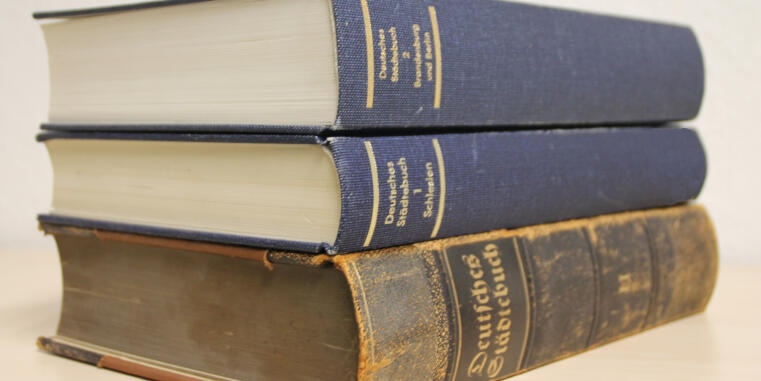
The “Deutsches Städtebuch” (German Almanac of cities and towns) is considered a key work of reference in interdisciplinary urban history research, as it provides standardized and comparable data on the historical development of German and formerly German cities and towns. Published since the first half of the 20th century, the handbook systematically documents the development of cities, towns and municipalities. Each volume is organized by region and contains standardized articles on geographical location, historical development, administrative structure, demographic data, economic conditions, and cultural and architectural particularities.
Its first edition was published in eleven volumes until 1974, sorted by five major geographical areas – Northeast Germany, Central Germany, Northwest Germany, Southwest Germany, Bavaria – and providing information on more than 2,300 towns and cities (some in neighbouring countries) within a uniform structure. With Volume V/1 (Bavaria), published in 1971, responsibility for the “Deutsches Städtebuch” was passed on to the Institute for Comparative Urban History.
As the first edition, which is largely out of stock, does not reflect state-of-the art research, and especially the first volume, published in 1939 by Erich Keyser, is politically problematic, a new edition has been in the works since the late 1980s. Four new editions have been published so far: the “Silesian Town Book” (Schlesisches Städtebuch), the “Town Book of Brandenburg and Berlin” (Städtebuch Brandenburg und Berlin), the “Town Book of Hinterpommern” (Städtebuch Hinterpommern), and the “Town Book of Historical East Brandenburg” (Städtebuch Historisches Ostbrandenburg). The “Town Book of Historical East Brandenburg” was also the first volume of the entire series to be published also in an open access version (link to open access PDF file). The articles are also available as PDFs on the IStG website.
Erich Keyser
As the initiator and editor of the Deutsches Städtebuch, Erich Keyser (1893–1968) played a formative role in the institutionalization of German urban history research. At the same time, however, he is strongly tainted by his involvement in the academic system of Nazi Germany. He clearly supported revanchist and nationalist positions advocating a Greater Germany, particularly with regard to the historical legitimacy of German claims to the eastern territories of Europe. In his work, he combined urban historical research with populist territorial narratives, which makes the scientific objectivity of his work problematic in parts.
The “Deutsches Städtebuch” is the standard reference work for local town history, comparative urban research, and urban planning. However, the volumes of the first edition are only available in a small number of libraries and are also difficult to use. For example, the volume “Norddeutschland” (Northern Germany), published in 1939, depicts the borders of the former German Reich and lists town names in German only.
All volumes published to date are now being listed alphabetically for each city covered, supplemented by the current and historical town names, their GND, the respective region and the bibliographic details of the entry (author including GND, title of the entry, volume number, page number). This enables a cross-volume search for authors and town names in different languages, allowing for comparative urban research across national borders.
Volumes I, II, III.1, III.2, III.3 and IV.1 have been compiled so far.
Towns and Cities covered in the Deutsches Städtebuch
Publication of the First Edition
Deutsches Städtebuch. Handbuch städtischer Geschichte, hg. von Erich Keyser:
Band I – Nordostdeutschland
- Provinz Ostpreußen, Freie Stadt Danzig, Provinz Pommern, Land Mecklenburg, Provinz Schleswig-Holstein, Hansestadt Hamburg, Provinz Brandenburg, Reichshauptstadt Berlin und Provinz Schlesien, hg. von Erich Keyser, Stuttgart/Berlin 1939.
Band II – Mitteldeutschland
- Land Sachsen, Thüringen, Provinz Sachsen und Land Anhalt, hg. von Erich Keyser, Stuttgart/Berlin 1941.
Band III – Nordwest-Deutschland
- Niedersächsisches Städtebuch, hg. von Erich Keyser, Stuttgart 1952.
- Westfälisches Städtebuch, hg. von Erich Keyser, Stuttgart 1954.
- Rheinisches Städtebuch, hg. von Erich Keyser, Stuttgart 1956.
Band IV – Südwest-Deutschland
- Hessisches Städtebuch, hg. von Erich Keyser, Stuttgart 1957.
- Baden-Württemberg, 1. Badisches Städtebuch, hg. von Erich Keyser, Stuttgart 1959.
- Baden-Württemberg, 1. Württembergisches Städtebuch, hg. von Erich Keyser, Stuttgart 1961.
- Städtebuch Rheinland-Pfalz und Saarland, hg. von Erich Keyser, Stuttgart 1964.
Band V – Bayern. Bayerisches Städtebuch
- Unter-, Mittel- und Oberfranken, hg. von Heinz Stoob, Stuttgart 1971.
- Ober-, Niederbayern, Oberpfalz und Schwaben, hg. von Heinz Stoob, Stuttgart 1974.
New Editions
On behalf of the Working Group of Historical Commissions and Regional History Institutes, and with the support of the Association of German Cities, the German Association of Towns and the German Association of Municipalities.
Band 1 – Schlesisches Städtebuch
- hg. im Institut für vergleichende Städtegeschichte an der Universität Münster von Heinz Stoob und Peter Johanek in Verbindung mit der Kulturstiftung der deutschen Vertriebenen Bonn, bearbeitet von Waldemar Grosch unter Mitarbeit von Heinz Stoob, Maria Elisabeth Grüter und Franz-Joseph Post, Stuttgart 1995.
Band 2 – Städtebuch Brandenburg und Berlin
- hg. von Evamaria Engel, Lieselott Enders, Gerd Heinrich und Winfried Schich, Redaktion Harald Engler, Stuttgart 2000.
Band 3,2 – Städtebuch Hinterpommern
- hg. von Peter Johanek und Franz-Joseph Post in Verbindung mit der Kulturstiftung der deutschen Vertriebenen, bearbeitet von Thomas Tippach unter Mitarbeit von Roland Lesniak, Stuttgart 2003.
Band 4 – Städtebuch Historisches Ostbrandenburg
- hg. v. Klaus Neitmann und Winfried Schich (†), bearbeitet von Joachim Stephan unter Mitarbeit von Holger Schmidt und Gerhard Weiduschat, Berlin 2022.
Funded by the Federal Government Commissioner for Culture and the Media, the Brandenburg State Archives and the Senate Chancellery – Science and Research of the State of Berlin.
The 47 articles on towns in historic East Brandenburg are available on the IStG website. The entire volume has also been published as an open-access version.