


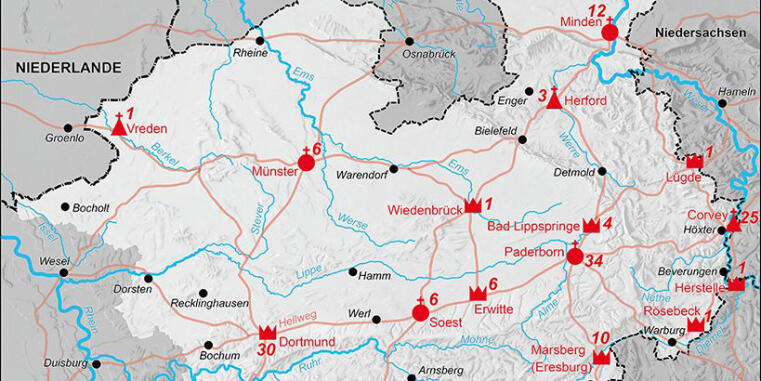
Volume 6: North Rhine-Westphalia. Part 3: Westphalia
About the Project
For this project, led by the Institute for Comparative Urban History, recognised experts consistently analysed all 15 royal residences in Westphalia for publication in the “Repertory of German Royal Palaces” (Repertorium der deutschen Königspfalzen). Beyond describing the royal residences themselves, the Repertory offers a wealth of information on the history and archaeology of the places, including the history of place names, supported by maps and site plans. The Westphalia volume, edited by the Institute for Comparative Urban History, expands both the historical focus and the cartographic component. Furthermore, the volume articles have been processed for online publication to make them accessible to a wider audience.
Project Duration
2012–2014
Projekt Team
Projekt Leader
Prof. Dr. Manfred Balzer, Prof. Dr. Peter Johanek, Dr. Angelika Lampen
Project Staff
Dr. Christian Helbich, Dr. Christof Spannhoff
Royal Palaces in Westphalia – Digital Version
Interactive Map
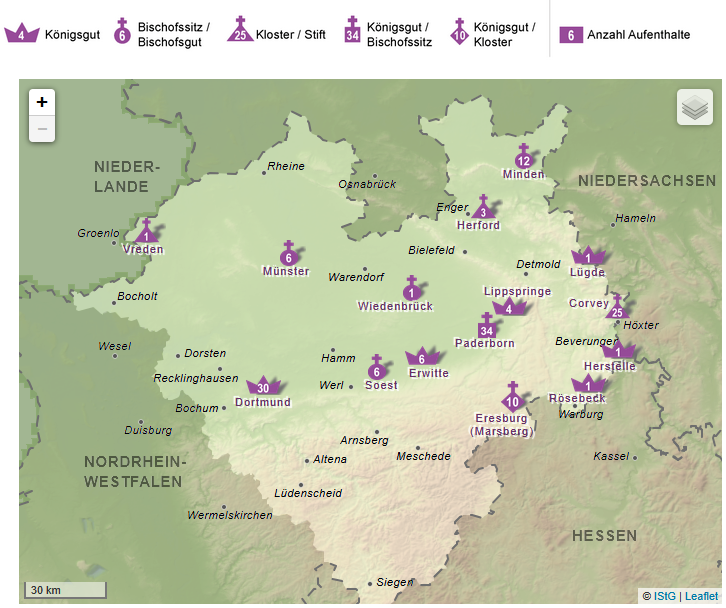
© IStG About the Map
Publication
Corvey – Karl Heinrich Krüger
Dortmund – Angelika Lampen
Eresburg/Marsberg – Karl Heinrich Krüger
Erwitte – Birgitt Studt
Herford – Christof Spannhoff
Herstelle – Christof Spannhoff
Lippspringe – Christof Spannhoff
Lügde – Peter Johanek
Minden – Christof Spannhoff
Münster – Christian Helbich
Paderborn – Manfred Balzer
Rösebeck – Christof Spannhoff
Soest – Ulrich Löer
Vreden – Volker Tschuschke
Wiedenbrück – Karsten IgelAbout the Overall Project
The original project Die deutschen Königspfalzen (Repertorium der Pfalzen, Königshöfe und übrigen Aufenthaltsorte der Könige im deutschen Reich des Mittelalters) – The German Royal Palaces (Repertory of Palaces, Courts, and other Residences of Kings in the Medieval German Empire) – was launched at the Max Planck Institute for History in the late 1950s. Organised by federal state, it documents all sites of royal stays for the purpose of governance that appeared as such before 1198. Walter Schlesinger established the methodological foundations for this enterprise in his essay on Merseburg, published in 1963. Other researchers closely linked to the overall project are Josef Fleckenstein, Adolf Gauert, Thomas Zotz, Otto Gerhard Oexle, Lutz Fenske, and Caspar Ehlers. Originally coordinated by the Max Planck Institute for History in Göttingen, the project has been managed by Caspar Ehlers at the Max Planck Institute for Legal History since 1 January 2007.
Publications
Background
The German Royal Palaces. Repertory of Palaces, Courts, and other Residences of Kings in the Medieval German Empire.
What is a Pfalz (Palace)?
In the Middle Ages, the kings and emperors of the Holy Roman Empire did not have a single permanent residence, but instead exercised their rule from various locations across the empire. These places, referred to as “Pfalzen” by historians, generally met three criteria: They were frequently visited by the ruler, they were part of the crown estates, and they featured imposing architecture. However, evidence of royal presence is not limited to these sites. Kings and emperors also stayed in diocesan towns, abbeys, and even smaller places in order to attend to governmental affairs or festivities.
What is the significance of research on Pfalzen (Palaces)?
During the Middle Ages, the kings and emperors of the East Frankish-German and medieval German Empire had no permanent residence. Instead, they governed from various locations across the realm. Some of these residences were property of the crown, but many were controlled by other authorities, especially bishops and abbots. As shown by the long title of the repertory (Repertory of Palaces, Courts, and other Residences of Kings in the Medieval German Empire), the different types of places where royal power was exercised also bear different names.
Researchers use the term “royal palace” (Königspfalz) only for building complexes owned by the crown that featured similar architectural structures. Unlike the “royal courts” (Latin: curia), which also belonged to the royal estates, a royal palace must be explicitly designated as such in the sources—as palatium regis, aula, or domus regia. It is presumed that the difference between “royal palace” and “royal court” was rooted in different political functions of the two sites. However, the exact criteria for this distinction have not been fully clarified to this day. In the repertory, these residences are dealt with according to pattern A. Stays or visits to other authorities, bishops, or monasteries and collegiate churches, where power was also exercised (for example, by issuing documents), are summarised under “other places of residence”. These locations are processed according to pattern B.
The phenomenon of the travelling kingdom, i.e. the ruler being constantly on the move in an “empire without capital” (Wilhelm Berges), is also mirrored in a specific form of academic approach paying tribute to the fact that the centre of attention is a specific place, not a person or time period – a situation well known to researchers of regional history. The “Repertory of German Royal Palaces” thus addresses those sites visited by the monarch for the purpose of exercising authority. This not only allows for a direct comparison between the locations but also opens up new perspectives by removing them from their chronological historical context and analysing them within a spatial context. For example, research has revealed specific habits of individual rulers, or how royal stays were affected by seasons and the church calendar. Political motives appear to have been the primary driver of the itinerary, although this was not always the case. The Repertory covers more than just royal palaces in the narrowest sense, which in Westphalia were limited to Dortmund and Paderborn. It also deals with royal courts (e.g., Rösebeck near Warburg), as well as monasteries and bishop's palaces (such as Corvey or Minden) that served as temporary residences for the medieval ruler. The term Königspfalzen (in contrast to Kaiserpfalzen) is used because the Eastern Frankish/German rulers can always be titled as kings, but not always as emperors. Moreover, as Caspar Ehlers puts it, they justified their authority north of the Alps based on their status as kings, not on the title of “emperor” (Kaiser).
Research Results
Throughout the Middle Ages, royal itinerary planning kept changing. Aside from the fact that the centres of royal authority varied depending on the dynasty in power, the locations for major assemblies and church festivals also changed. While the late Carolingians were primarily active in the west, Saxony – owing to the origin of the royal family – became the centre of the empire under the Ottonians. The Salians sought to integrate the Saxon region into their itinerant kingship, in addition to their Rhenish-Franconian ancestral lands (the area around Speyer and Worms). The Hohenstaufens initially succeeded in incorporating the north as well. However, the conflicts between Frederick I Barbarossa and Henry the Lion are an indicator of continued tensions within the Empire. Henry VI and Frederick II rarely moved north of their Swabian ancestral lands, as their itineraries were decisively shaped by a political shift toward the south and into Italy. The Staufen period also marked a move toward the pursuit of personal dynastic power (Hausmachtpolitik), which became a central element of royal policy under Rudolf of Habsburg, whose election in 1272 ended the Interregnum. This general trend can be specified using Westphalia as an example.
On the basis of royal visits to Westphalia from the 8th to the 12th century, it must be concluded that the region between the Rhine and the Weser was not a heartland of the monarchy. The number of royal stays in Westphalian places does not come close to the figures recorded for other German locations with imperial palaces. Yet, when looking at the quality of specific stops, it is evident that simple statistics can be deceptive because they overlook the situational and individual factors that shaped the travel routes. Because of its palace and its wealth of royal lands, Dortmund, for instance, was often more than just a stop on the journey, but the intended destination itself.
Looking at the episcopal residences, the imperial abbey of Corvey, and the imperial abbeys of Herford and Vreden, it is clear that the status of individual bishops, abbots, or abbesses in the Empire – and their personal ties to the ruler – played a decisive role in determining royal visits during the 11th and 12th centuries.
Westphalia was therefore not merely a transit region, although the intensive use of the Hellweg might lead to a different conclusion. Rather, the term “integration space” (Integrationsraum, as defined by Eckhard Müller-Mertens) appears appropriate. For the recorded locations of royal stays were repeatedly centres of praesentia regis, where the king's presence and royal authority were publicly demonstrated through exceptional church festivals and official government acts. They were special destinations of the royal itinerary, presumably planned well in advance.
Analysis of Locations
The “Repertory of German Royal Palaces” naturally places a strong emphasis on the study of the locations and individual royal visits. The section on archaeology, architecture, and art history centers on the topography and architectural history of the buildings and their interior fittings. In Westphalia, it is noteworthy that, apart from the sites used in the 8th and early 9th centuries and possibly the town of Erwitte in the 10th or 11th, there were no “rural” palaces, but only extended royal courts. Palaces and royal visits served as catalysts for urban development; on the other hand, the rulers primarily resided in the “urban” centres of their time. For this reason, the Repertory articles always explore the interrelations between the location of the royal stay and the town. Special emphasis was placed on incorporating the most recent results from archaeology and urban history.
The relationship between the ruler and the royal palace location is illustrated in each article through the issuance of charters at that particular place. Individual stays are documented not only by citing the sources proving the presence of a king or emperor, but by quoting them. Consequently, the user of the repertory has access to nearly all narrative and normative sources related to the site. Events are briefly summarised, and the individuals mentioned in reports and charters are listed. The latter allows for the identification and analysis of the circle of people surrounding the sovereign.
The project is based on the Regesta Imperii, a work in progress for over a century that records the actions and (resulting) itineraries of the rulers in chronological order from the early Carolingian period onwards.
Funding

© LWL