

Work of the AG Müller. (Upper left: Pinguicula longifolia by W. Barthlott)
© W. Barthlott, M. Wolf

Evolution and Biodiversity of Plants

The group Evolution and Biodiversity of Plants (chair Kai Müller) was established in 2009, as one of the five major groups in the Institute for Evolution and Biodiversity at the University of Münster. It deals with the evolution of plant biodiversity. Using phylogenetic reconstructions based on molecular data, we contribute to new plant classifications as a means of communication in the whole field of biology. In addition, we test hypotheses on spatial and temporal diversification and key innovations of several angiosperm groups. One current focus are carnivorous plants in the order Lamiales: here, chloroplast genome evolution and the observed nuclear genome miniaturization are among the main research topics. In the context of these subjects, we also contribute to bioinformatic method and software development.
News

AdWL Mainz
|
© Hannah Neuhaus

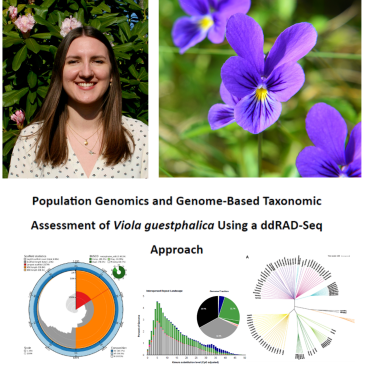
Biodiversity Award for Hannah Neuhaus

In her Master's thesis, Hannah Neuhaus decoded for the first time the genome of the Galmei violet, a metallophyte known from only a single location worldwide.

The Biodiversity Award is presented to Hannah Neuhaus for her Master's thesis, “Population Genomics and Genome-Based Taxonomic Assessment of Viola guestphalica”, conducted in the research group of Professor Kai Müller at the University of Münster. Using Oxford Nanopore long-read sequencing, Hannah Neuhaus decoded the genome of Viola guestphalica (1.29 Gb) for the first time, making it the first genome of a metallophyte within the genus Viola. The Galmei violet grows on heavy-metal-rich soils and is of particular interest today, not least in the context of restoring contaminated sites. Worldwide, it is known from only a single location: the lead enriched soils of Blankenrode (North Rhine-Westphalia, Germany). Neuhaus analysed its genome using state-of-the-art molecular biological methods, clearly differentiated the Galmei violet genetically from its closely related species, the Yellow violet, and compared genetic diversity at the natural site with that found in ex situ conservation collections maintained by botanical gardens. The findings of her Master's thesis also have significant implications for nature conservation, particularly for the management of threatened species. The work thus combines methodological excellence in research with tangible implications for biodiversity conservation in a changing world.