

Are human rights reaching their limits in Europe?
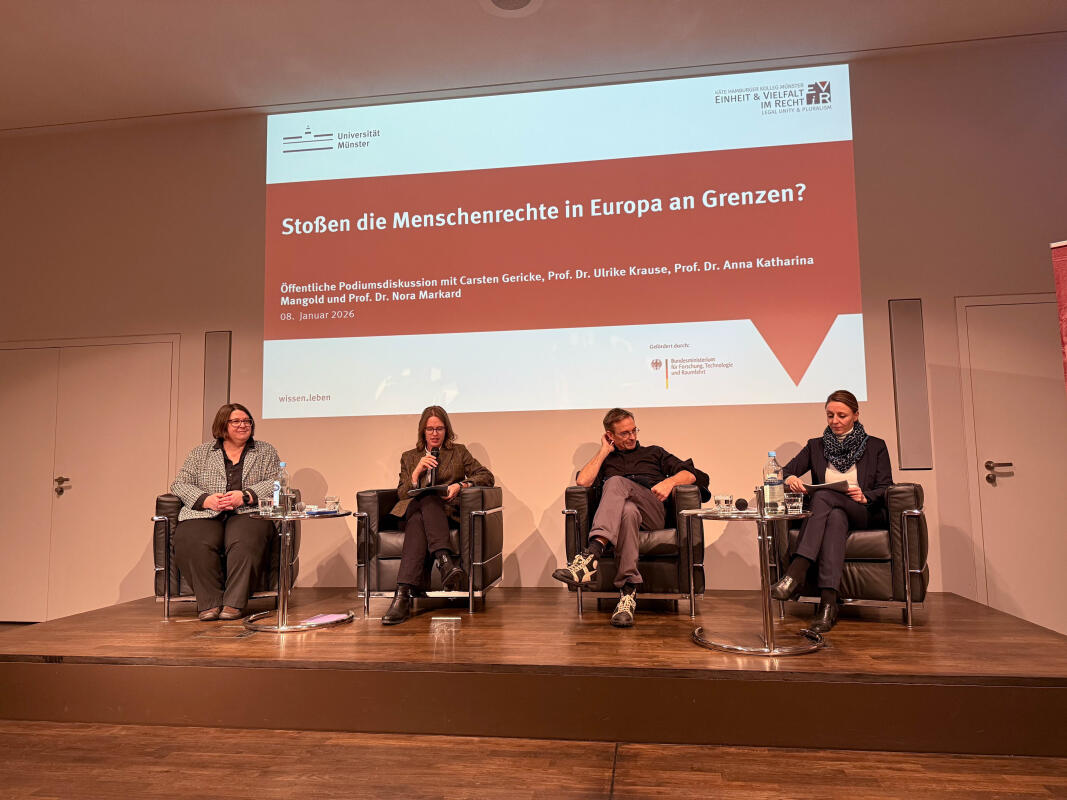
Panel discussion addressed conflicts in migration policy between law, politics and human rights protection
On 8 January 2026, the Käte Hamburger Kolleg ‘Legal Unity and Pluralism’ at the University of Münster hosted a panel discussion on whether human rights in Europe are reaching their limits in light of current developments in migration policy. The event was hosted by Prof Dr Nora Markard, co-director of the Kolleg. The event concluded with a reception, during which further discussions with the experts were possible.
European law expert Prof Dr Anna Katharina Mangold (Flensburg) diagnosed a growing disregard for legal obligations at the European level. Border controls and rejections are becoming normalised not only at the EU's external borders, but increasingly within the Union as well. With reference to security exceptions, European law is being strategically instrumentalised, which calls into question freedom of movement and the EU as a legal community as a whole. Especially in view of Germany's potential role model function, this poses considerable risks for democracy and the rule of law in Europe.
Lawyer and Hamburg Constitutional Court judge Carsten Gericke emphasised the serious human rights consequences of this policy. Practices such as pushbacks, illegal detention and violence at borders have long been known to be unlawful, yet they continue and are tolerated. Another cause for concern is the growing pressure on courts, lawyers and plaintiffs, which undermines the independence of the judiciary and increasingly forces the European Court of Human Rights into a defensive position.
Political scientist Prof Dr Ulrike Krause (Münster) classified the current developments as an expression of a symbolic political agenda driven by externalisation. Models for outsourcing asylum procedures promise control, but are expensive, legally problematic and ineffective in the long term. A sustainable asylum system must take human rights seriously as a binding foundation, understand protection as an international obligation and focus on cooperation, participation and long-term perspectives.
The discussion made it clear that the solution to the current conflicts is failing less because of legal boundaries than because of a lack of political will. This raises the question of whether there is still consensus on defending universal minimum rights as the foundation of democratic order and adhering to these rights even when dealing with outsiders. In this context, the consequences of moving away from these fundamental values within German society were also discussed.