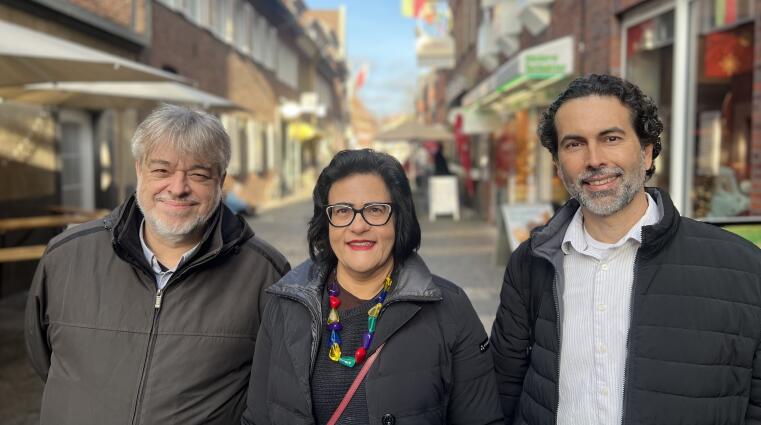
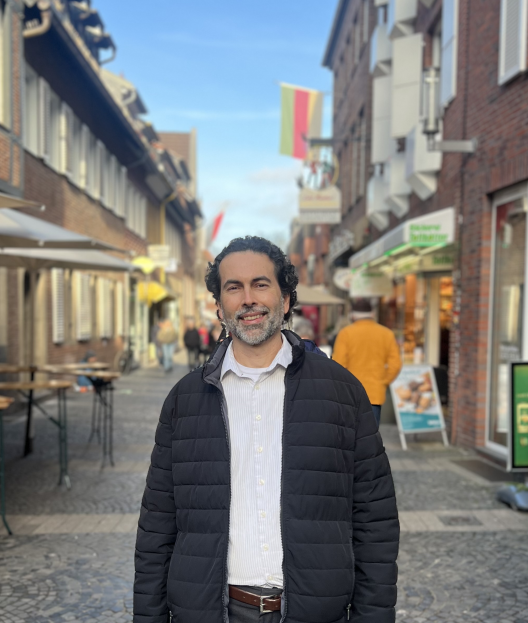
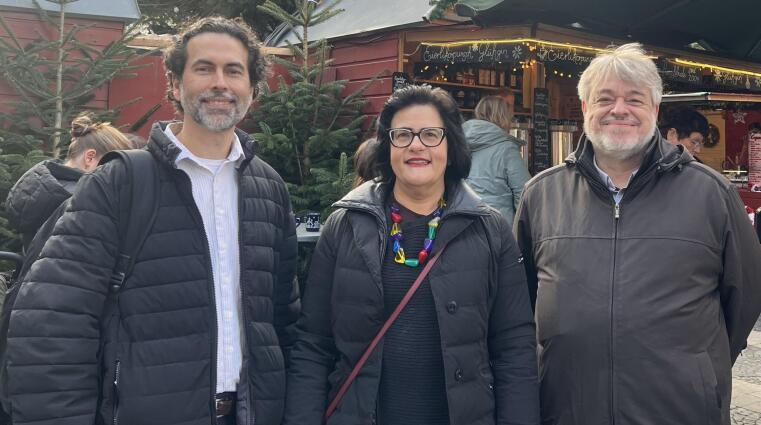
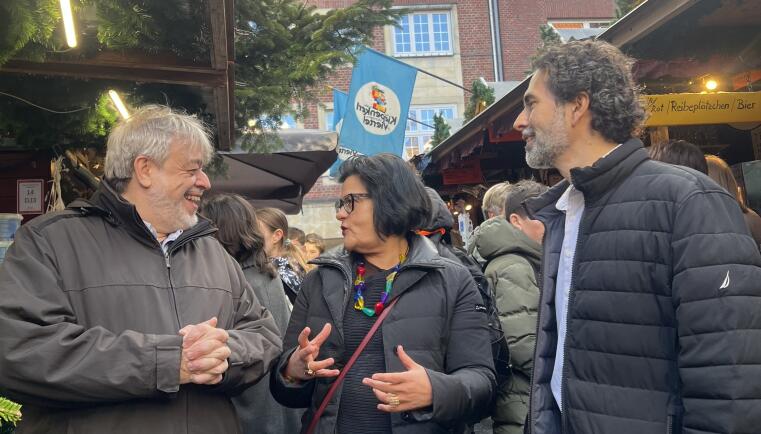
In the historic centre of Münster, in front of the historic Kiepenkerl monument, three Brazilian researchers from leading research institutions met on a Thursday afternoon in a festive, Christmas atmosphere at Münster’s Christmas market: Prof. Dr José Carlos Vaz, University of São Paulo (USP); Prof. Dr Ana Larissa Marciotto Oliveira, Federal University of Minas Gerais (UFMG); and Prof. Dr Daniel Villela, Oswaldo Cruz Foundation (Fiocruz). All three are holders of the Brazil Chair at the University of Münster, which is coordinated by the Brazil Centre and funded by CAPES (Brazilian Federal Agency for Support and Evaluation of Graduate Education), a funding agency affiliated with the Brazilian Ministry of Education.
Prof. Vaz, a visiting professor at the Institute of Political Science since 2024 hosted by Prof. Dr Norbert Kersting, is the longest-serving holder of the Brazil Chair and is approaching the end of his third stay. He views the city through the attentive lens of a scholar specialised in public policy who, within the framework of the Brazil Chair, works on the topic of “Smart Cities and Online Participation”, and he speaks of his admiration for both the city and the university. Among the outcomes of his stay is a webinar series on the future of online participation in smart cities—an initiative that has built bridges between Latin America and Europe and fostered exchange on instruments of online participation, artificial intelligence, technology and dominance. This initiative also resulted in the policy brief Artificial Intelligence for Participation.
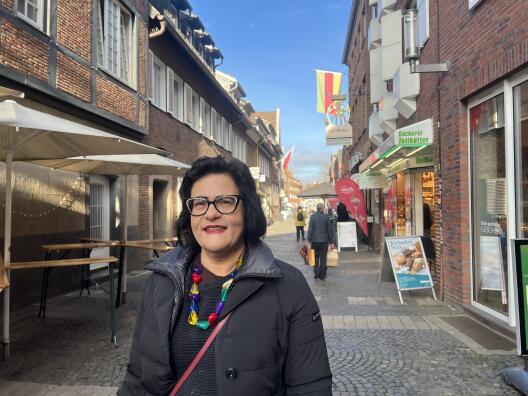
Prof. Dr Oliveira, Chair Holder at the Institute of Communication Studies with Prof. Dr Julia Metag as her academic host, devotes her stay in Münster to research on the topic “The New Limits of the Sayable in Political Discourse: The Language of Conflict as a Challenge to Pluralistic Societies”. Enthralled by the beauty of Münster, the professor—currently halfway through her stay—describes living in the city as feeling “like being in a fairy tale”. During walks through the Christmas market—a traditional setting to which she devotes a daily stroll between her responsibilities as a visiting professor—she expresses the deep affection she has felt for the city since her arrival in February 2025.
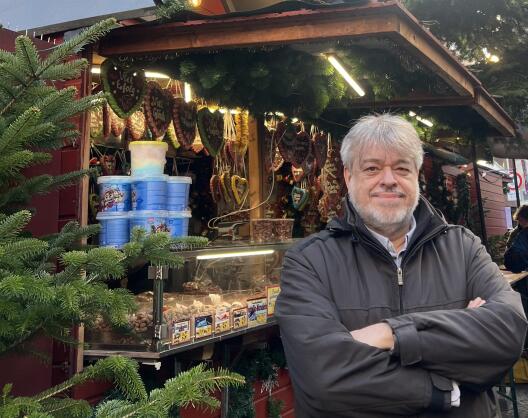
Shortly afterwards, Prof. Dr Villela joins the group. He is the most recent holder of the Brazil Chair and a researcher at Fiocruz (Oswaldo Cruz Foundation), which is also the newest partner institution of the University of Münster. He is at the beginning of his stay, which started less than two months ago. He is hosted jointly by the Institute for Information Systems, represented by Prof. Dr Bernd Hellingrath, and by the Institute of Epidemiology and Social Medicine, represented by Prof. Dr André Karch. During his stay, he will focus on research on “Modeling the Dynamics of Infectious Diseases for Epidemiological Management” and will also be active at the Interdisciplinary Center for Modeling Infectious Diseases (IMMIDD), of which both hosts are members.
Beyond borders: interdisciplinary partnerships between Brazil and Münster
What unites the three scholars is not only their country of origin and their role as visiting professors, but equally their shared commitment to deepening and expanding collaboration between Brazil and Münster. During the meeting, the researchers exchange perspectives on academic cooperation, interdisciplinarity, strengthening ties between partner institutions and—naturally—on intercultural issues, particularly those related to Christmas traditions.
Prof. Oliveira, for example, emphasises the pleasure of having the opportunity to collaborate with researchers at the University of Münster: “It is our commitment to enabling a genuine exchange—it is an exchange of knowledge,” she explains, adding: “It means building partnerships with partners—it is a very significant opportunity for academic interaction.” The linguistics specialist not only strengthens collaborations within her own field, but also pays close attention to expanding interdisciplinary networks, while maintaining contacts with researchers from other institutes, such as the Institute of Educational Science and the Institute of Political Science. She is particularly interested in new perspectives on her research topic that emerge from different viewpoints and disciplines—something that, for her, represents the possibility of new horizons and research questions.
Against the backdrop of social change and the growing use of artificial intelligence, Prof. Vaz expresses his familiarity with interdisciplinary approaches: “I come from an interdisciplinary background and can contribute to the University of Münster. The Brazil Chair is an investment that multiplies through interdisciplinarity.” Towards the end of his Chair term, the researcher combined his interest in continuing to produce knowledge on topics that underpin relevant discussions for and with society—such as the responsible use, opportunities and risks of artificial intelligence in smart cities—with the opportunity to interact with researchers from other regions. In doing so, he gained new perspectives and promoted scientific progress towards emerging trends through collaboration and innovation. “Exchange is very important if we want to advance into new areas,” the professor emphasises.
This theme recurs in the reflections of Prof. Villela as well, for whom the interest in partnerships is also central to his stay in Münster. He describes the University of Münster’s Interdisciplinary Center for Infectious Disease Modeling (IMMIDD) as a place that brings together diverse research profiles under one roof. Selected through the Brazil Chair call with a research topic that has gained enormous relevance in recent years due to the COVID-19 pandemic, the professor highlights his excellent integration into the research groups at the University of Münster. He also underlines the realistic prospect of long-term collaboration between the University of Münster and Brazilian institutions—in his case, Fiocruz.
Amid the scent of mulled wine and the festive atmosphere, the conversations reflect the diverse perspectives of different academic disciplines. Despite their affiliation with distinct fields of knowledge, all share a similar understanding of the great importance of the Brazil Chair. By listening attentively to one another at different stages of their Chair stays, their view of their own stay expands beyond the purely academic realm—towards the responsibility of representing Brazilian science and towards a renewed and strengthened return to the Brazilian academic landscape.
Supporting early-career researchers, teamwork and social impact
One aspect, in particular, unites the Chair holders with regard to fostering the next generation of researchers: the opportunity to involve early-career Brazilian researchers and integrate them into the Brazil Chair team. Prof. Vaz emphasises that this aspect of the programme highlights how teamwork significantly enhances the quality of work within the Brazil Chair. It offers young researchers the opportunity to deepen their research, supported by their own network, while gaining the chance—individually and collectively—to expand their professional contacts, present their research and build bridges to other universities.
Prof. Villela, who has not yet assembled his Chair team, also expresses his expectations regarding teamwork and agrees: “It is about combined efforts—the sum and complementarity of the individual parts.” He describes this possibility as the necessary strength for establishing and consolidating international collaborations. For him, joint efforts by researchers at different career stages give the Brazil Chair an organic and sustainable mode of operation that strengthens scientific research.
Prof. Oliveira shares this view and points to the difficulties young researchers face when seeking to enter research environments outside their home countries. One of the outcomes of her Chair appointment—the e-book “Digital Language, Gender and Democracy in Brazil”—could not, she explains, have been produced without the researchers accompanying her within the framework of the Brazil Chair. Prof. Vaz agrees, referring to the policy brief, one of the outcomes of his team’s work during his stay. It explores current and potential applications of artificial intelligence in processes of political participation and democratic governance in smart cities. The professors also emphasise that the outcomes of the Brazil Chair—such as both the e-book and the policy brief—serve a clear social function by making scientific knowledge accessible to a non-specialist audience. In this context, Prof. Villela likewise expresses his expectations regarding the wide range of possible outputs within the Brazil Chair, including teaching activities, science communication and the establishment of networks with other researchers.
Beyond academic discussions, the Chair holders also exchange experiences about their favourite moments outside of work. With great appreciation for Münster, they unanimously agree on the city’s Christmas setting: it is magical. “I love the german version of mulled wine,” says Prof. Oliveira, while her colleagues reflect on the closeness between Brazil and Münster through this winter beverage. Winter festivals in some regions of Brazil also resemble Münster’s Christmas market—traditions that may have emerged through various waves of migration and that reflect Brazil’s multicultural character. Prof. Vaz and Prof. Oliveira also speak of their delight at the event Münster singt 2025 (Münster Sings – 2025), a traditional event in which they recently took part. During the event, the city gathers on the Domplatz in Münster to sing Christmas songs together—an unforgettable and typically Münster experience. Prof. Villela recalls another experience from the same day: his visit to the Christmas market in Cologne. Experiences such as these illustrate that, alongside its scientific dimension, the Brazil Chair also has an undeniable intercultural dimension that enriches the stay of Brazilian researchers in the city.
The simultaneous meeting of three distinguished professors at different stages of their stay within the framework of the Brazil Chair in Münster offers a unique opportunity to observe similarities, differences and challenges of scientific collaboration across diverse disciplines.
With the Kiepenkerl*, a historic German figure, the three researchers share only one thing: crossing borders. In this case, however, it is done to promote scientific progress through cooperation and to expand networks through the exchange of experiences, knowledge and lived practice.
*The term Kiepenkerl was historically used to refer to itinerant traders in the Westphalia region from the 15th century onwards. These merchants crossed borders and travelled to other cities to sell various goods, primarily foodstuffs.