

DFG Funds New Research into the ‘Münster Mummy’
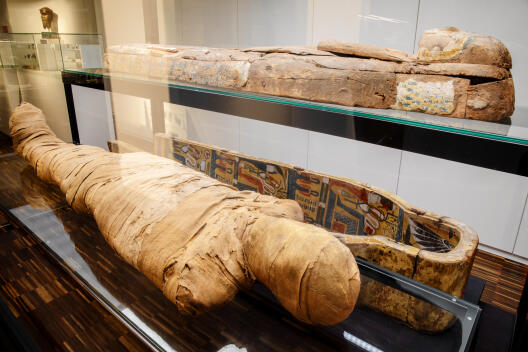
Who was the man whose mummy is on display in the basement of the University of Münster’s Archaeological Museum? Why was he buried in a coffin that is several centuries older than he was? And how did the mummy and coffin come into the possession of the merchant Wilhelm Schmitz-Scholl, a descendant of the Tengelmann founding family? These specific questions will probably remain unanswered forever. However, Egyptologist Prof. Dr Angelika Lohwasser and project collaborator Dr Marc Loth, together with the team at the Archaeological Museum, hope that the new project funded by the German Research Foundation (DFG), ‘Stories in a “Dense Find” – a multidisciplinary investigation of the Egyptian coffin containing a mummy in Münster”, will yield numerous new insights into everyday life in Egypt 3,000 years ago.
Through collaboration between researchers from a wide range of disciplines – who are, for example, investigating the materials and techniques used to construct the coffin, the methods employed for mummification, and the possible significance of the coffin’s texts and images – the aim is to produce a multifaceted overall picture. Modern analytical methods promise to reveal information about the mummy’s age, diet and health.
“The Münster collection is neither exceptional nor of particularly high quality. Yet it is precisely for this reason that it is well suited to a comprehensive publication, as it is usually the unusual or exquisite objects that are published as individual studies,” says Prof. Lohwasser. “This, however, skews our understanding of Egyptian coffins, as most objects in museums are not of high quality. Therefore, this average collection can be used to illustrate an ancient Egyptian standard, which can also serve as a benchmark for other collections.”
A second aspect of the project focuses on the 3,000-year history of these objects: beginning with the coffin’s manufacture by a joiner, its refurbishment with stucco and paint, through to its use and possible reuse, right up to its disposal. To date, there is no information whatsoever on this, nor on where the two objects were found.
The earliest confirmed mention dates only to 1903, when Wilhelm Schmitz-Scholl donated the mummy and coffin to his former school in Mülheim. After a series of twists and turns, the artefacts arrived in poor condition – for example, the head was missing, and has now been replaced by a replica – at the Archaeological Museum in Münster, where they have been on display since 2021 following extensive restoration.
The mummy and coffin can be viewed free of charge from 10 am to 6 pm, Tuesday to Sunday, at the Archaeological Museum in Münster, Domplatz 20–22.