

The Coffin
Human-shaped coffins were developed during the Middle Kingdom, around 1800 BC, and continued to be used in various forms until the end of Pharaonic civilisation. The coffin in Münster was probably made between 980 and 950 BC. Characteristic of this period are the yellow undercoat and the rich decoration on the inner and outer walls of both the coffin body and the lid. The paintwork was applied to a layer of stucco made from Nile mud and chaff, over a base coat of chalk, quartz and glue.
The stucco layer has flaked off over a large area, particularly on the lid, so that only a few scenes of the original decoration are still recognisable. A characteristic feature is the sometimes very thick application of paint, which makes individual hieroglyphs or symbols stand out in relief. The face is carved from a separate piece of wood, which is attached to the lid. The hands, which are now lost, were also carved from a separate piece. The holes for the tenons that would have held the hands in place provide evidence of this.
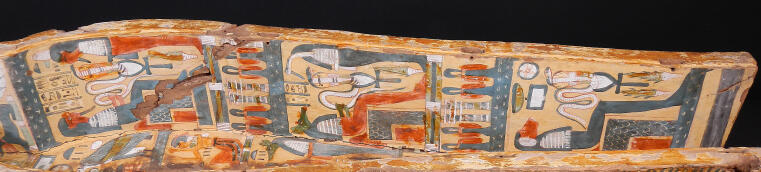
The motifs painted on the lid, of which only fragments remain, can be identified as various symbols associated with regeneration (such as a scarab). The decoration on the coffin chamber is significantly better preserved, although the footboard is completely missing. On the outer walls, the inscriptions list the offerings that the deceased presents to the gods. The scenes depict the deceased standing before various gods in a gesture of worship, as well as representations of deities of the underworld. Interestingly, the deceased depicted is male, whilst the inscriptions refer to a woman bearing the title ‘Singer of Amun’.
The interior walls depict protective deities: demons, who are not viewed negatively in Egypt as protectors of the deceased, bear various animal heads – jackal, snake or baboon. Between the individual scenes are amulets resting on the sky hieroglyph. At the head end is the Ba-bird: a bird with a human head, spreading its wings to unite with the preserved body of the deceased.
The motif on the floor of the coffin is particularly colourful. Central to this is the goddess Nephthys, who, alongside Isis, is the second mourner at the bier of Osiris, the ruler of the afterlife. She holds the ‘Isis knot’ emblem in her hands. Directly beneath this is a painted Djet pillar, the emblem of the god Osiris. Thus, the deities central to conceptions of the afterlife – Osiris as ruler of the realm of the dead, Isis and Nephthys as the mourners – are depicted within a very confined space. The empty spaces around the figure of the goddess are filled with depictions of minor deities, symbolic animals (falcons, vultures) and symbols. The discolouration on Nephthys’s robe is caused by the seepage of embalming substances.