

Mummification
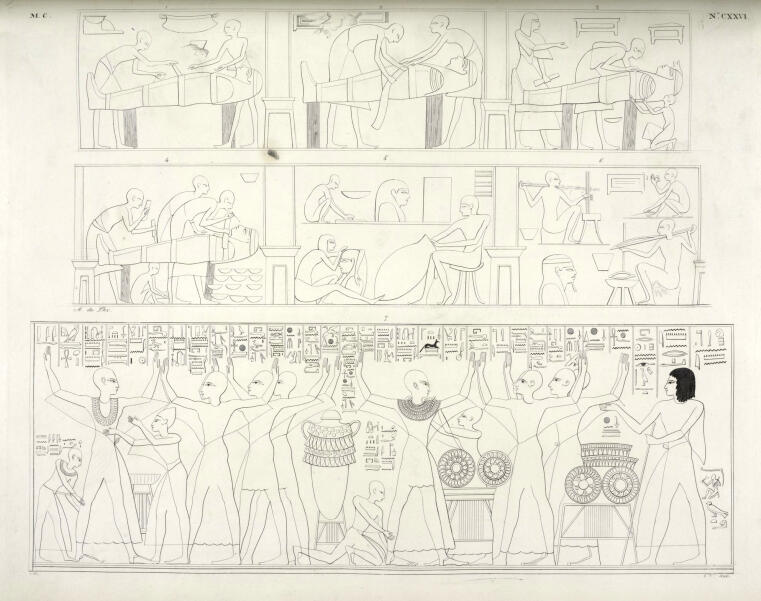
As in many other cultures, in ancient Egypt too, death did not signify the complete end, but rather a necessary transition to another form of existence. However, it is only through an intact body that it is possible to continue to exist after death. This belief was likely fostered by the fact that, in Egypt’s hot and dry climate, the body is exceptionally well preserved. In Saqqara, bodies dating from around 3000 BC were found, tightly wrapped in linen and impregnated with resin. Although the practice of mummification declined with the rise of Christianity, it did not cease until the Arab invasion of Egypt (641 AD) and the introduction of Islam.
In the embalmer’s workshop, the deceased is laid on a ‘lion’s bed’ – the embalming table with lion’s feet. The jackal-headed god Anubis is regarded as the embalmer and is frequently depicted in this role on coffins. He also removes the brain from the skull of the deceased. No further attention is paid to the brain, as the heart is regarded as the seat of thought and emotion. The heart is essential to a person’s identity; all memories and deeds are stored within it. It is therefore usually left inside the body and is often accompanied by the so-called heart scarab – the only amulet placed inside the body.
The next step involves the removal of the viscera. To do this, an incision is made in the lower left side of the abdominal wall using a sharp knife. The viscera are removed through this incision and treated separately with natron. However, some organs remain in the body, foremost among them the heart, which is regarded as the seat of the mind and emotions. The incision in the abdominal wall is not sutured, but a specific amulet is placed over it. The organs are treated with natron and, wrapped in linen cloths, placed in four vessels known as ‘canopic jars’.
The body is now surrounded by dry natron, which draws out the fluids and dries out the body. The salt is often placed in linen sacks and piled around the corpse – this allows the dampened salt to be easily replaced. This procedure, which usually lasts 35 to 40 days, prevents decomposition. The body, now free of internal organs and thoroughly dried, is then rubbed with anointing oil, which is also often poured into the abdominal cavity. Finally, the embalmers fill the body with various materials to give it a fuller appearance.
Wrapping the body in linen bandages is an essential stage in the mummification process: It preserves the integrity of the body and, together with the mask and mummy pads, gives it the outward appearance of the now-transformed human being. Amulets intended to protect the deceased are wrapped into the layers of linen. These are placed in specific locations, as each amulet is effective for a particular part of the body. Most amulets are made of blue-green faience, as this is the colour of sprouting vegetation and thus of regeneration. The shapes of the amulets depict either deities, sacred symbols, or animals and plants.
The now-completed mummy is placed in the coffin and transported to the tomb along with it. There, the burial ritual takes place, which is essential for the ‘revitalisation’ of the mummy and enables its existence in the afterlife. This ritual consists of several stages and culminates in the ‘ritual of opening the mouth’, before the now-transformed deceased is laid to rest in their tomb.
Source: Angelika Lohwasser/Lena Rauße, ‘Egyptian Mummies between the Rhine and the Ems’