

The Collection of Castings of Ancient Sculptures
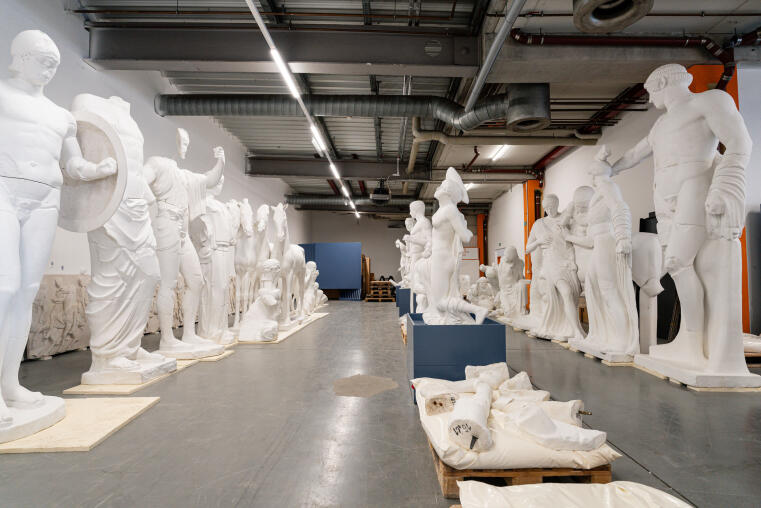
Since the 19th century, casts of ancient sculptures have been an important part of archaeological museums and universities. They allow famous works of Greek and Roman art to be studied in detail. Unlike photographs, plaster casts vividly reproduce the shape, size, and spatial effect of the originals and therefore remain an important tool for research and teaching to this day, while also offering visitors exciting insights.
The cast collection at the University of Münster is one of the oldest institutions of the Archaeological Museum, which was founded in 1883. Despite recurring problems such as lack of space and limited financial resources, the collection grew steadily: by the beginning of the 20th century, it already comprised over a hundred pieces.
However, the museum was completely destroyed during World War II. In the 1950s and 1960s, archaeologist Max Wegner began rebuilding the collection. Many new casts were acquired and exhibited in the attic of the Fürstenberghaus.
In the 1970s and 1980s, the collection once again found itself in a difficult situation:
Some pieces were damaged or stolen, and parts of the collection had to be moved out of the building for renovation.
It was not until the 1990s that the cast collection could be comprehensively restored and rebuilt. In the meantime, some pieces found a new home in the bicycle cellar of the Fürstenberghaus, where the basement of our museum is located today. The plaster casts were moved to a hall on Nienkamp, where, after extensive restoration, they found a worthy exhibition space for the first time. However, the dramatic rainfall of 2014 did not spare the plaster cast collection, and dramatic water damage was recorded, which was laboriously repaired in the following years.
However, the good fortune did not last long, as the hall on Nienkamp became so dilapidated that a new hall had to be found in 2024. Thanks to the tireless efforts of numerous employees at the University of Münster, a hall in Mecklenbeck was found and converted to meet the requirements. Now, for the first time since the collection was established, the casts of the gable sculptures can be displayed in their entirety. However, the plaster casts, some of which are over 70 years old, show traces of the collection's eventful history. The focus now is on repairing the minor and major damage and preserving the cast collection for the future.