
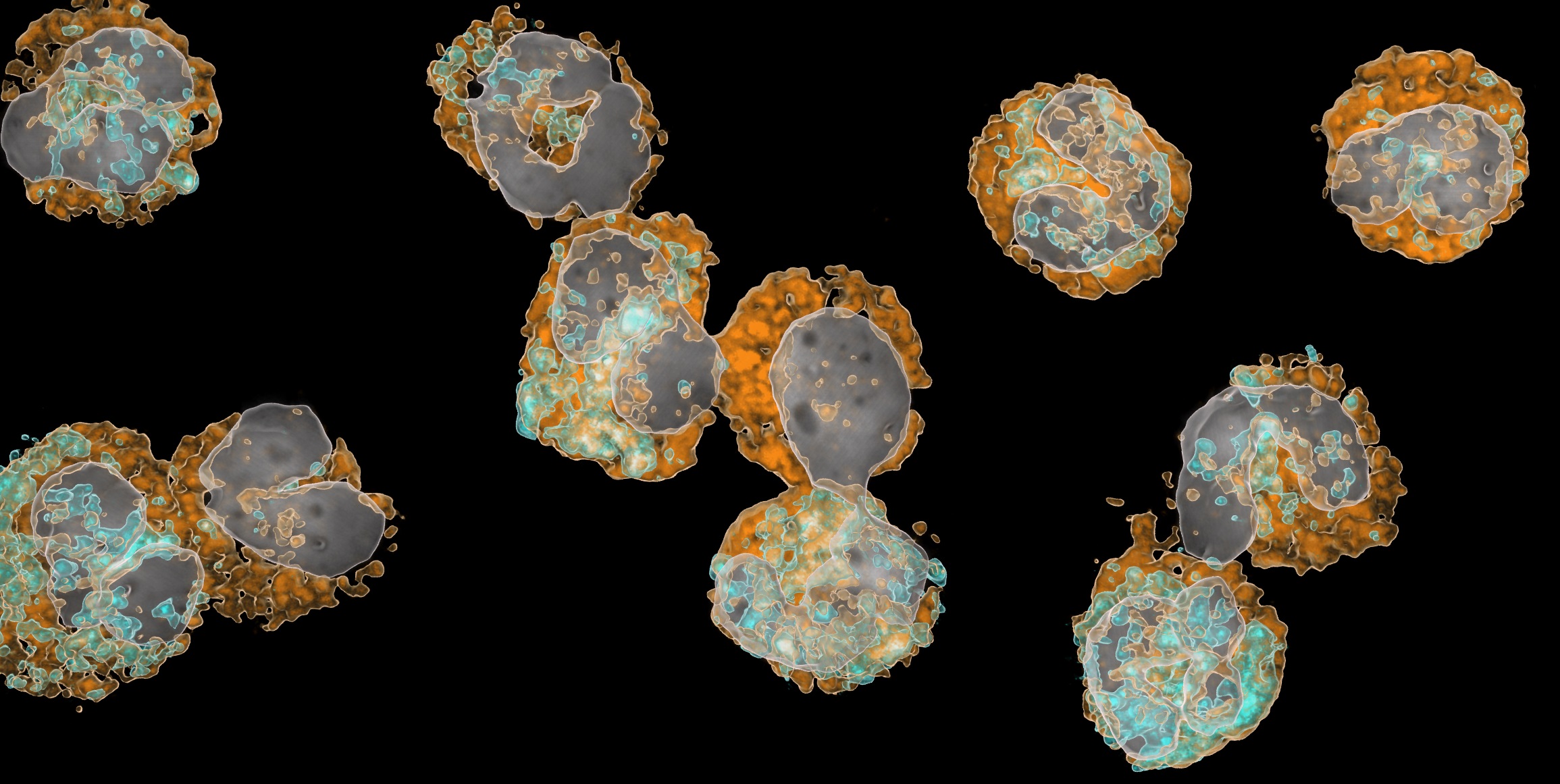
Immature immune cells predict chances of survival following a heart attack
During a heart attack, the immune system reacts as well as the heart. In particular, large numbers of neutrophils – the most abundant type of white blood cell – are released from the bone marrow into the bloodstream. Under normal circumstances, only mature cells circulate there. However, when the body is under severe stress, such as during a heart attack, the bone marrow also releases more immature precursors of these cells into the bloodstream. This indicates that the bone marrow is operating in an emergency state and drawing on its earliest reserves. Neutrophil mobilization during an acute heart attack has been known for almost a hundred years, but its significance for the progression of the disease has only recently become clearer. One unresolved issue is how to reliably identify high risk patients immediately upon hospital admission.
A research team led by Professor Oliver Soehnlein of the Institute of Experimental Pathology at the Centre for Molecular Biology of Inflammation at Münster University has investigated the extent to which this 'emergency mobilisation' of neutrophils occurs in various acute conditions, and whether this can inform our understanding of disease progression. To this end, the team compared patients experiencing heart attacks, heart failure, and strokes. They found that the extent of this recruitment was closely linked to the severity of the condition. The more severe the condition, the greater the number of immature neutrophil precursor cells present in the blood. The presence of the most immature of these precursor cells significantly increases the short-term risk of death. These findings have been published in the journal Nature Cardiovascular Research.
For the study, the researchers analysed blood samples from over 200 patients who had experienced a heart attack, stroke or heart failure, alongside samples from healthy individuals. Using high-resolution spectral flow cytometry, they identified the different stages of neutrophil maturation. This technique allows individual cells in the blood to be characterised precisely and simultaneously on the basis of numerous features. The release of immature cells was most pronounced in cases of 'ST-elevation myocardial infarction'. This is the most severe form of heart attack, where a coronary artery is completely blocked. The researchers even found very immature precursor cells, known as preneutrophils, in the blood of affected patients. The scientists also measured inflammatory mediators in blood plasma and identified a coordinated inflammatory pattern accompanying the increased cell mobilisation.
“For clinical practice, it is important that these immature cells can be detected using a simple differential blood count, a laboratory test available in almost every hospital, which determines the exact composition of white blood cells,” explains first author and PhD student Mathis Richter. “They can be identified as immature granulocytes (IG).” To validate the predictive value of the IG count, the researchers verified their findings in two further independent patient groups comprising several hundred individuals, including retrospective and prospective cohorts. The IG value proved to be a better predictor of the risk of death within the first thirty days than established biomarkers.
Even when other known risk factors were taken into account, the IG value remained an independent predictor. This suggests that it provides information that goes far beyond what is already known about risk factors. “We were surprised at how clearly the severity of the disease is reflected in the maturity of the released cells. In the event of a severe heart attack, the bone marrow literally draws on its last reserves,” emphasises Mathis Richter. The advantage of the method is that it does not require any expensive or time-consuming specialist analyses. This would enable high-risk patients to be identified upon admission to hospital and monitored more closely, for example.
Before the procedure can be adopted for use in clinical practice, the predictive value of IG must be confirmed by conducting further research on independent patient cohorts. In the long term, this could help identify people at risk earlier and provide them with more targeted care. “We now have a better understanding of the close communication between the damaged heart and the bone marrow. Our next step is to clarify exactly which signals trigger this increased cell release, as this could provide future targets for new treatments,” says Oliver Soehnlein.
Participation
The study was led by the Institute for Experimental Pathology (ExPat) at the Center for Molecular Biology of Inflammation (ZMBE) at the University of Münster (first author: Mathis Richter, last author: Oliver Soehnlein) and the Department of Cardiology I at Münster University Hospital. Other participating institutions: Düsseldorf University Hospital; LMU University Hospital; Essen University Hospital; Schleswig-Holstein/Lübeck University Hospital; the Leibniz Institute for Analytical Sciences (ISAS) in Dortmund; the Medical University of Innsbruck; and other institutes at the University of Münster, including the Institute for Medical Informatics; the Institute for Epidemiology and Social Medicine; and the Institute for Molecular Tumour Biology.
Funding
Financial support for the study was provided by the German Research Foundation (DFG), including several Collaborative Research Centres and individual grants (primarily SFB TRR332), as well as by the Leducq Foundation, Novo Nordisk, the EU doctoral network PRAETORIAN, the Else Kröner Fresenius Foundation, and the Faculty of Medicine at the University of Münster.
Original publication
Richter, M., et al. (2026): Depth of neutrophil mobilisation stratifies survival in ST-elevation myocardial infarction. Nature Cardiovascular Research. DOI: 10.1038/s44161-026-00836-0