
|
Münster (upm).
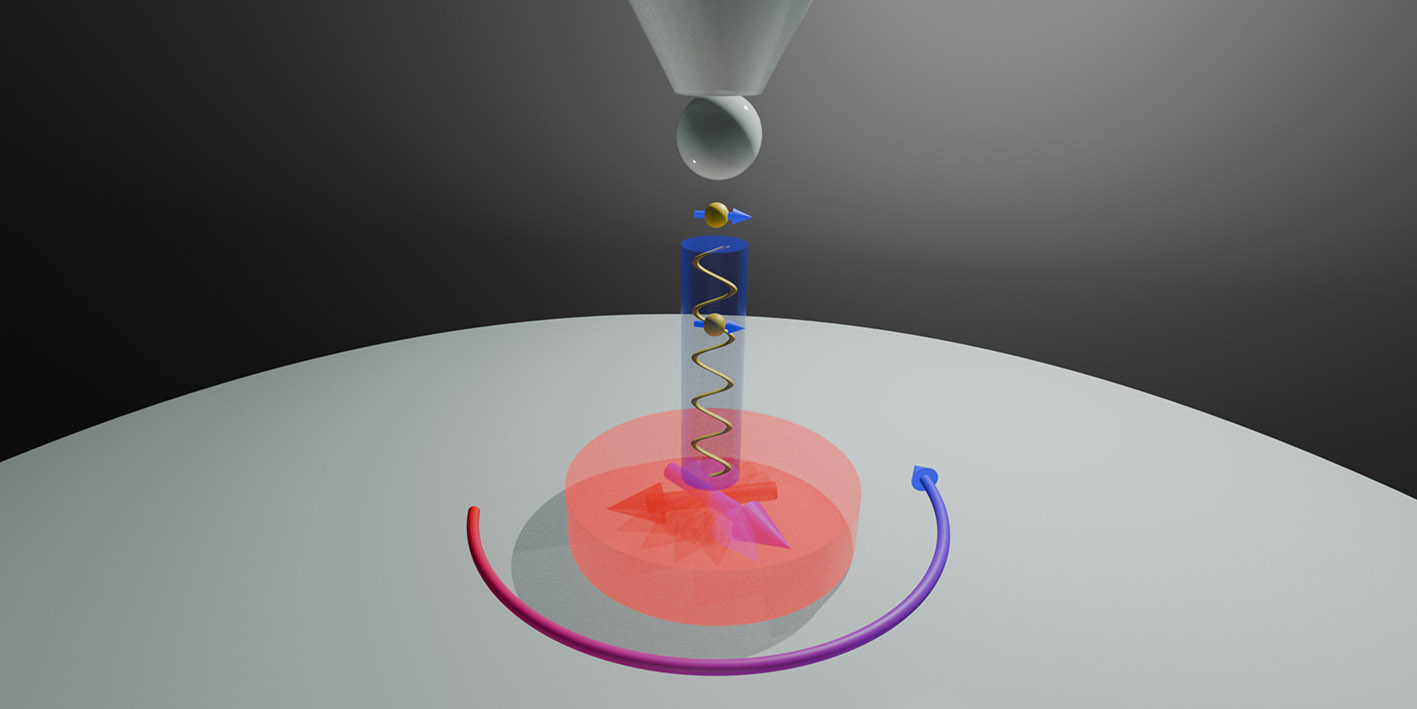
A diagram of the experimental setup: Electrons (small yellow spheres) tunnel from the magnetic scanning tunnelling microscope tip through the vacuum into the nanomagnet (red).<address>© Maciej Bazarnik, Anika Schlenhoff</address>
Electrons (small yellow spheres) tunnel from the magnetic scanning tunnelling microscope tip through the vacuum into the nanomagnet (red).
© Maciej Bazarnik, Anika Schlenhoff

New spin filter on the atomic scale

Physicists at the University of Münster have succeeded in controlling spin currents at the atomic scale and making individual microscopic processes accessible

In information technology, so-called spin currents are used to switch the magnetisation in memory cells. This technology is essential, as it allows magnetic information, e.g. in smartwatches, to be written particularly fast and at extremely high density. The capability to switch between two magnetic states, which function as bits, requires precise control of the spin currents at the smallest scale. Dr Maciej Bazarnik and Professor Anika Schlenhoff from the Institute of Physics at the University of Münster have now demonstrated that it is possible to precisely adjust spin currents at the atomic scale. The study was recently published in the journal ACS Nano.
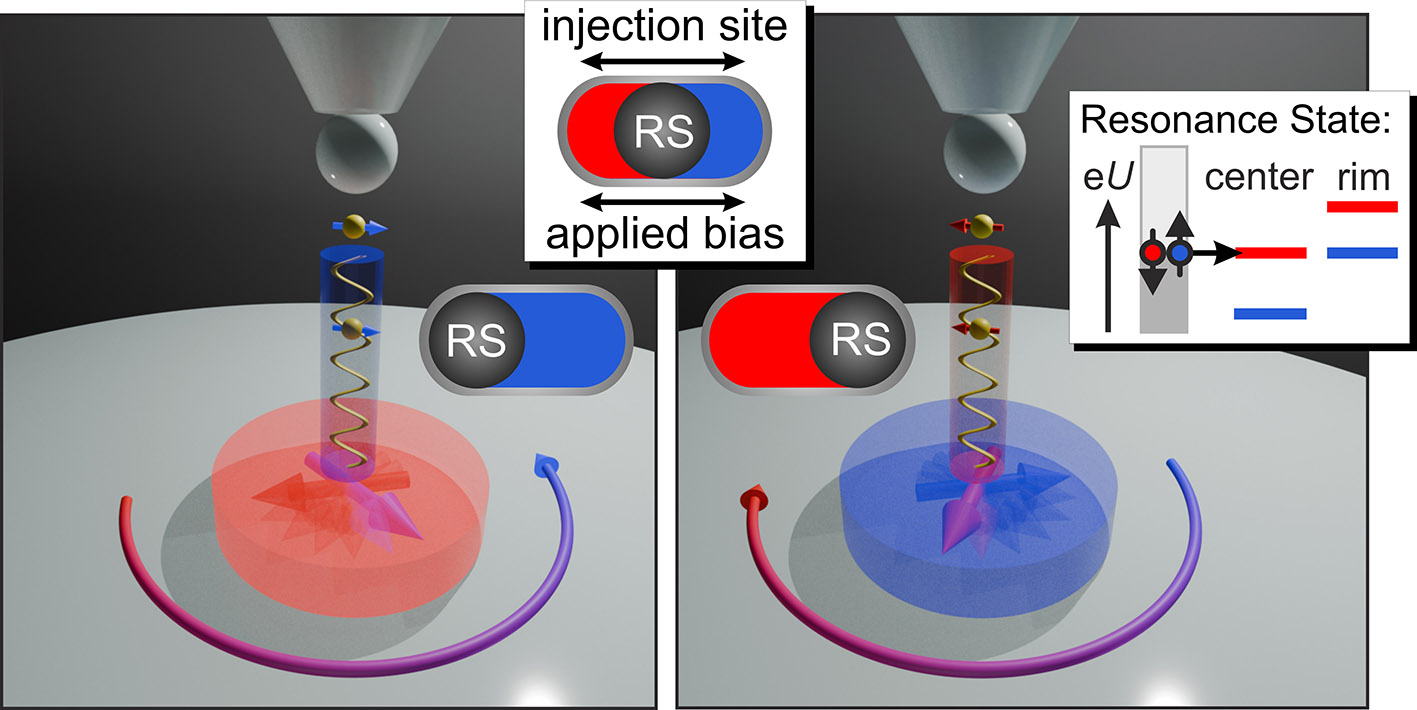
A diagram of the experimental setup<address>© ACS Nano - Maciej Bazarnik, Anika Schlenhoff</address>
The illustration shows the experimental model setup of a resonant tunnelling magnetic tunnel junction. Electrons (small yellow spheres) tunnel from the magnetic scanning tunnelling microscope tip through the vacuum into the nanomagnet (left: red, right: blue). The resonant tunnelling process (indicated by the yellow wavy lines above the nanomagnet) is highly sensitive to the applied voltage or the injection point of the electrons on the nanomagnet. Thus, the spin current associated with the electrons can be precisely controlled, and the nanomagnet can be switched back and forth on demand.
© ACS Nano - Maciej Bazarnik, Anika Schlenhoff
The researchers used an experimental model setup that replicates the magnetic tunnel junctions found in today’s memory cells at the atomic scale. These are based on so-called resonant tunnelling, in which electrons overcome two barriers in succession. Physicists had already predicted in theory that microscopic processes take place in such resonant tunnelling magnetic tunnel junctions, which would allow precise control of the spin currents. But until now, no suitable method existed that would produce experimental evidence at the highest resolution. Researchers in Münster have now succeeded in doing so by combining the method of resonant tunnelling with spin-polarised scanning tunnelling microscopy, which allows magnetic information to be read and switched back and forth microscopically.

The team also showed that nanomagnets can be switched back and forth on demand by adjusting the voltage or the position at which the spin currents are injected. ‘Our results are relevant for the further miniaturisation of current data storage technologies,’ says Anika Schlenhoff. ‘Our experimental approach is also important for the study of novel magnetic materials as potential candidates for new storage media,’ adds Maciej Bazarnik.

Spin is a quantum mechanical property of electrons. When tunnelling, electrons pass through an insulating barrier from one magnetic layer to another. Resonant tunnelling is a special form. In this case, a conductive layer lies within the insulating layer, which acts as a kind of filter and only allows electrons with a certain energy and a certain spin to tunnel. Maciej Bazarnik and Anika Schlenhoff replaced the layers between the two magnets with a vacuum, resulting in a particularly uniform filtering effect. By also replacing the outer magnets with a nanomagnet and an atomically sharp magnetic microscope tip, they achieved atomic-scale precision in measurement and control.

The project was funded by the German Research Foundation (DFG).


Original publication

M. Bazarnik, A. Schlenhoff (2026): Spin Filtering on Demand via Localized States in an Atomic-Scale Resonant Tunneling Magnetic Tunnel Junction. ACS Nano; DOI: 10.1021/acsnano.5c21248

Further information