
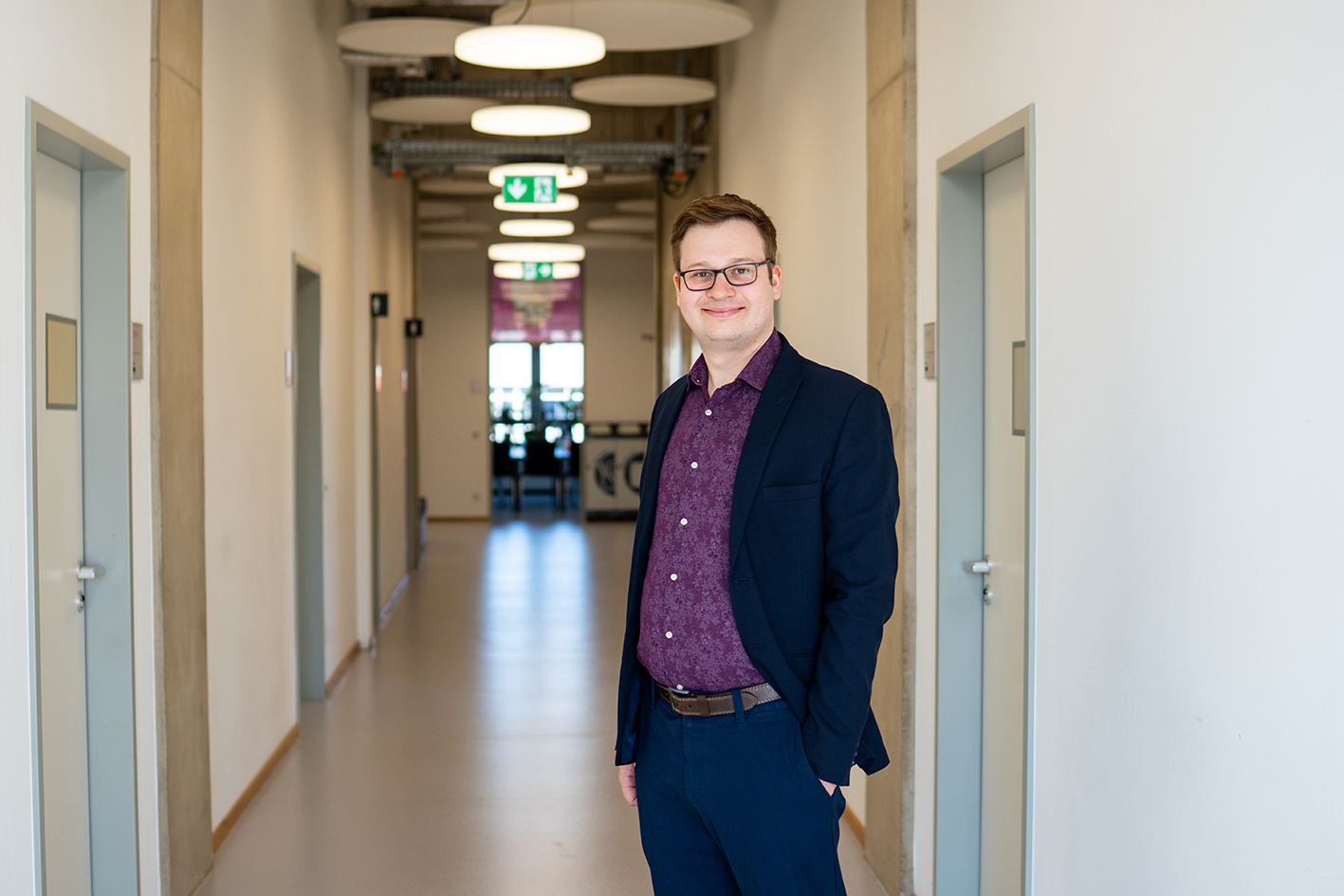
Curious and infinitely creative
When one of Robert Hein’s friends at school asked him in Class 12 whether he wanted to come along to the Open Day being held at the University of Bremen, he spontaneously agreed to do so. And as he was thrilled by the university – which he had never heard of up to that point – he decided without further ado to study chemistry there. At the University of Bremen, the focus was on research and all teaching was done in English – which delighted Hein. During his studies he took the opportunities offered for a placement at the University of Cambridge in the UK and an exchange semester at Cornell University in the USA. Today he is a university teacher and since 2024 he has been an associate professor, undertaking teaching and research at the Institute of Organic Chemistry at the University of Münster.
Robert Hein grew up near the border with Poland, in a small town situated in the countryside in the state of Brandenburg, and it was a long and winding road that eventually took him to Münster. For his dissertation in the field of chemistry, he first went to Oxford. There, an opportunity presented itself to stay and do a post-doctorate. The subject was the development of new, selectively interacting molecules which can function as contaminant sensors when they are applied to suitable surfaces. At that time, Hein’s field of research was at the interface between supramolecular chemistry and electrochemistry, and this is still the case today. “For me, it’s a challenge,” he says. “I like to merge various disciplines in networks.”
During the next stage of his career, which found him at the University of Groningen in the Netherlands, Robert Hein made the decision to come back to Germany for his habilitation. Two years ago he thus moved to the University of Münster – first with the support of a Liebig scholarship awarded by the Chemical Industry Fund (Fonds der Chemischen Industrie), then, shortly afterwards, with financial support from the Returnee Programme run by the state of North Rhine-Westphalia. Hein, who was recently given a Research Career Development Award by the Hector Fellow Academy, is full of praise for Münster, describing it as an outstanding location for research in chemistry with a large number of strong alliance projects. This is reflected in the long list of the collaborations he is involved with. For example, he is a researcher at the Center for Soft Nanoscience at the University of Münster. And he is a member of the “Intelligent Material” Collaborate Research Centre, as well as of the international Research Training Group working on “Functional π-systems” (a project being undertaken jointly with the University of Nagoya in Japan) and of the international battery research school BACCARA.
What the 31-year-old Hein likes particularly about his work is the fact that creativity pretty much has a free rein. “I’m fascinated by producing molecules and materials which didn’t previously exist,” he says. One of the things his working group is doing research on is how to switch molecules in such a way that properties of materials such as colour, geometry or fluorescence are altered. The aim is to develop reversibly switchable systems. One good example of this, says Hein, is “intelligent” glass which becomes darker when the sun shines on it. “We’re aiming to produce effects like this by means of electrically switchable molecules – changing the properties of materials at the push of a button, so to speak. How can we develop these materials? How do the molecular switches in the material behave? And how frequently can we allow electricity to flow without it leading to material fatigue which stops the effects from functioning? It is to these questions, and others too, that we’re looking for answers.” For Hein, chemistry is one of the keys to a more environmentally friendly future. “There are still lots of people who associate the idea of chemistry with pollution and problems,” he says, “although chemistry is much more than that, and has been so for a long while now. What’s important is to find solutions which can be used to reduce environmental impacts.”
Robert Hein’s partner is English, and he met her during his time at Oxford. He lives and thinks beyond national borders, and as a result he automatically makes comparisons. Germany, he says, offers very good conditions in a variety of ways for pursuing an academic career in the field of chemistry – for example, with regard to possibilities for research funding. But, in other respects, lessons could be learned here from other countries, he says. “In my experience, in the Netherlands and in the UK it is easier to start a project without first discussing all eventualities in detail. Only when problems crop up do people there start looking for solutions.” This approach, he says, is pragmatic and unbureaucratic. He takes a relaxed view of things when research sometimes doesn’t run entirely smoothly and some approaches taken don’t work out. “If nothing went wrong in research, we could just finish our work – because that would be a sign that everything has already been researched and is already known.”
A craving for research and a delight in experimentation can also be seen in Robert Hein’s private life – in the form of cooking. “I’m a foodie,” he confesses – in other words, someone who is interested in special ingredients and delicacies from all over the world. “Cooking is my hobby. And apart from that, I like travelling and trying local specialities.” There is one quality in particular that marks him out – regardless of whether we’re talking about unusual dishes, domiciles or research questions: he is receptive to new things and new ideas, and he is flexible. “That’s stood me in very good stead so far,” he says.
Author: Christina Hoppenbrock
This article is taken from the university newspaper *wissen|leben*, issue no. 3, 6 May 2026.