
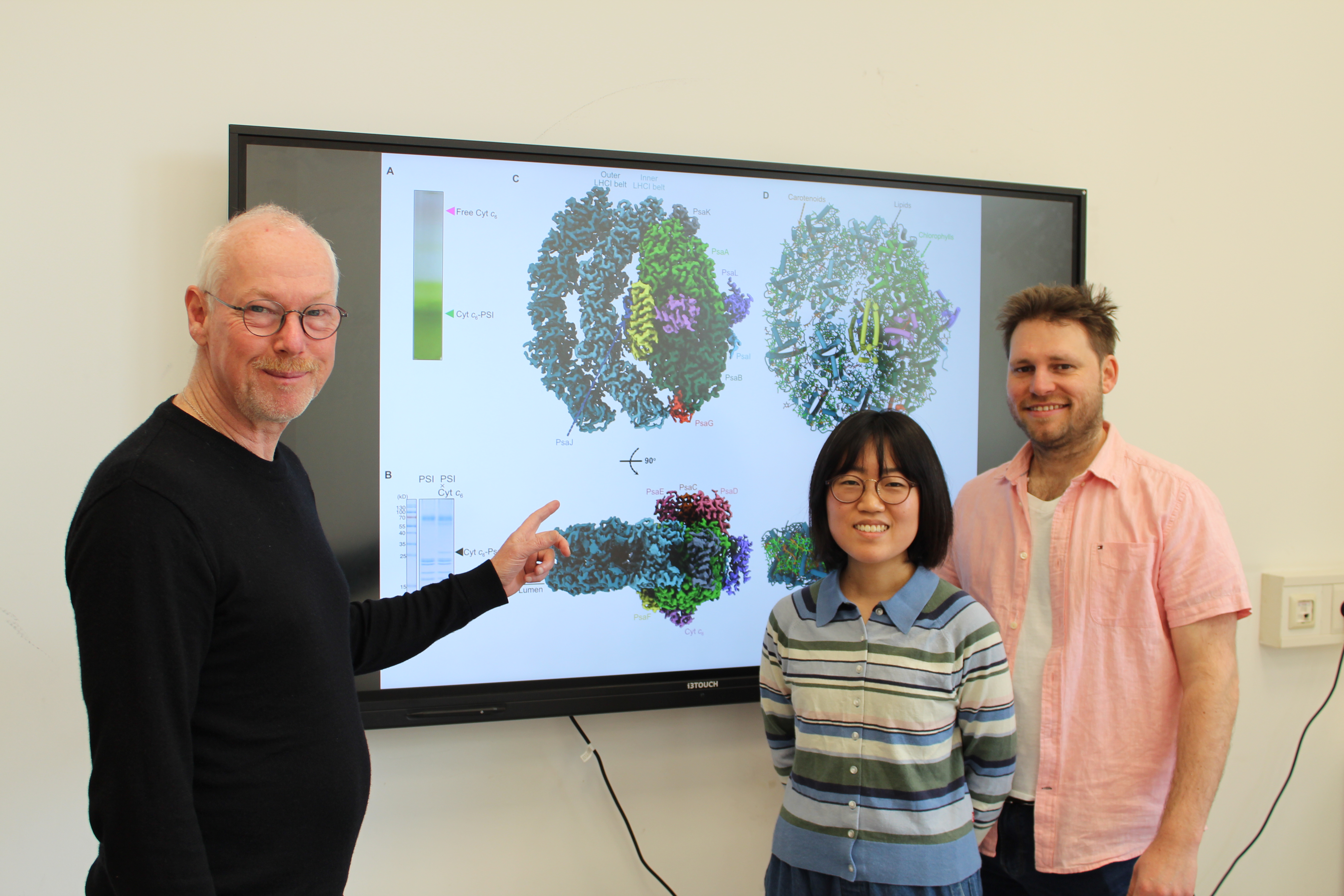
Research team decodes structure important for photosynthesis
Plants and unicellular algae utilise the energy of sunlight and convert it into sugar and biomass during photosynthesis. Oxygen is released in the process. Without this process, life on earth as we know it would not be possible. A team led by Prof Michael Hippler from the University of Münster and Dr Jan Michael Schuller from the University of Marburg has now investigated the so-called photosystem I in the green alga Chlamydomonas reinhardtii. Using cryo-electron microscopy, the scientists have elucidated the molecular structure of this central component of the "photosynthesis machine" and, above all, have understood how the iron-containing electron transport protein cytochrome c6 functions in it.
This protein plays a crucial role in cyanobacteria and in some green algae: it supplies the electrons that are fed into photosystem I. Only then can electron transport begin, which ultimately drives the conversion of light energy into chemical energy. Although it was already known that cytochrome c6 differs structurally from its functional “twin,” the copper-containing protein plastocyanin, the research team has now been able to show that both proteins are positioned in the photosynthetic complex in remarkably similar ways. Specifically, the iron atom in cytochrome c6 is located exactly in the same position as the copper in plastocyanin. This identical positioning explains how both proteins can perform the same function in electron transport despite their different structures.
While higher plants only utilise plastocyanin, the unicellular green alga Chlamydomonas reinhardtii has both proteins, cytochrome c6 and plastocyanin. This enables the alga to react flexibly to different availabilities of iron and copper in its environment.
The results provide insights into the evolution of the photosynthetic apparatus and create a molecular basis for a better understanding of electron transport over long distances in biological systems.
Funding
The open access publication was made possible by the DEAL initiative to strengthen open access publishing in Germany.
Original publication
Ogawa, Y., Mahapatra, G.P., Milrad, Y. et al. (2026): Cryo-EM structure of Chlamydomonas reinhardtii Photosystem I complexed with cytochrome c6. Nature Communications 17, 3031; DOI: 10.1038/s41467-026-70944-9