
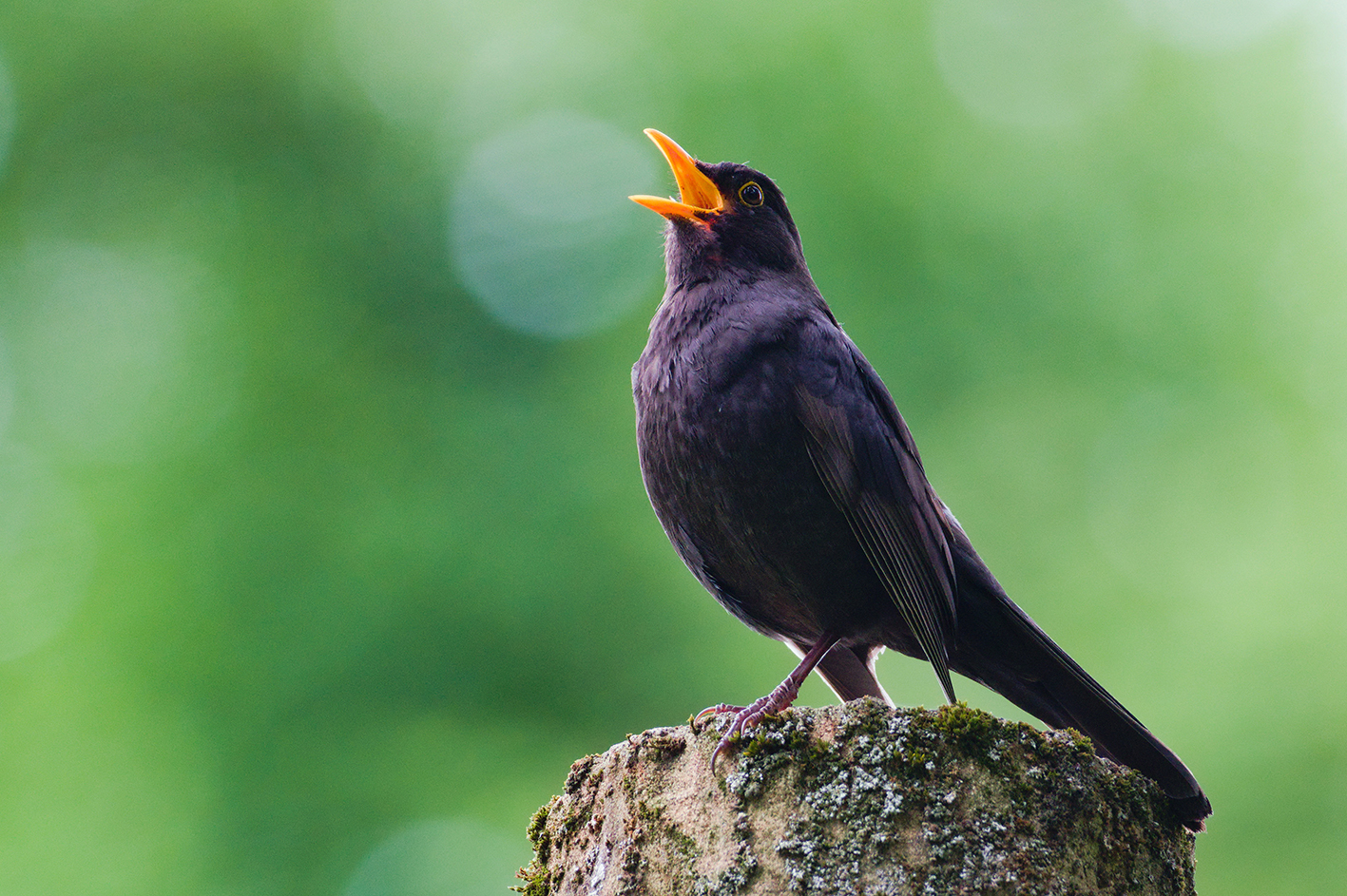
"Many birds can sing in two voices"
Spring is on its way and bird concerts can be heard in many places. Prof Franz Goller from the Institute of Integrative Cell Biology and Physiology at the Faculty of Biology is investigating how birds manage to produce this vocal diversity and which ecological and evolutionary factors play a role in this. In an interview with Christina Hoppenbrock, he explains how and why birds produce their distinctive songs.
Why do birds start singing at all after winter?
Two functions are particularly important. The first is defence of territory. Songbirds recognise their neighbours individually by their voice. When they hear them singing in the morning, they know that they don't have to try to take anything from their neighbours' territories. Secondly, the song is used to attract a mate. In many of our native songbirds, the males sing more. They establish a territory, sing and attract females in this way. I am currently studying the drumming of woodpeckers, which has a similar function.
Are birds born with their song?
Partly, partly. Many calls are innate, for example the crowing of the cock. Parrots, on the other hand, imitate sounds well. It is therefore obvious that learning plays an important role. A blackbird cannot sing properly if it has not heard and practised its typical song as a young blackbird. In North America, on the other hand, there is a wren that is a 'jazz singer': it has complicated songs with fast trills, but it does not seem to have to learn to sing. It improvises.
And how do birds actually produce their song?
They have a specific sound organ, the syrinx. In humans and other land-dwelling vertebrates, the vocal organ is located in the upper part of the trachea. In birds, however, the syrinx is located at the point where the trachea forks towards the bronchi. As a result, many groups of birds, including our native songbirds, have two vocal organs - one on each side of the fork. They therefore have two pairs of vocal folds that their brain can control independently of each other and they can sing in two voices.
Which sounds can be distinguished?
There is a range of sounds and timbres, from the characteristic whistling tones to rarer, very chaotic-sounding tones. Birds produce whistling sounds differently to us. When we purse our lips and whistle, the sound is produced by aerodynamic turbulence. Birds produce sounds through the vibration of their vocal folds. This also produces overtones, i.e. multiples of the fundamental frequency. However, a whistling tone has no overtones. This means that the birds that we perceive as whistling have to filter out the frequencies of these overtones. They do this using special structures in their trachea and mouth.
How exactly does this work?
Imagine a bottle that you blow on at the neck. The sound that is produced depends on the volume of the bottle, the size of the opening and the length of the bottle neck. The birds adjust the cavity in their trachea by moving a special bone structure, the hyoid bone. If you watch a bird singing, you will see this movement.
You sometimes wonder how birds take a breath in between - you can hardly hear any pauses.
This phenomenon was first studied in canaries. They take ultra-rapid breaths, known as 'mini breaths' in scientific jargon. A 'mini breath' lasts only twelve to 15 milliseconds. Canaries can breathe in and out up to 30 times per second in this way when singing - you can hear this as a trilling song. A student from the working group I was part of as a postdoc investigated the phenomenon in North American mockingbirds. These birds imitate the song of other birds. They can also imitate canaries, but have to take longer pauses to breathe. This is because mockingbirds are significantly larger than canaries, and their more massive chests cannot be raised and lowered as quickly.
You recently published a study on how brown-headed cowbirds produce a special sound: that of water droplets hitting a water surface. Why does a bird incorporate such sounds into its song?
Nobody knows. The selection pressure to produce a distinctive song in the midst of a choir of numerous bird species certainly plays a role. However, we were particularly interested in how this timbre is created. To do this, we used a computer model that we developed ourselves, which maps the physical parameters of bird calls and enables us to imitate the bird calls.

The trick is that it closes its vocal folds and builds up pressure for up to 40 milliseconds, which is about ten times longer than for other sounds. When the pressure is high enough, he opens them. This creates an explosive vibration, an extremely rapid increase in volume, which then slowly decreases. The starlings do this alternately with both pairs of vocal folds. The left pair has eight to ten times the volume of the right pair and therefore produces lower frequencies - it sounds like drops of water of different sizes.
During our conversation, you imitated various bird calls very convincingly. You must play an instrument or sing ...
No, unfortunately I'm very unmusical.
This article is taken from the university newspaper "wissen|leben", issue no. 2, 1 April 2026.
Original publication
Franz Goller, Brenton G. Cooper, Gabriel B. Mindlin (2025): Water-like timbral quality in birdsong arises from complex motor control of two sound sources. Current Biology, Volume 35, Issue 23, Pages 5915-5922.e2: DOI: 10.1016/j.cub.2025.10.045
Further information
- News from the University of Utah on Franz Goller’s study of the song of the brown-headed cowbirds
- Audio recording of a brown-headed cowbird (on YouTube)
- Bird-song portal ‘xeno-canto’
- Original publication in "Current Biology"
- The April issue of the university newspaper as a PDF (in German)
- All issues of the university newspaper at a glance