
Insights into the energy landscape of a ‘memristive’ material
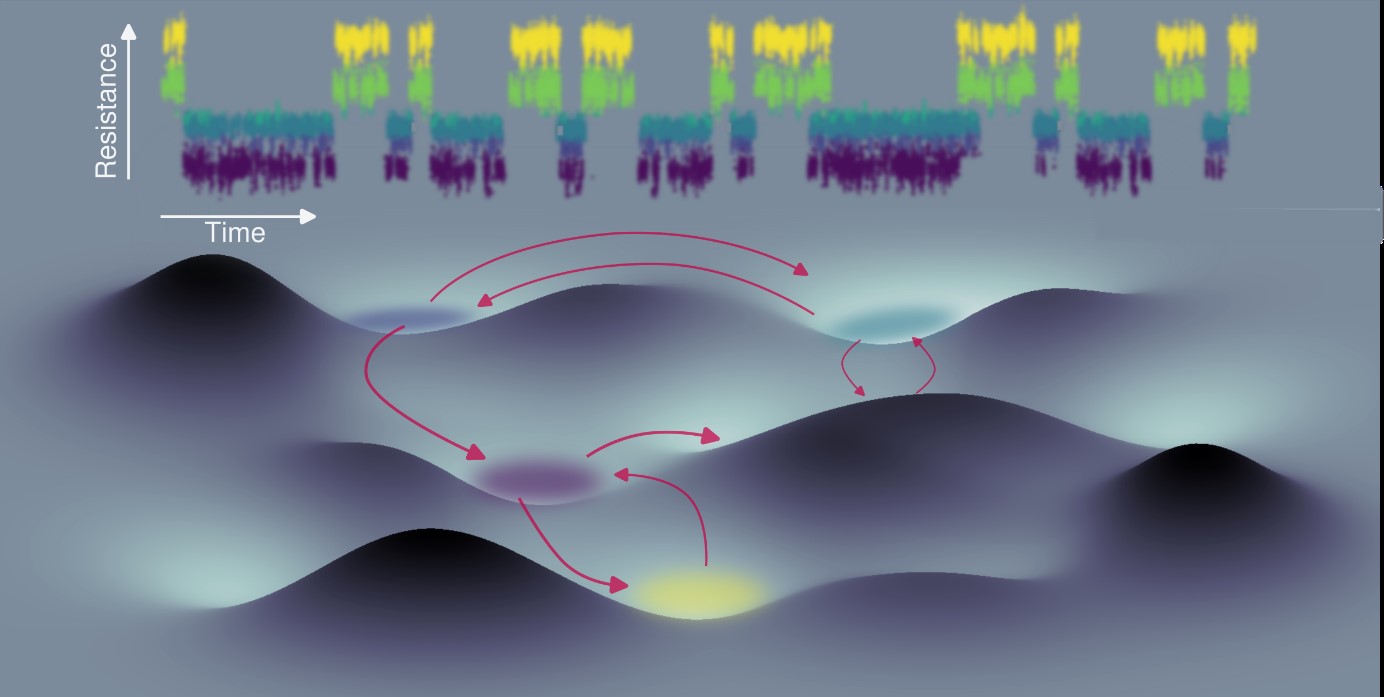
For modern data storage and new computing concepts, so-called memristive materials are of great interest because they can store information without a continuous supply of energy and because even small changes in their atomic structure lead to pronounced changes in electrical resistance. This makes it possible to create very dense networks of memory cells in which computational operations can take place directly within memory. In this way, the time- and energy-intensive transfer of data between processor and data storage can be avoided. However, this high sensitivity, which makes these materials attractive for applications, also has a downside. In a nanoscopic volume of germanium telluride, a particularly versatile material for memristive and ferroelectric applications, even slight atomic rearrangements lead to significant intrinsic noise, i.e. spontaneous changes in resistance. Using this noise, doctoral student Sebastian Walfort and Prof Martin Salinga’s team at the Institute of Materials Physics were able to derive thermodynamic quantities and map the energy landscape that governs the material’s behaviour.
Mapping an energy landscape involves describing which atomic configurations a material can adopt and how stable they are. Each configuration corresponds to a point in an imagined landscape of valleys and hills. The deeper a valley, the lower the energy and the more stable the state. To move from one state to another, atoms must cross a “pass”, or energy barrier.

The measurements revealed a wide range of transition behaviours. Many transitions involve only moderate energy barriers, but they can nevertheless be strongly hindered by a narrowing of the accessible configurations at the pass. This makes it less likely that the atoms will find the required transition pathway. As a result, transitions can be strongly suppressed despite comparatively low energy barriers. This shows that not only energy but also entropy, understood here as a measure of the number of possible atomic configurations, plays a central role in shaping the free energy landscape of germanium telluride.
The findings are relevant for fundamental understanding, but also for applications. The ability to extract thermodynamic information directly from noise opens up new ways to design memristive and neuromorphic computing devices (devices inspired by the brain). Atomic rearrangements and resistance changes could be suppressed when they interfere with computational accuracy. Alternatively, these spontaneous changes could be exploited for probabilistic computing approaches.
The researchers received financial support from the German Research Foundation (DFG) and the European Research Council (ERC).
Original publication
Sebastian Walfort, Xuan Thang Vu, Jakob Ballmaier, Nils Holle, Niklas Vollmar und Martin Salinga: A free energy landscape analysis of resistance fluctuations in a memristive device. Nature Materials; DOI: 10.1038/s41563-026-02487-9.