
‘I feel the perfect atmosphere’
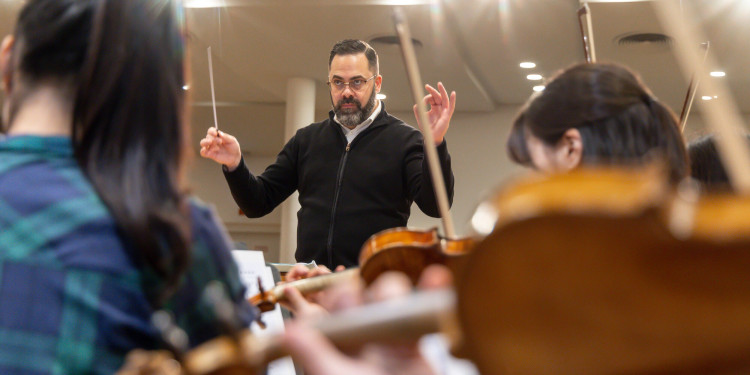
The definition is straightforward: the conductor is the leader of an orchestra. But what does that actually mean in practice? How does a conductor shape and influence the ensemble? And could things work, if necessary, even without the person waving the baton? In his interview with Norbert Robers, Miloš Dopsaj from the University of Music (FB 15) reveals how he achieves top performance and whether it is true that a conductor needs a healthy dose of self-confidence.
One of the best-known conductors, the Austrian Herbert von Karajan, who died in 1989, once said: ‘Orchestras have no sound of their own; the conductor creates it.’ Was he right?
Of course, he expressed himself rather pointedly. But a conductor who builds a new orchestra or takes over an existing one can indeed steer an ensemble in a certain direction and leave a personal stamp on it.
The profession doesn’t seem to lack self-confidence. Another conductor once said: ‘I’m not perfect, but as a conductor I’m damn close.’
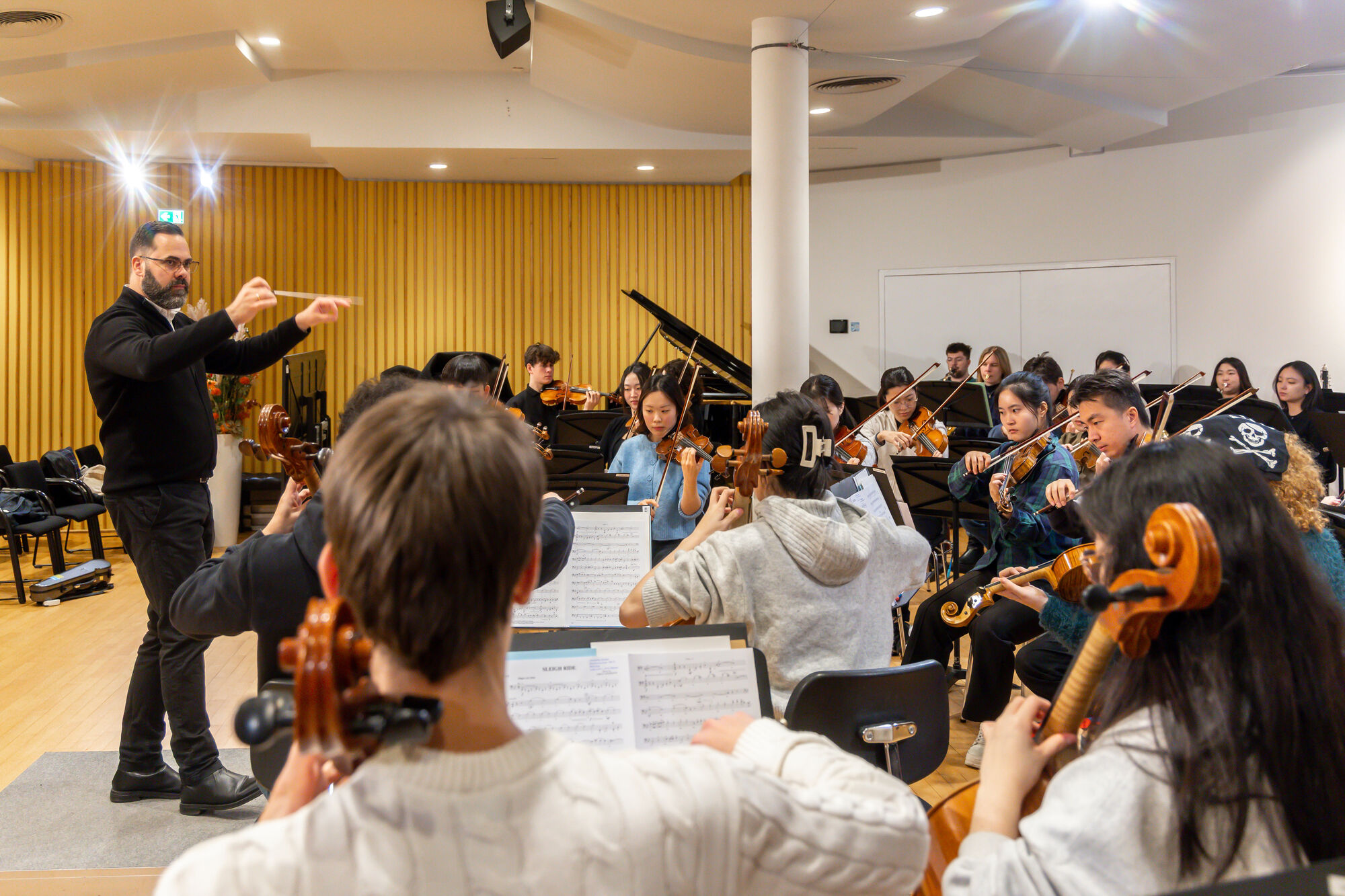
No question about it: without self-confidence, it’s impossible to fulfil such a lofty role effectively. As a conductor, you stand in front of 60 to 80 highly trained musicians, who themselves are also well endowed with confidence. But in an orchestra, it’s not the individual that counts, but the ensemble. A conductor’s task is therefore, on the one hand, to coax the best possible performance out of each individual and, on the other, to ensure that everyone works together optimally. This definitely requires a strong, mature personality.
Yes, that’s part of it too – after all, we are standing on a stage.
So is a conductor in some way like a football coach who needs a functioning team but also wants to improve each individual player?
Yes and no. It is true that a conductor has to keep an overview. But what distinguishes him from a coach is the fact that he is not standing on the touchline, but right in the middle of things.
And should the conductor fall ill right before a concert and the orchestra have to play alone, how big is the difference?
With 60 orchestra members, you might get 120 opinions about any particular section. Someone has to bring that together and make decisions. In other words, yes, even without a conductor it could be a beautiful concert. But with one, it’s much better.
As you already hinted, every musician is something of a small star. How much individuality do you allow?
It works best when every musician offers something during rehearsals. The conductor’s role is to shape these contributions into a harmonious overall structure. My goal is that we’re all happy together.
And how does this ‘shaping’ work in concrete terms? Do you communicate with the musicians by raising an eyebrow, through a particular hand movement or with a grim facial expression?
The most important thing is training, in other words, the rehearsals. These are the hours in which individual passages are practised and discussed. A conductor tells the orchestra clearly and in detail what it means when he moves the baton softly or vigorously, or when he looks at someone with a specific facial expression.
That means you have to keep all the musicians constantly in view during the concert?
Exactly. The musicians, in turn, have to ‘read’ both their music and the conductor in order to feel secure.
Do you ever give someone a wink?
As a sign of confirmation, that does happen. Body language is important anyway – which way I turn, and whether I perhaps ‘puff myself up’ to demand more volume or a forte.
And what do you do if only one of the 60 orchestra members is, in your view, constantly playing too quietly?
I’d give a hand signal, for example, that the audience wouldn’t likely notice. Or I’d wait for the millisecond of eye contact and then give the appropriate signal with a facial expression. However, a wrong note cannot be corrected by a conductor either. In a concert, it is primarily about motivation. A good conductor sends out the signal: ‘I am with you, I am not leaving you alone, even in difficult passages.’ And ideally I receive the signal back that every individual, and therefore the orchestra as a whole, is ready to go beyond themselves.
So a good conductor has to be a good motivator?
That’s certainly one of the most important qualities. In the end, I can do whatever I like with the baton – if the orchestra does not follow, the concert will not be good.
So your form on the day is also an important factor?
Exactly. And you should leave your private worries or problems outside. I expect that from every member of the orchestra as well.
You are a bassoonist. Do you pay particular attention to the bassoons during a concert?
I can’t deny this happens – at least subconsciously. But in the end, it’s the whole team that counts. That’s why our communication above all has to be clear.
Have you ever had the feeling after a concert that it was perfect?
Yes, absolutely. Although for me that does not mean that every single note was correct. What matters to me is the feeling that, as an orchestra, we have thrilled the audience. I feel this perfect atmosphere, and I draw on it for a long time.
Your tools are not only the baton, but also the score – the written overview of all the parts and notes in a work. Which is more important?
There is no first or second place. To get to know the instruments and the performers, the score is the first thing I hold in my hands. It gives me the necessary overview – like stage directions.
I see you’ve brought Tchaikovsky’s “The Nutcracker” score along with you today. It is almost as thick as a book and full of information in addition to the notes. Do you learn such scores by heart?
It is almost impossible to absorb and process all this information in seconds while conducting. That’s why it’s important to know the piece extremely well. I also make some notes in the score with a pencil, for example, when I want to highlight something …
This abundance of information reminds me of driving a car, where you also have to process many impressions at the same time and where routine helps …
That’s a good analogy. You learned to drive, and therefore you are able to drive with a certain ease. You know what to do, and I have that same self-confidence as a conductor.
Do you have special routines on the day of a concert?
In the morning there is usually the dress rehearsal, in the afternoon I look at the score again, and in the evening, there is the concert. On such a day, I think of nothing but the concert anyway, because I have to deliver top performance.
Which can make you break a sweat, can’t it?
Absolutely, sometimes you go through several shirts during a concert. It is physically demanding, sometimes for several hours, to stand upright and stay fully focused – and that with sometimes very large and complex orchestral works. At the end, you know what kind of work you’ve done. No, that’s an understatement. Quite often, at the end you’re simply exhausted. But also happy. Our profession is wonderful because it gives me so much in return.
Biography
Born in 1981 in Belgrade (Serbia), Miloš Dopsaj first completed his bassoon studies there, which he continued in 2004 at the Berlin University of the Arts, graduating with both a Diplom and a concert examination (Konzertexamen). At the age of 18, he received his first permanent position as a principal bassoonist. This was followed by permanent positions at the Belgrade National Opera and the Osnabrück Symphony Orchestra. In 2016, he transferred to the Münster Symphony Orchestra as principal bassoonist. For the past three years, he has been teaching students majoring in bassoon at the Münster University of Music and has additionally taken over the direction of the University orchestra in the winter semester.
Upcoming performances
On 15 December at 7:30pm, the University of Music invites you to the University orchestra’s Christmas concert at the Waldorf School (Rudolf-Steiner-Weg 11). Admission is free, but donations to support the orchestra’s work are welcome. The main hall has 470 seats. The first Christmas concert will take place on 13 December at 7:30pm with very limited seating capacity at the University of Music (Ludgeriplatz 1).
This article is taken from the university newspaper wissen|leben No. 8, 10 December 2025.