
Biologists reveal ancient form of cell adhesion
The cells of all animals – including humans – are characterised by their ability to adhere particularly well to surfaces in their environment. This mechanically stable adhesion enables the development of complex tissues and organs and is made possible by certain cell surface receptors called integrins. However, it is unclear how this form of cell adhesion developed over the course of evolution, as many single-celled organisms do not have integrin receptors. A team led by Prof Carsten Grashoff and doctoral student Srishti Rangarajan from the Institute of Integrative Cell Biology and Physiology at the University of Münster has now shown that the talin protein plays a central and evolutionarily conserved role in cell adhesion.
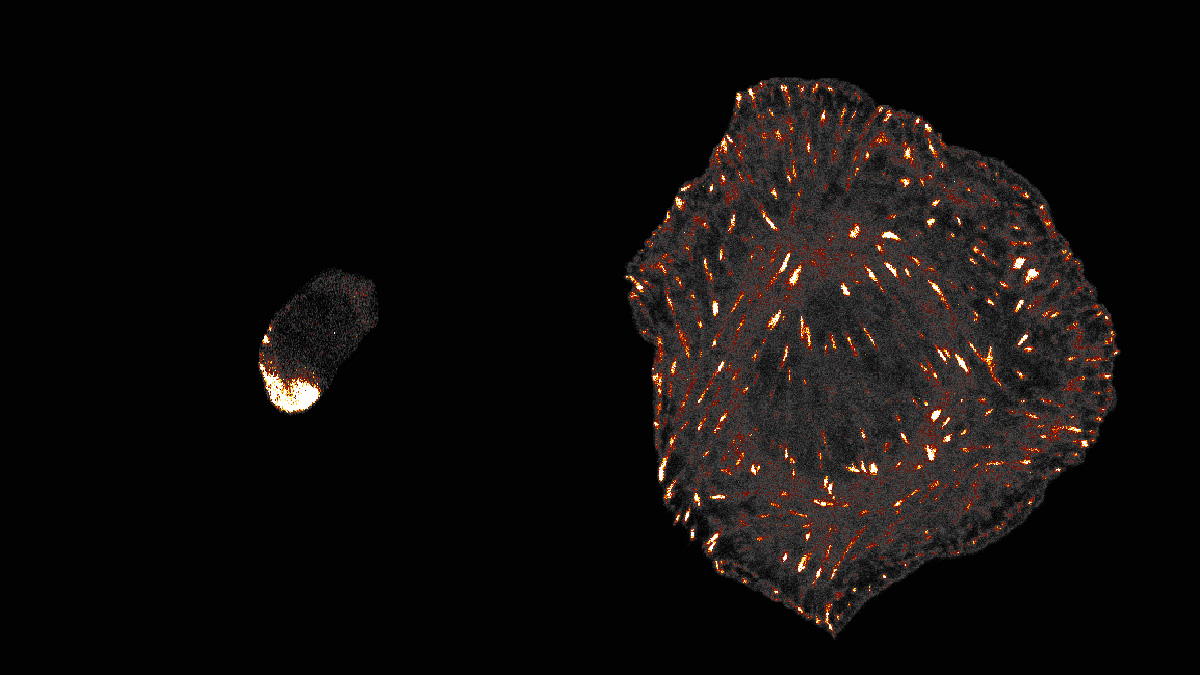
Talin is found in numerous eukaryotic (nucleus-containing) single-celled organisms and also in all animal cells. The protein ensures the mechanical attachment of integrins to the cell interior. Through comparative studies in amoebae and animal cells, the researchers have now demonstrated that talin – much like in humans – also transmits mechanical forces during cell adhesion in single-celled organisms.
Even though each molecule only bears a force of a few trillionths of a newton, this mechanical function of talin appears to be crucial for successful cell adhesion. The talin protein has a number of additional tasks in human cells that have not yet been observed in amoebae. However, the crucial mechanical role of the protein had probably already developed long before the first animals appeared.
As Srishti Rangarajan points out, “the integrin-mediated adhesion of animal cells is described in all modern textbooks on cell biology. However, it appears to be merely a specialisation of a much older cell adhesion mechanism that originated in single-celled organisms and is mediated by talin.”
The team used methods from molecular genetics, high-resolution fluorescence microscopy and molecular force microscopy measurements.
Funding
The research project was funded in part by the Volkswagen Foundation.
Original publication
Srishti Rangarajan, Lena Espeter, Hannes C.A. Drexler, Anna Chrostek-Grashoff and Carsten Grashoff (2025): Talin force coupling underlies eukaryotic cell-substrate adhesion. Nature Communications 16, 10950; DOI: 10.1038/s41467-025-67354-8