

Vader
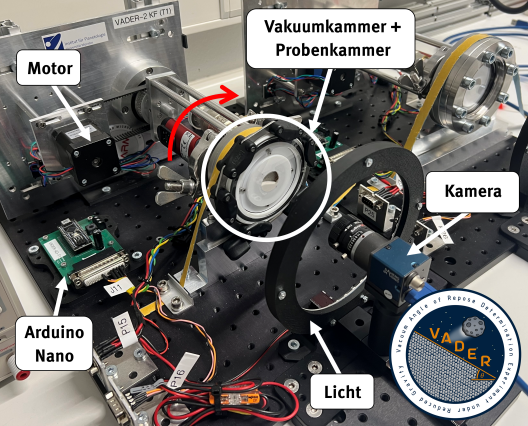
How do avalanches form on asteroids, and what are the key influencing parameters? The VADER (Vacuum Angle of Repose Determination Experiment under Reduced Gravity) experiment aims to answer these questions. Using a small rotating vacuum chamber filled with granular material, the experiment investigates how granular material avalanches depending on grain size and gravity. This is particularly interesting with regard to the asteroid Apophis and its very close flyby on Earth in 2029. It is expected that Earth’s gravity will trigger activity on the asteroid’s surface. Through our experiments, we hope to be able to make predictions about areas of potential avalanching and, through mission observations during the flyby, to learn more about granular physics under reduced gravity in general.
As grain size decreases, cohesion—i.e., the adhesive forces between particles—increases. As a result, the material avalanches at higher angles of repose. On asteroids, this cohesive behavior is further amplified by the very low gravity. To replicate these conditions as closely as possible, experiments were conducted in the Drop Tower and in the GraviTower at ZARM in Bremen to study the influence of reduced gravity on avalanching of granular material. The results showed a clear cohesion dominance under reduced gravity, leading to a higher angle of repose. Conducting the experiment in a vacuum also eliminates the influence of moisture on avalanching behavior.