

CoMPaSS
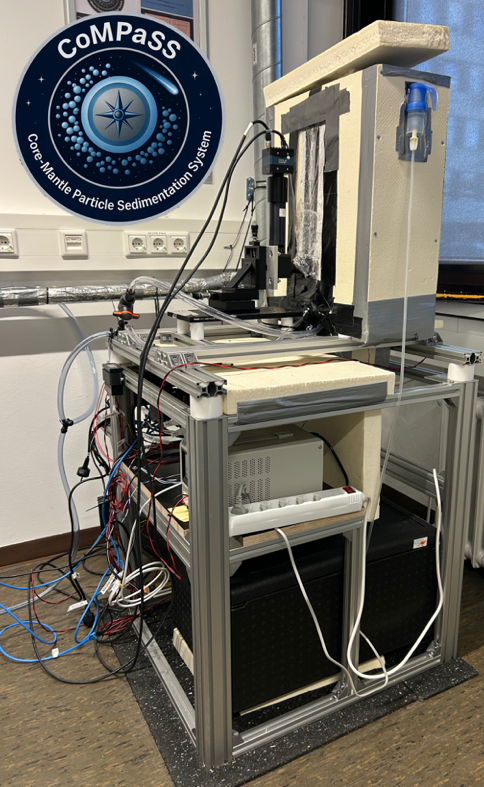
CoMPaSS (Core-Mantle-Particle Sedimentation System) is a cryogenic sedimentation chamber designed to investigate the adhesion of micrometer-sized ice particles over a temperature range from 90 K to 210 K. Using a disperser, water droplets are sprayed into a cold nitrogen atmosphere, where they freeze and subsequently sediment onto a target. The ice particles are then observed with a high-resolution optical imaging system. Furthermore, the chamber can be extended to produce and investigate core-mantle particles. This setup enables the study of the growth of fractal ice aggregates and the evolution of their structure under protoplanetary conditions. These properties play crucial role in the formation of planetesimals, comets, and other icy bodies.
The video shows the specific surface energy γ as a function of temperature over time. At low temperatures (90 K to 170 K) γ is very low. The values gradually increase with increasing temperature. Around 170 K, a change in the temperature dependence becomes apparent, resulting in a steeper increase in γ (170 K to 210 K). The attached images show sedimenting ice particles with radii on the order of 2–10 µm that undergo fragmentation. The fractal structures increase systematically with increasing temperature. The increase in γ at lower temperatures is most likely related to the surface properties of the ice particles. Above approximately 170 K, the change in slope may be associated with sintering processes, which modify the particle surfaces and contact areas. This could explain the observed increase in the size of the resulting fractal structures with increasing temperature.