
The Erasmus Program
In the framework of the Erasmus program the Department of Physics helps students in their third year of the Bachelor’s or first year of the Master’s program in finding a place for a study abroad studieren weltweit (in German). Compared to a self-organized stay abroad the Erasmus program provides both organizational and financial advantages. Erasmus students will be supported in organizational questions by the Erasmus coordinators of both their home and their host university. Furthermore, each Erasmus student obtains a mobility funding and is exempted from tuition fees at the host university.
The long-standing collaboration of the Department of Physics with partner universities in different European countries again simplifies the organization of the stay abroad. In particular, concerning the questions which courses are reasonably taken at the host university and how can these be recognized in Münster, experiences of previous Erasmus students are often helpful.
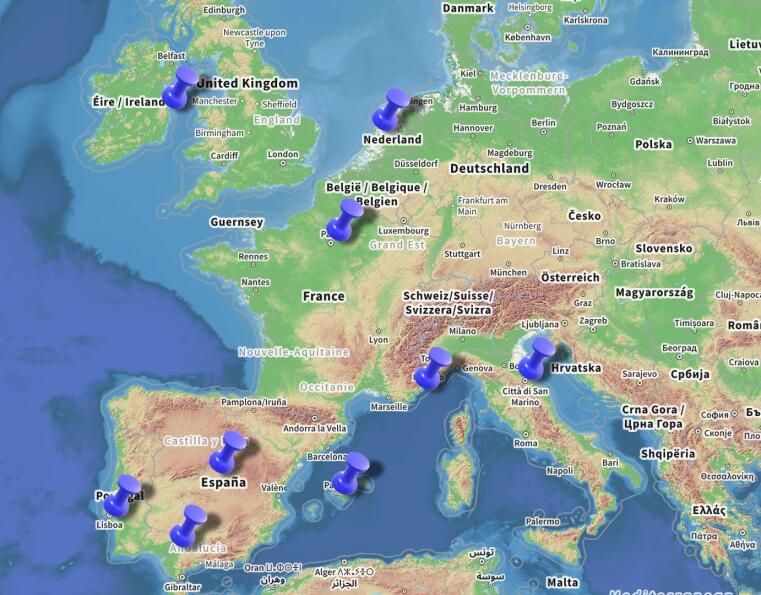
Partner universities which are regularly cooperating with the Department of Physics include:
- Paris-Saclay
- Sevilla (Here, in addition to a stay within the Erasmus program also a German-Spanish double degree program for the Master’s degree is offered.)
- Nizza
- Dublin
- Bologna
- Lissabon
- Madrid (Universität Complutense)
- Palma de Mallorca
Erasmus coordinators:
- Madrid: Prof. Dr. Michael Becken
- Paris-Sud: Prof. Dr. Anton Andronic
- Sevilla, Lissabon, Dublin, Nizza und Palma de Mallorca: Prof. Dr. Alexander Kappes
Furthermore, there are contracts with the universities in (please contact Prof. Dr. A. Kappes):
- Ankara (METU)
- Izmir
- Leiden
In exceptional cases a self-organized Erasmus stay is possible also at other European universities. The Erasmus coordinator can give his advice also in this case.
For geophysics students the partner universities in Nice, Paris-Sud, Bologna and Madrid are particularly suitable.
Information on applying for an Erasmus place can be found here.
Application
Students who are interested in a stay abroad within the framework of the Erasmus program should contact the responsible Erasmus coordinator at least one year before the start of the planned study abroad. At the Department of Physics this is
- Prof. Dr. Michael Becken for the University Complutense Madrid,
- Prof. Dr. Anton Andronic for the University Paris-Sud,
- Prof. Dr. Alexander Kappes for all other partner universities
The following registration deadlines should be met:
- 15.9. Universities Lissabon, Leiden
- 28.2. for all other partner universities
(i.e. one or half a year before the start of the study year of the planned stay abroad). The application deadlines apply to the entire academic year, i.e., both the winter and summer semesters. For example, anyone interested in an Erasmus stay in the summer semester of 2026 should submit their application by February 28, 2025, or September 15, 2024.
For the registration it is sufficient to submit the completed application form to Mrs. Mayer (Institute of Nuclear Physics, Wilhelm-Klemm-Str. 9, room 222) together with a short letter of motivation (~1 page). Please indicate several desired study locations, since especially the English-speaking universities are in great demand and the coordinators try to make a stay abroad possible for all interested students.
Organization of the stay abroad
Before the stay abroad
Once you have been accepted for a place at one of the partner universities, you must first complete the University of Münster's internal online application (you will receive the link to this from your coordinator). The completed and printed document is then submitted to the International Office.
In addition, the Learning Agreement is completed in consultation with the responsible coordinator. The Learning Agreement states which courses will be attended at the host university and to what extent these will be recognized at the home university.
During the stay abroad
The date of arrival at the host university must be recorded in the data sheet right at the beginning of the stay abroad. The departure date must also be entered on site shortly before departure. This information is necessary for the payment of the mobility grant.
Within the first month of the stay abroad, any necessary changes to the courses to be attended should also be entered in the Learning Agreements. This is done in consultation with the local coordinator.
After the stay abroad
After submitting your return data to the EU, the EU will ask you to complete an online questionnaire. You will then be informed about this.
After the stay abroad, the host university will send the Transcript of Records, which documents the academic achievements as part of the Learning Agreement. This must also be submitted to the International Office.
On the basis of the Learning Agreement and the Transcript of Records, the Dean of Studies of the department can then recognize the coursework and examinations taken.
More information can be found here.
Language courses and other offers
Even if no language certificate is usually required to apply for a place at a partner university of the Department of Physics, sufficient knowledge of the local language is absolutely essential for everyday life and participation in lectures on site. It is therefore advisable to learn the local language at an early stage or to improve your existing language skills.
Language courses
The Language Center in Münster offers language courses for this purpose. In most languages, a C-test is taken at the Language Center before registering for a course to assess the language level. It is also important to note the registration periods for the various language courses, as the Language Center's courses are usually in high demand.
Tandem program
Another way to improve your language skills is through so-called tandem programs. Here you will be matched with a tandem partner who is usually a native speaker of the language you are learning and would like to improve their German language skills. Together with your partner, you can then improve your language skills in self-organized meetings. The placement of tandem partners is also offered by the Language Center. Erasmus Münster e. V. also offers the placement of tandem partners.
Buddy Program
One of the other services offered by this association is the organization of the Buddy Programme. Here, Erasmus students who are new to Münster are assigned a contact person who can help them with problems during the settling-in phase. This program therefore also offers the opportunity to come into contact with Erasmus students as a buddy before or after your own stay abroad.
Language courses on site
The partner university usually offers language courses for Erasmus students during their studies. In addition, some partner universities offer preparatory intensive courses before the start of the academic year.
Partner universities
Italy, Bologna: Universita' di Bologna
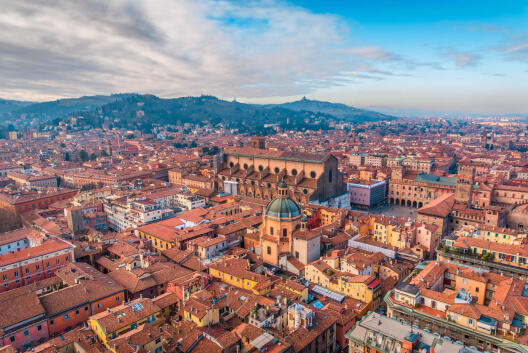
Bologna is a vibrant city of 400,000 inhabitants and 150 different nationalities, renowned for its rich history and culinary delights. Most notably, it is the home of the Europe's oldest university (1088): Alma Mater Studiorum, the highest-ranked university in Italy and a top 100 in the world for Physics, Astronomy, and Geophysics across the last five years. Two students per year from the University of Münster's Department of Physics can spend one year of study at Alma Mater's Department of Physics and Astronomy, where most of the Master courses are held in English.
The university’s esteemed history is reflected in Bologna’s medieval structures, winding streets, and the iconic Two Towers—symbolising the city's medieval past. Bologna’s vibrant student population, the second in Italy in terms of international student percentage, exemplifies its bright future. This population contributes to its lively atmosphere, which is filled with cafes, bookstores, and cultural events under its covered walkways, a UNESCO heritage. Beyond education, the city is famous for its gastronomic culture, making it a delightful destination for both scholars and tourists alike.
The winter term starts mid-end of september and teh summer term starts at end of february.
Homepage of the University: https://www.unibo.it/en
© Unknown 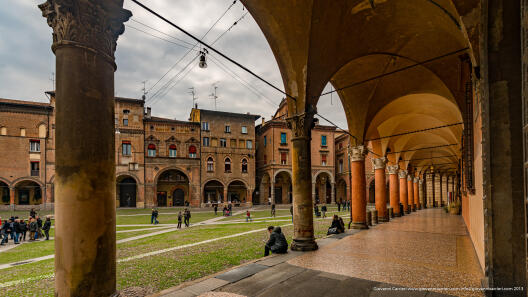
© Giovanni Carrieri France, Nice: Université de Nice – Sophia Antipolis
The University of Nice also offers two exchange places each year for students in their third or fourth year of physics at the University of Münster. This exchange is particularly interesting for students with the elective subject Nonlinear Physics or Applied Physics, as these modules are well covered in Nice.
The University of Nice is located on a mountain and can be reached from the city center of this city of 350,000 inhabitants on the Côte d'Azur in 15 minutes by bike or the new tram. A student residence is located in the immediate vicinity of the campus.
Before the semester begins, a free language course is offered for Erasmus students. During the semester, there is a paid language course for those interested, which takes place three times a week in the evenings.
The classes are held in French (Bachelor) and mostly English (Master).
The semester starts typically at the end of August/start of September (winter term) and end of January (summer term).
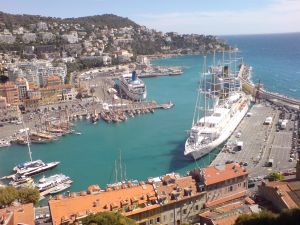
Nice – View of the harbor from Colline de Château© Uni MS/Fachbereich Physik 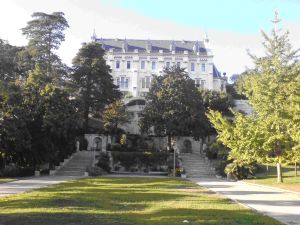
Nice – Castle on the campus of the fac de science© Uni MS/Fachbereich Physik Homepage of the University of Nice: https://univ-cotedazur.eu
France, Orsay: Université Paris-Saclay
The natural sciences department of the Université Paris-Saclay is located on the campus in Orsay, a small town with approximately 15,000 inhabitants, 20 km south of Paris. Thanks to excellent rail connections with the RER B, the city center of Paris can be reached in 35 minutes.
The long-standing and successful exchange program between the university's physics department and the “Physique et Applications” (Physics and Applications) department at Paris-Sud University offers up to six students the opportunity to spend their third year of study in Orsay each year.
For the duration of their stay, students can be accommodated in one of three student residences, some of which are located directly on campus or nearby. A one-week language course is offered at the beginning of September before the semester starts. Erasmus students can also take part in a language course once a week during the semester.
The lectures, exercises, and practicals are held in French and cover the compulsory program for the 5th and 6th semesters in Münster, with the exception of the subfield “Nuclear and Particle Physics.” An optional two-month internship at the end of the summer semester with a final presentation can be credited as a bachelor's thesis. An English-language master's program is now also offered.
Start of semester: September (autumn term), January/February (spring term)
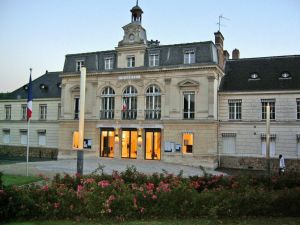
Orsay – Mairie© Uni MS/Fachbereich Physik 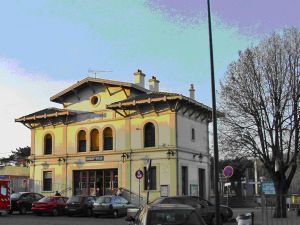
Orsay – RER station© Uni MS/Fachbereich Physik Homepage der Uni Paris-Saclay: universite-paris-saclay.fr
Homepage des Département de Physique: www.phys.universite-paris-saclay.fr/
Information brochure for students: link
Information about the semester, and application dates: https://www.universite-paris-saclay.fr/en/admissions/international-students/study-period-universite-paris-saclay-exchange-programme-erasmus-or-bilateral-agreementIreland, Dublin: Dublin Institute of Technology
As part of the Erasmus program, four students can spend an academic year in the Irish capital at the Dublin Institute of Technology (DIT), which was founded in 1978. Courses are taught in English, and language courses at various levels are offered during the semester.
The university is located in Dublin city center and is easily accessible by public transport. Accommodation cannot be arranged through the university, but information on how to find private accommodation can be found on the website.
Begin of Semester: Middle of September (autumn term), end of January (spring term).
DIT homepage: www.dit.ie
Homepage of the DIT Physics Department: physics.dit.ieSpain, Seville: Universidad de Sevilla
Seville is Spain's fourth largest city with a population of around 700,000. Thanks to an exchange agreement with the University of Seville, the country's second largest university, three students from the Department of Physics at the University of Münster can spend their third year of study in this southern Spanish city, which enjoys consistently good weather. Most courses are taught in Spanish.
In addition to the lectures and exercises in physics, a language course is held twice a week at the Language Center, which is conveniently located right next to the Physics Institute.
The semester in Seville begins at the mid/end of September (autumn term) or end of January (spring term), but it is advisable to arrive earlier, as Erasmus students have to find their own accommodation. However, due to the large number of rooms available in shared apartments, finding a room should not be too difficult if you start looking early enough.
Start of Semester: Mid/End of September (autumn term), End of January (spring term).
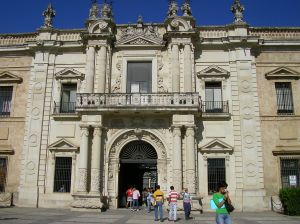
Seville – Main university building© Uni MS/Fachbereich Physik 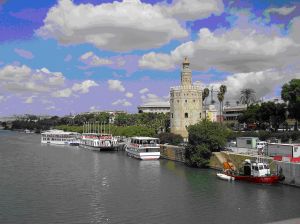
Seville – Torro del Oro and Guadalquivir© Uni MS/Fachbereich Physik University of Seville website: www.us.es
Physics Faculty website: fisica.us.esIn addition to the Erasmus exchange program, students have the opportunity to earn a German-Spanish double degree. As part of the program, students spend their fourth year of study (1st–2nd master's semester) in Seville and then continue their studies in Münster. After successfully completing their master's degree in Münster, they receive
- a Master of Science (M.Sc.) in Physics from the University of Münster and
from the University of Seville, depending on their specialization,
- a Máster Interuniversitario en Física Nuclear,
- a Máster Universitario en Microelectrónica, or
- a Máster Universitario en Ciencia y Tecnología de Nuevos Materiales.
Portugal, Lisbon: Universidade de Lisboa
Lisbon is a vibrant metropolis with around 550,000 inhabitants and a strong international character, known for its maritime history, mild climate, and cultural diversity. Above all, however, it is an important center of science in Portugal and home to the Universidade de Lisboa, one of the country's most renowned universities.
The university's long academic tradition is combined in Lisbon with the special character of the city, which is reflected in its historic districts, the narrow streets of Alfama, and the striking viewpoints over the Tagus River. The large and active student body shapes the cityscape and contributes to an open, international atmosphere. Cafés, bookstores, and cultural events define life around the university campuses and make Lisbon an attractive place for study and research. This is complemented by the proximity to the sea, the famous Portuguese cuisine, and the diverse cultural offerings that make the city particularly appealing to both scientists and visitors alike.
The Faculdade da Ciencias da Universidade de Lisboa (FCUL) recuires incoming Ersamus students to at least have an English level of B1 and a Portuguese level of A2. The Bachelors classes will be taught in Portuguese, meanwhile in the Master classes there is the option to hold the lectures in English.
Start of Semester: 2nd week of September (autumn term), 2nd/3rd week of February (spring term).
Homepage Universidade de Lisboa: ulisboa.pt
Homepage Faculty of Physics: fcul
Spain, Madrid: Universidad Complutense
With over three million inhabitants, Madrid is one of Europe's largest cities and is characterized by a unique blend of historical depth and modern urbanity. As the capital of Spain, it is a central hub for politics, culture, and science. The Complutense University of Madrid occupies a prominent position in this environment: it is one of the country's most traditional universities and remains an important driving force for research, academic exchange, and social debate.
University life in Madrid is closely intertwined with everyday life in the city. The spacious campus of the Complutense University forms its own academic space, while at the same time the urban environment with its neighborhoods, squares, and cultural institutions enriches everyday student life. Students from all over the world shape social and cultural life and contribute to an open, international atmosphere. Discussion groups, exhibitions, concerts, and a diverse range of gastronomic offerings make Madrid a lively place of learning and encounter. The combination of academic excellence, cultural density, and Mediterranean lifestyle makes the city particularly attractive for study, research, and international coexistence.
Start of Semester: Beginning of September (autumn term), End of January (spring term).
Homepage of the University: https://www.ucm.es/
Homepage of the physics faculty: https://fisicas.ucm.es/
Spain, Palma de Mallorca: Universitat de les Illes Balears
With around 420,000 inhabitants, Palma de Mallorca is the economic, cultural, and administrative center of the Balearic Islands. The city combines a long history shaped by diverse cultural influences with a modern urban infrastructure. In addition to its importance as a tourist attraction, Palma has also established itself as an important center of education and science on the island in recent decades. The Universitat de les Illes Balears (UIB) plays a central role in this, making a significant contribution to research, teaching, and international exchange.
Academic life in Palma is closely linked to the special character of the city and its surroundings. The proximity to the Mediterranean Sea, the mild climate, and the historic old town with its squares, markets, and cultural institutions shape the everyday life of students and researchers. University activities are complemented by a diverse cultural offering, ranging from museums and concerts to literary and social events. This combination of academic work, urban life, and Mediterranean surroundings makes Palma de Mallorca an attractive place for study, research, and international encounters.
The winter term starts typically in september and the summer term starts in february.
The lectures in the masters program are held in English, meanwhile the bachelor classes are held in Spanish/Catalan!
Homepage of the university: https://www.uib.eu/
Homepage of physics faculty: https://dfs.uib.es/