
Many physical systems obey reciprocal interactions at the most fundamental level: when two objects interact, the force exerted by one on the other is equal and opposite, as required by Newton’s third law. This reciprocity is deeply embedded in equilibrium statistical physics and is closely tied to conservation laws, energy balance, and time-reversal symmetry.
However, a growing number of active systems of current interest do not satisfy this assumption. In these systems, interactions can be nonreciprocal, meaning that one degree of freedom affects another without a corresponding back-action of equal strength. Such behavior appears naturally in nonequilibrium settings, including active matter, chemically driven systems, and certain biological and synthetic materials.
In a recent article published in SciPost Physics, a Diamond Open Access journal, Dr. Kristian Blom and Prof. Uwe Thiele from the Institute of Theoretical Physics at the University of Münster, together with Prof. Aljaž Godec from the University of Freiburg, investigate how such nonreciprocal interactions can be described within a coarse-grained field-theoretical framework.
From microscopic dynamics to field equations
The central goal of their work is to derive effective dynamical equations for two interacting fields starting from microscopic models. Field theories are widely used to describe collective behavior in complex systems, but their structure is often postulated on symmetry grounds rather than derived from underlying particle dynamics.
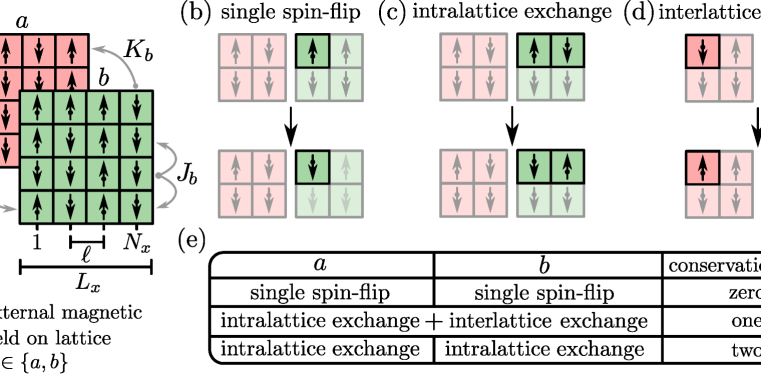
Here, the authors explicitly construct the macroscopic equations by coarse-graining microscopic models with nonreciprocal couplings. This approach clarifies which terms are allowed, how nonreciprocity enters the equations, and how it modifies the system’s large-scale behavior.
The role of conservation laws
An important organizing principle in the paper is the presence or absence of conservation laws, such as conservation of particle number or density. Conservation laws strongly constrain the form of dynamical equations and influence how disturbances propagate through a system.
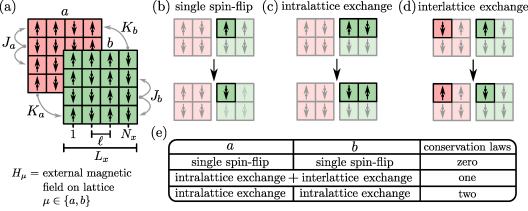
The authors analyze three distinct cases: systems with no conserved quantities, systems with one conserved field, and systems with two conserved fields.
Each case leads to a different class of dynamical behavior. The study shows that nonreciprocity interacts with conservation laws in nontrivial ways, producing effects that do not occur in equilibrium systems, such as persistent currents or unconventional instabilities.
Implications for nonequilibrium physics
By providing a controlled microscopic derivation, the work helps place phenomenological models of nonreciprocal dynamics on firmer theoretical ground. This is particularly relevant for the study of active and driven systems, where detailed balance is violated and traditional equilibrium concepts no longer apply.
The framework developed in the paper can be used as a starting point for analyzing pattern formation, collective motion, and stability in a wide range of nonequilibrium systems. More broadly, it contributes to ongoing efforts to classify and understand universal features of nonequilibrium dynamics beyond the constraints of reciprocity.
Conclusion
This study demonstrates how nonreciprocal interactions emerge naturally at the macroscopic level from simple microscopic rules, and how their effects depend crucially on conservation laws. By bridging particle-level dynamics and field-theoretic descriptions, the work advances our theoretical understanding of nonequilibrium systems with nonreciprocal interactions.
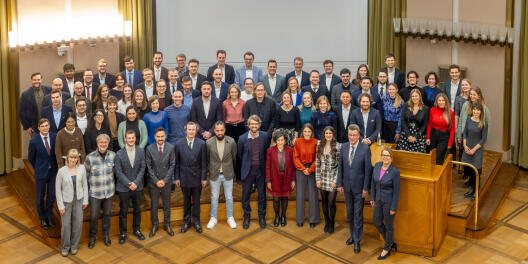
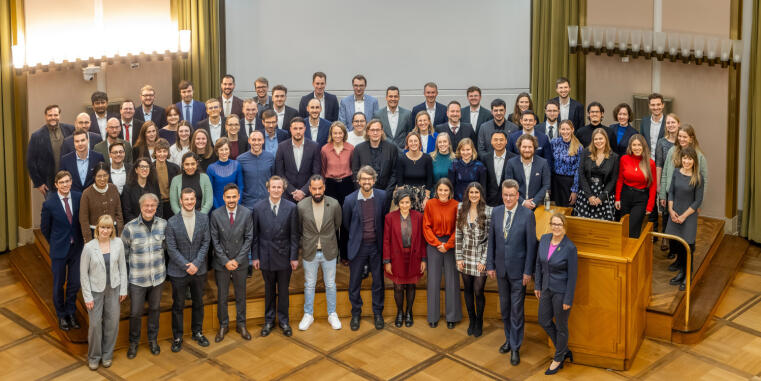
On Friday (5 December), the Rectorate of the University of Münster honoured the best doctoral theses of 2025. Among the theses are two from the nonlinear physics research groups, for which we would like to congratulate Thomas Seidel (Gurevich research group) and Tobias Wand (Thiele research group).
A total of 122 young scientists received the highest possible grade of ‘summa cum laude’ for their work. In their honour, the Rectorate hosted a reception in the auditorium of the castle and joined in this ‘highest praise’. ‘We are proud to honour such a large number of successful graduates. This is proof that the University of Münster trains excellent young scientists across its entire range of subjects,’ emphasised Rector Prof. Dr Johannes Wessels. ‘With the topics and content of their work, they are providing significant impetus in their fields of research and thus contributing to the further development of the university's research profile.’ A total of around 750 young scientists obtain their doctorates at the University of Münster each year.
With two articles in renowned research journals, Alina Steinberg bids farewell to the Institute of Theoretical Physics after six successful years.
In addition to the close succession of publication dates, one thing in particular is surprising: the two papers deal with completely different fields of research!
In the article ‘Localised states in dipolar Bose-Einstein condensates: To be or not to be of second order’, whose title Shakespeare would undoubtedly have liked, she addressed the question of phase transitions in Bose-Einstein condensates. The surprising finding that is published in Physical Review Research: although at first glance it appears that second-order phase transitions occur, bifurcation analysis shows that stable phase coexistence and thus a first-order phase transition is present.
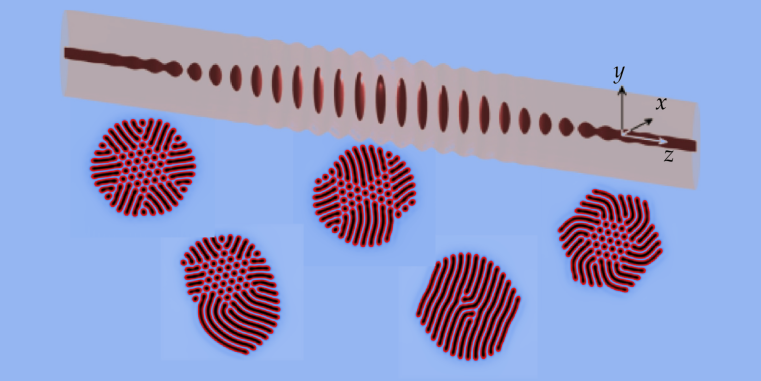
In contrast, in the article ‘Motility-induced crystallisation and rotating crystallites’, published in the journal Physical Review Letters, Alina Steinberg and her co-authors dealt with the theoretical description of self-propelled particles using active phase-field-crystal models. The fact that these systems are not subject to the classical laws of equilibrium thermodynamics can lead to astonishing effects: in addition to various forms of static phase coexistence, rotating crystals appear and, if you look very closely, some that wave goodbye...
We wish Alina all the best for for her future!
Publications:
A. B. Steinberg, F. Maucher, S. V. Gurevich, and U. Thiele, Localized states in dipolar Bose-Einstein condensates: To be or not to be of second order, Physical Review Research 7, 10.1103/13k1-rxmw (2025).
M.P. Holl*, A. B. Steinberg*, M. te Vrugt, and U. Thiele, Motility-induced crystallization and rotating crystallites, Phys. Rev. Lett. 135, 158301 (2025).
*shared first authorship