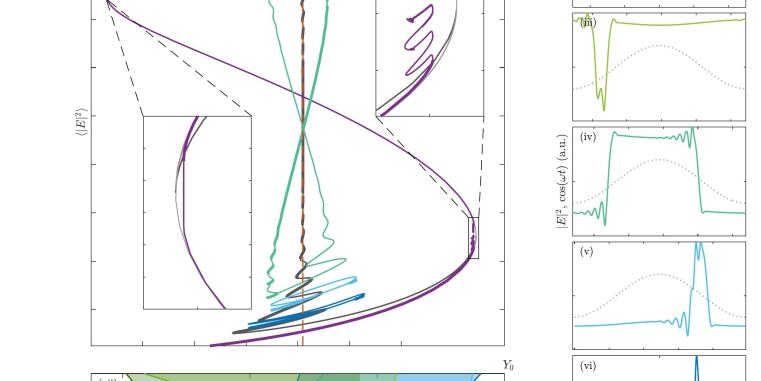
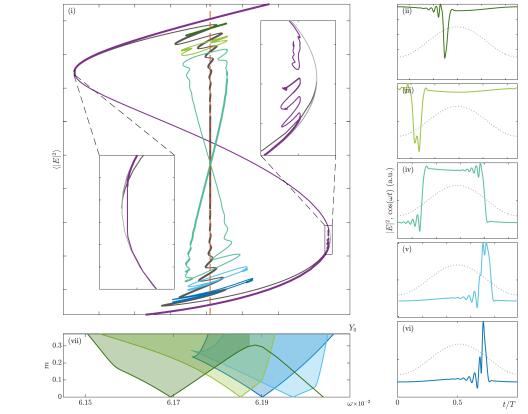
We are delighted to announce that our latest paper, "Impact of phase modulation on the dynamics of temporal localized structures in injected Kerr microcavities," has been published in Chaos: An Interdisciplinary Journal of Nonlinear Science and selected as an Editor's Pick, recognizing its significance and broad interest to the nonlinear dynamics community. This achievement is especially rewarding as the work builds directly on the master thesis of Marc Hunkemöller, highlighting the successful continuation of research from graduate studies into a high-impact publication.
Marc Hunkemöller, Thomas G. Seidel, Julien Javaloyes, Svetlana V. Gurevich; Impact of phase modulation on the dynamics of temporal localized structures in injected Kerr microcavities. Chaos 1 July 2026; 36 (7): 073136. DOI: https://doi.org/10.1063/5.0332806
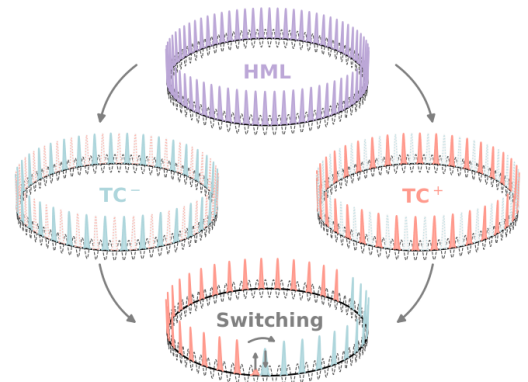
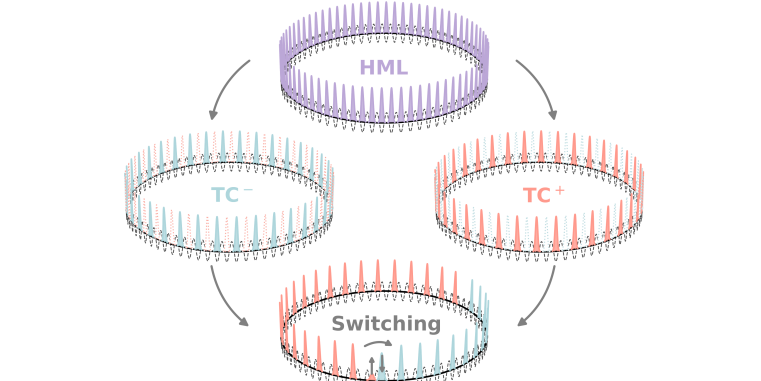
As part of an international collaboration with the Universitat de les Illes Balears and the University of Auckland, the group of Prof. Svetlana Gurevich has published its joint research in the renowned journal Phys. Rev. Letters. The study combines theoretical and experimental efforts which were led by the two PhD students, Elias Koch (Münster) and Ruiling Weng (Palma), respectively. It demonstrates for the first time that a semiconductor laser operating in the multi-pulse mode-locked regime can spontaneously reorganize its emission into a new dynamical state. Instead of producing evenly spaced pulses, the laser undergoes a sharp transition and begins emitting pulses at half the original repetition rate, effectively “skipping” every other pulse. This behavior is a clear signature of a discrete time crystal, a phase of matter that breaks the time-translation symmetry of the driving system. Time crystals were long considered impossible and have only recently been observed in highly controlled and often complex experimental platforms. A key advance of this work is that the phenomenon emerges in a simple, tunable, and robust laser system, making it considerably more accessible than previously demonstrated implementations. Beyond the period-doubling behavior, the system reveals an additional layer of complexity: two equivalent chiral states can coexist, forming distinct temporal patterns. These switching states are separated by sharp boundaries analogous to domain walls in conventional crystals (c.f. illustration). The findings not only provide new insight into how complex laser systems self-organize in time, but also open new perspectives for future applications. Time-crystal dynamics in lasers could enhance ultra-precise timing technologies, improve frequency-comb generation (with applications in spectroscopy, metrology, and GPS), and provide new tools to control light in advanced photonic devices.
R. Weng, E. R. Koch, J. Yelo-Sarrión, J. Batle, N. G. R. Broderick, J. Javaloyes, and S. V. Gurevich, "Discrete Time Crystals in Actively Mode-Locked Lasers", Physical Review Letters 136(19), 193801 (2026).
DOI: 10.1103/k1cn-ngy6
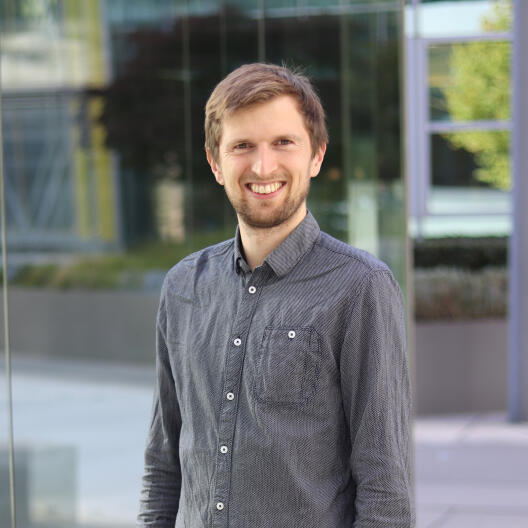
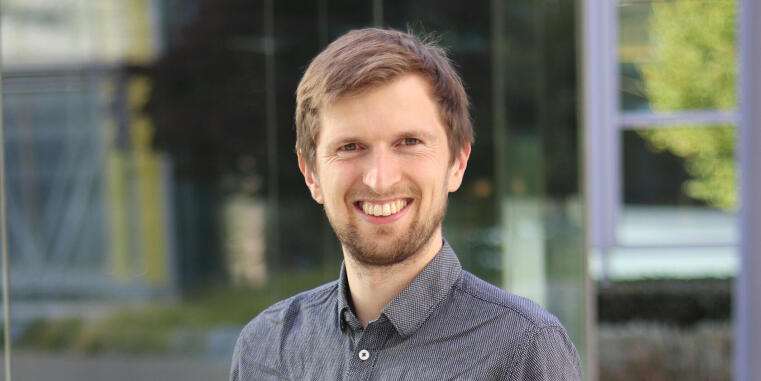
Physicist Dr. Thomas Seidel has been awarded the Infineon Doctoral Prize 2026, endowed with 3.000 euros, for his dissertation at the University of Münster, which was graded “summa cum laude.” This award for outstanding doctoral achievements is presented annually by the Department of Physics in collaboration with Infineon AG. Thomas Seidel's dissertation is relevant to modern photonics.
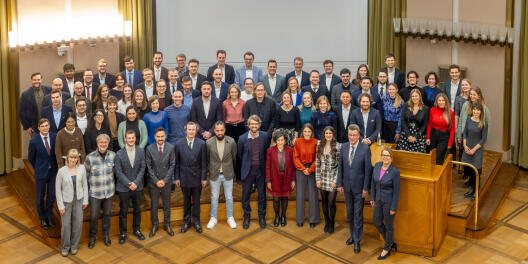
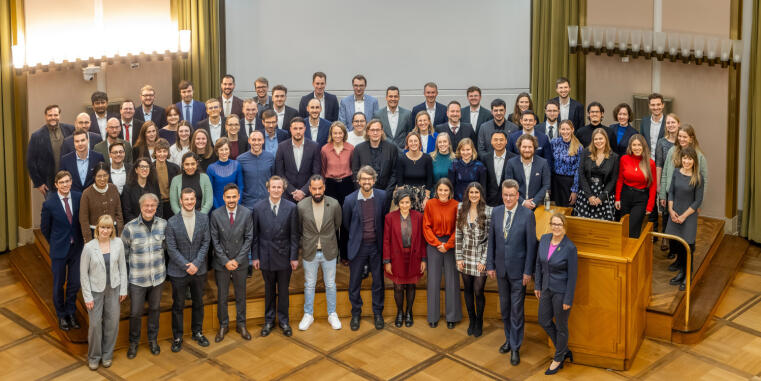
On Friday (5 December), the Rectorate of the University of Münster honoured the best doctoral theses of 2025. Among the theses are two from the nonlinear physics research groups, for which we would like to congratulate Thomas Seidel (Gurevich research group) and Tobias Wand (Thiele research group).
A total of 122 young scientists received the highest possible grade of ‘summa cum laude’ for their work. In their honour, the Rectorate hosted a reception in the auditorium of the castle and joined in this ‘highest praise’. ‘We are proud to honour such a large number of successful graduates. This is proof that the University of Münster trains excellent young scientists across its entire range of subjects,’ emphasised Rector Prof. Dr Johannes Wessels. ‘With the topics and content of their work, they are providing significant impetus in their fields of research and thus contributing to the further development of the university's research profile.’ A total of around 750 young scientists obtain their doctorates at the University of Münster each year.