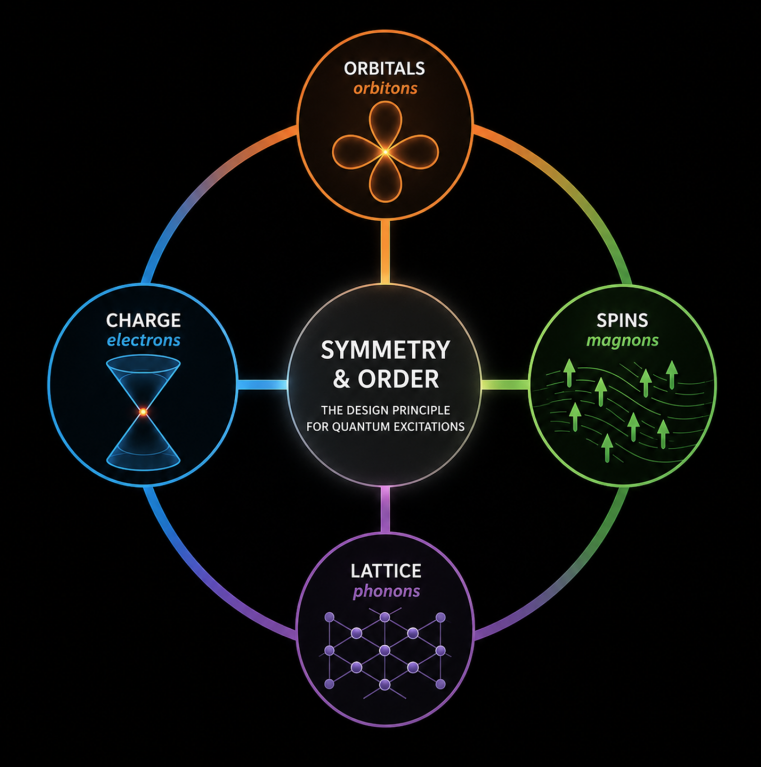

Symmetry, order, and collective quantum excitations
How does the symmetry of matter shape its quantum excitations? Our group explores this question across the hierarchy of quantum degrees of freedom in condensed matter: from electrons and orbitals to spins and lattice vibrations.
We are particularly interested in situations where symmetry and order give rise to new forms of collective behavior. Magnetic order, orbital order, crystal symmetry, and their interplay can imprint characteristic structures on quantum excitations, producing phenomena that have no simple counterpart in conventional materials. A central theme of our research is therefore to use symmetry as a design principle for quantum excitations.
A major focus is on magnons, the collective excitations of magnetic order. We study their topology, spin polarization, interactions, and transport, ranging from magnon Chern insulators and Weyl points to interaction-induced topology, magnon decay, and hybridization between different many-body sectors.
More recently, we investigate how altermagnetism and related forms of unconventional magnetic order reshape collective excitations. We have shown how orbital order can itself generate altermagnetism, and how its characteristic momentum-space spin textures can appear not only in electronic bands but also in magnons and other collective modes. This includes spin-split magnons, collective spin-demon modes, and unconventional magnetic responses.
We extend these ideas beyond magnetism. Phonons can inherit the symmetry and topology of magnetic excitations through magnon–phonon hybridization, leading to unconventional angular-momentum textures of lattice vibrations. Likewise, coupling magnons to plasmons creates new hybrid quasiparticles whose topology emerges from the interaction between electronic and magnetic degrees of freedom.
An overarching goal is to understand how different quantum degrees of freedom communicate with one another. Hybridization, interactions, and symmetry can transform the character of an excitation: from a magnon into a mixed spin-multipolar quasiparticle, from a phonon into a chiral magnon–phonon hybrid, or from separate electronic and magnetic modes into a topological magnon–plasmon excitation.
Thus, rather than treating electrons, spins, orbitals, and phonons as separate sectors, we seek the unifying principles that govern their collective dynamics. Our research combines symmetry analysis, analytical quantum many-body theory, microscopic model building, and numerical approaches to uncover new quasiparticles, unconventional forms of order, and new manifestations of topology in quantum materials.