PharMSchool Final Symposium January 16, 2026
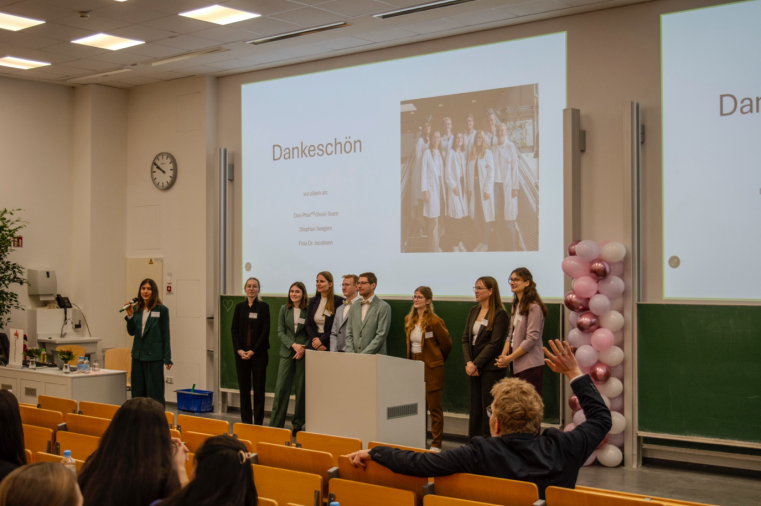
This year once again, the PharMSchool Symposium opened the stage to curious minds and dedicated young scientists. In their presentations on the topic of “widespread diseases,” the students showcased the results of two years of intensive work following their undergraduate studies, offering insights into projects that ranged from initial ideas to concrete solution approaches. The focus was not only on academic content, but above all on initiative, creative thinking, and the courage to tackle complex challenges.
The fact that the path to a convincing result is rarely straightforward became particularly evident in the laboratory work: failed experiments, unexpected results, and the resulting frustration are just as much a part of the learning process as eventual success. These experiences are precisely what made the 24th PharMSchool Symposium more than just a presentation event. It provides a vivid and realistic preview of professional life, where flexibility, perseverance, and the ability to solve problems independently are required on a daily basis—whether in a pharmacy, in industry, or on the path toward a doctoral degree.
Event and Presentations
As in previous years, the event was opened with welcoming remarks by Professor Dr. Klaus Langer, Director of the Institute of Pharmaceutical Technology and Biopharmaceutics and spokesperson of the PharMSchool. In his address, he emphasized the importance of a research-oriented teaching format for a contemporary pharmaceutical education and set the tone for the diverse program ahead. Following this, Dr. Oliver Schwalbe, representative of the Apothekerkammer Westfalen-Lippe, addressed the audience. He underlined the relevance of scientific competencies for future professional practice and highlighted the importance of commitment, support for young professionals, and professional exchange within the profession and among its future members. Professor Dr. Ulrike Weyland, Vice Rector for Studies and Teaching at the University of Münster, acknowledged the students’ dedication as well as the innovative teaching structure of the PharMSchool. In his role as Deputy Chair of the Deutsche Pharmazeutische Gesellschaft (DPhG), Professor Dr. Georg Hempel took the opportunity—via Zoom—to emphasize the importance of the DPhG. He illustrated why engagement in the professional society extends far beyond formal membership and stressed the particular value of professional exchange, scientific networking, and active participation in shaping pharmaceutical research and teaching. The symposium was moderated by students Kim Josefin Becker and Christin Hehmann, who guided the audience through the program in a structured and confident manner. Their moderation connected the individual program items seamlessly and contributed significantly to the consistently positive atmosphere throughout the day.
A special scientific framework was provided by the plenary lectures of distinguished guest speakers: Professor Dr. Theo Dingermann from Goethe University Frankfurt delivered a lecture entitled "Vaccination Against Cancer? Anything but a Foregone Conclusion.” He addressed the challenges and prospects of modern oncological vaccination strategies. In a clear, well-founded, and forward-looking presentation, he outlined the potential role innovative vaccination strategies could play in oncology—an issue that attracts considerable interest not only medically but also socially.
Offering a deliberate shift in perspective, Dr. Matthias Burghart from the Max Planck Institute for the Study of Crime, Security and Law in Freiburg presented “The Dark Side of Personality: Psychopathy and Antisocial Behavior.” His talk provided fascinating insights into a highly topical field of research and impressively demonstrated how diverse and interdisciplinary scientific questions can be. The subsequent discussion revealed strong audience engagement, reflected in numerous questions and thought-provoking contributions.
At the core of the symposium were the students’ project presentations focusing on common widespread diseases. Projects addressed diabetes mellitus, gastrointestinal diseases, depression, obesity, hypercholesterolemia, thyroid disorders, hypertension, as well as headaches and migraine. The students presented their findings in oral presentations and poster sessions, engaging in in-depth discussions with the expert audience. The thematic emphases proved to be as diverse as they were distinctive - ranging from natural science-analytical approaches to practice-oriented and creative concepts.
Implementation and Award Ceremony
Throughout the entire project phase, the PharMSchool projects were closely supervised and actively supported by the coordination team, consisting of Dr. Frauke Weber and Dr. Stefan Esch. The dedicated guidance provided by the respective mentors also played a crucial role in enabling the projects to be fully developed and successfully implemented.
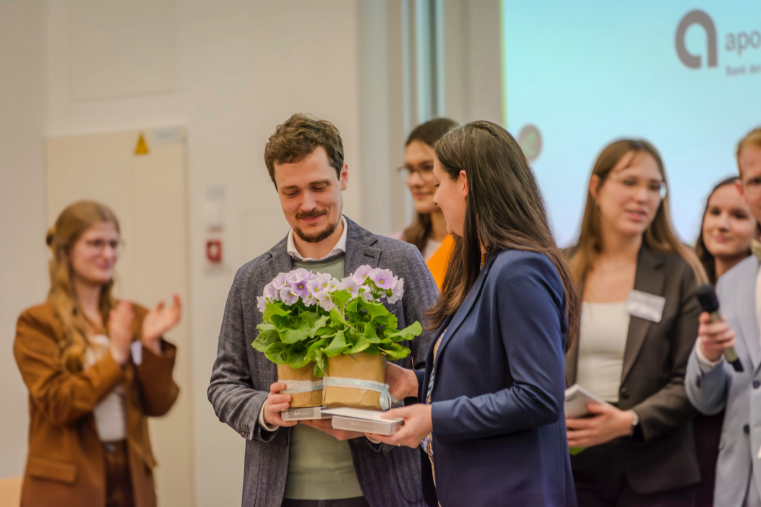
The highlight—and at the same time the conclusion—of the event was the award ceremony honoring the two most outstanding posters and the best presentation. The jury, represented by Dr. Frank Begrow and Dr. Jandirk Sendker, faced no easy decision. The award for best presentation was presented to the Diabetes mellitus group. In their project, the students sought to reduce the characteristic fish-like odor of metformin by modifying the tablet formulation, thereby improving patient acceptance of the medication. Their approach demonstrated that even persistent odor-related challenges can be addressed through pharmaceutical creativity and may provide valuable starting points for future development. The two poster awards went to the Hypertension group and the Obesity/Hypercholesterolemia group. Within the field of clinical pharmacy, the Hypertension group investigated how measurement errors in blood pressure determination affect the recorded values. Through practice-oriented blood pressure measurements, they clearly demonstrated the extent to which incorrect measurement techniques can influence results—and consequently the interpretation of blood pressure readings. The Obesity and Hypercholesterolemia group focused on the practical relevance of the recommended 8–12 hour fasting period prior to laboratory assessment of blood lipid levels. To examine this question, the students conducted a self-experiment. Their findings showed that total cholesterol levels depend not only on the time elapsed since the last meal, but also significantly on the time of blood sampling.
Acknowledgments
Special thanks are extended to the sponsors, whose commitment made a decisive contribution to the success and realization of the event. During the breaks, participants not only had the opportunity to engage in professional exchange with the attending sponsors, but also to take a closer look at the project posters and discuss content, methods, and results in greater depth. Adequate catering was also provided, creating an inviting atmosphere for conversation and networking among participants. The 24th PharMSchool Symposium once again impressively demonstrated how competently students approach scientific questions and present their findings at a high professional level. The event thus makes an important contribution to fostering young pharmaceutical professionals and strengthening scientific exchange. Given the diversity of contributions, the dedicated involvement of all participants, and the positive feedback received, there is already great anticipation for the next PharMSchool Symposium.