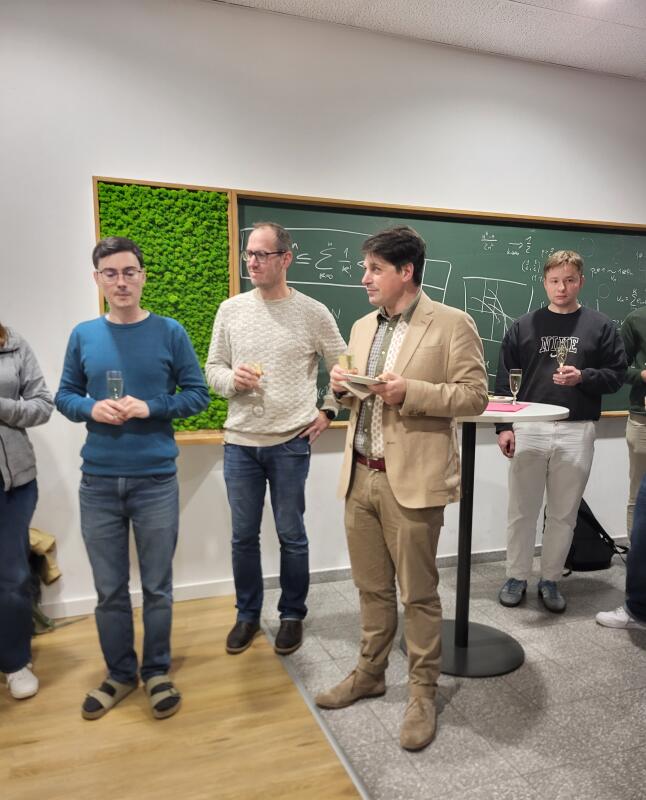
The RTG Colloquium takes place in room SRZ 216/217. It starts at 4:00 pm (sharp) with an introductory talk for PhD students and postdocs followed by a coffee break in the Cluster Lounge. At 5:00 (sharp) the Colloquium talk will begin.
upcoming talks:
28 October 2026: Prof. Dr. Serte Donderwinkel, University of Groningen
16 December 2026: Prof. Dr. Remco van de Hofstad, Eindhoven University of Technology
27 January 2026: Prof. Dr. Lisa Hartung, Johannes-Gutenberg-Universität Mainz
Mini Course
A mini-course by Benoit Dagallier will be held on
13 April, 15 April, 16 April as well as 20 April 2026 each from 10.00am to 12.00pm
Room: SRZ 216/217
Title: An introduction to the Polchinski flow
Abstract: In this course I will introduce the Polchinski flow (or dynamics), a general framework to study asymptotic properties of statistical mechanics and field theory models, inspired by renormalisation group ideas.
The Polchinski dynamics has appeared recently under different names, such as stochastic localisation, and in apparently very different contexts (Markov chain mixing, optimal transport, functional inequalities...). I will motivate the construction of this object from a physics perspective, then consider concrete statistical mechanics models where it can be used to obtain functional inequalities. The connection with (optimal) transport and stochastic localisation will be discussed, together with some open questions.
The course is based on a review paper with Roland Bauerschmidt and Thierry Bodineau, accessible here: https://projecteuclid.org/journals/probability-surveys/volume-21/issue-none/Stochastic-dynamics-and-the-Polchinski-equation-An-introduction/10.1214/24-PS27.full
29 October 2025
29 October 2025
Opening Colloquium
We are glad to announce the Opening Colloquium of the RTG 3027 "Complex Random Systems" which will be given by Prof. Dr. Antoine Gloria (Sorbonne Université & Université Libre de Bruxelles)
on Wednesday, 29 October 2025, at 5 p.m. (sharp) in SRZ 216/217.
Effective ellipticity for high contrast homogenization
Abstract: Homogenization is the art of averaging coefficients of differential operators in a consistent way. It is the mathematical theory associated with composite materials. The theory is by-now well-understood for linear elliptic equations with random coefficients that are uniformly bounded and elliptic. For applications to mathematical physics and to more contemporary homogenization problems, it is however desirable to move away from uniform ellipticity. In this colloquium I will introduce a concept of effective ellipticity field and ellipticity radius, which quantifies how and at which scale an elliptic operator with (degenerate and unbounded) stationary ergodic coefficients is close to a uniformly elliptic operator. Combined with nonlinear concentration of measure, this allows one to extend quantitative homogenization theory to the setting of high- (and even infinite-) contrast.
Detailed programme of the event:
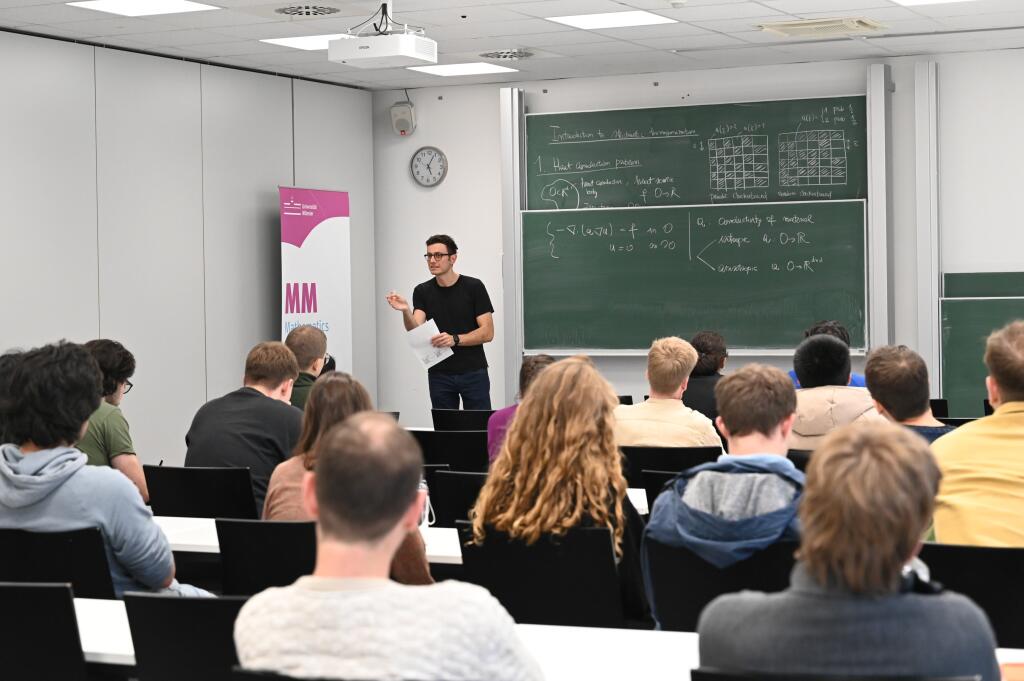
4 p.m. (sharp) in SRZ 216/217: introductory talk for PhD students and postdocs by Dr. Francesco Deangelis
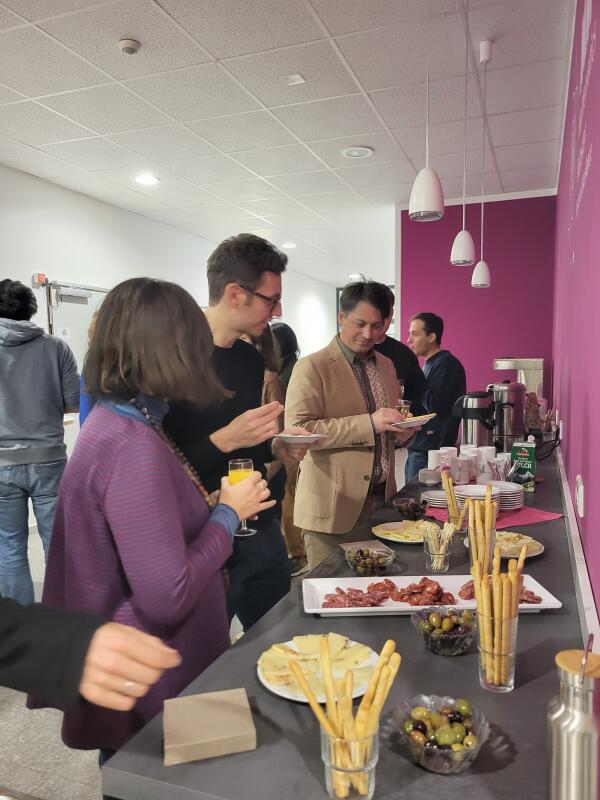
4.30 p.m. coffee and tea will be served in the Cluster Lounge (Orléans-Ring 12)
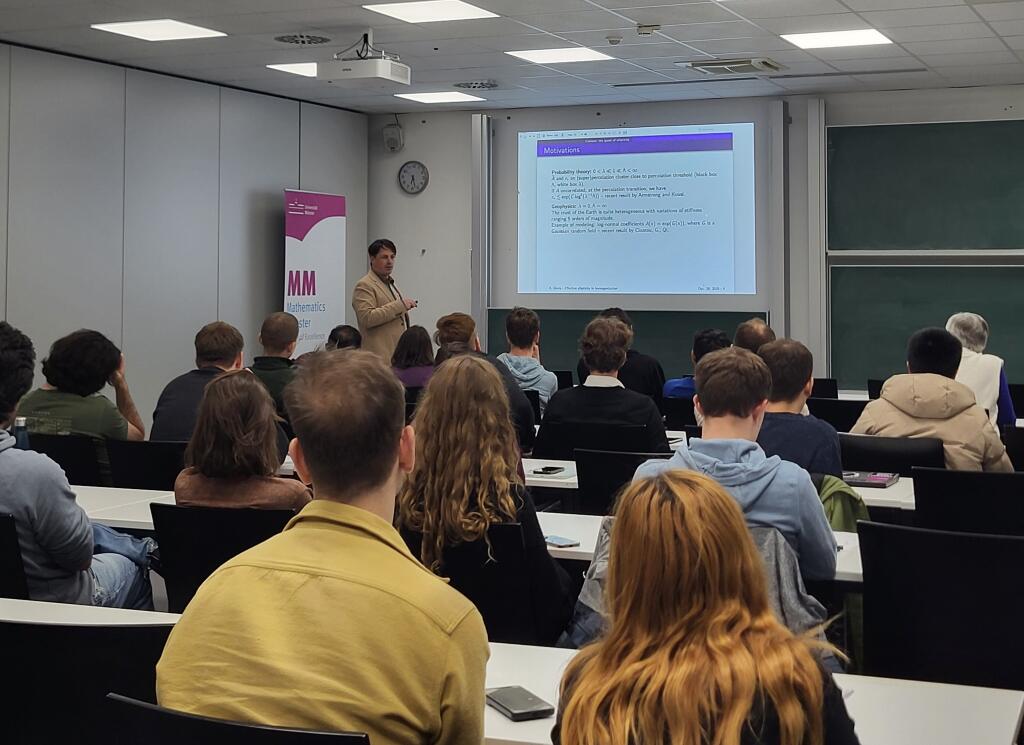
5 p.m. (sharp) in SRZ 216/217: Colloquium-talk by Prof. Dr. Antoine Gloria
6 p.m. informal reception in the Cluster Lounge (Orléans-Ring 12)