
"Deo gratias, went well"
Within the framework of a festive evening event at the Catholic Academy Munich, the completion of the Faulhaber-Edition was celebrated on 29 June 2026. Following welcome addresses from the academy director and the general vicar of the Archbishop of Munich and Freising, central results of the edition project were presented to over 150 guests in various formats.
Photos

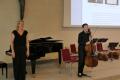
The event was musically framed by the young cellist Levi Schudel and the youth orchestra of the Wittelsbacher Gymnasium.© Katholische Akademie München - Robert Walser 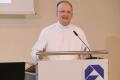
On behalf of Cardinal Reinhard Marx, General Vicar Christoph Klingan thanked the project leaders Professor Andreas Wirsching and Professor Hubert Wolf, as well as the research team.© Katholische Akademie München - Robert Walser 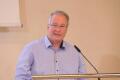
Dr Peer Volkmann© Katholische Akademie München - Robert Walser 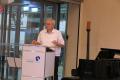
Project leader Professor Hubert Wolf© Katholische Akademie München - Robert Walser 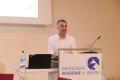
Dr Matthias Daufratshofer© Katholische Akademie München - Robert Walser 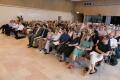
Within the framework of a festive evening event at the Catholic Academy Munich and over 150 gests, the completion of the Faulhaber-Edition was celebrated on 29 June 2026.© Katholische Akademie München - Robert Walser 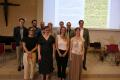
There was great applause when Dr Peer Volkmann named all the involved project staff members and invited them onto the stage.© Katholische Akademie München - Robert Walser 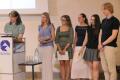
Students of the Faculty of History of the Wittelsbacher-Gymnasium read some texts from the diaries and letters of Cardinal Faulhaber.© Katholische Akademie München - Robert Walser 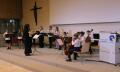
The youth orchestra of the Wittelsbacher Gymnasium© Katholische Akademie München - Robert Walser


Dr Achim Budde, as director of the Catholic Academy in Bavaria, welcomed all guests initially. In his welcome speech, he explained that the Catholic Academy had intensively accompanied the project from the beginning and provided a venue for discussion and presentation for all events. On behalf of Cardinal Reinhard Marx, General Vicar Christoph Klingan thanked the project leaders Professor Andreas Wirsching and Professor Hubert Wolf, as well as the research team. For the archdiocese, there is no way around making all sources of research accessible and standing by its history. There was great applause when Dr Peer Volkmann named all the involved project staff members and invited them onto the stage. Students of the Faculty of History of the Wittelsbacher-Gymnasium read some texts from the diaries and letters of Cardinal Faulhaber.
Professor Wolf and assistant professor Dr Matthias Daufratshofer presented their presentation under the motto "Deo Gratias, it went well" – a formulation that Cardinal Faulhaber had used exactly 75 years earlier, on 29 June 1951, in his diary when he returned from the priestly ordination in Freising. Using various examples, they placed diary entries and supplements in their historical context and thus illustrated the potential that the edition has for evaluating even well-researched historical topics. The event was musically framed by the young cellist Levi Schudel and the youth orchestra of the Wittelsbacher Gymnasium.
Nominated bishop of Speyer in 1911, Michael von Faulhaber (1869-1952) became archbishop of Munich and Freising in 1917. In 1921, Pope Benedict XV appointed him cardinal. Between 1911 and his death in 1952, he kept a visitor’s diary. In 32 volumes, spanning a total of 4,095 pages, he recorded nearly daily his visitors, associated conversation notes, and brief impressions. Over these 41 years, he was in contact with more than 18,000 people. Among his conversation partners were, among others, the popes Pius XI and Pius XII, US President Warren G. Harding, the Centre Party politician Matthias Erzberger, the chancellors Wilhelm Marx and Heinrich Brüning, the Bavarian prime minister Gustav von Kahr, representatives of the Bavarian royal house, and chancellor Konrad Adenauer.
Faulhaber wrote in the now extinct shorthand "Gabelsberger". After his death, his private secretary took possession of the diaries, which eventually made their way to the Archdiocesan Archive Munich in 2010. An interdisciplinary research team led by Professor Hubert Wolf of the University of Münster and Professor Andreas Wirsching of the Institute for Contemporary History Munich transcribed the diaries and around 200 conversation protocols from "Gabelsberger" shorthand over a period of twelve years, and carried out a prosopographic identification of the persons appearing in the diaries. Faulhaber's diaries are completely accessible Open Access at www.faulhaber-edition.de.
To conclude the project, which was supported by the German Research Foundation (DFG) from 2013 to 2025, 10,729 diary entries and 14,252 short biographies have been made available online. The diaries are supplemented by the so-called "Beiblätter", stenographic note cards that relate to the visit diaries. Faulhaber created them to record more extensive reflections on important topics, events, and conversations. They are characterised by their richness in detail and a high level of reflection, such as the conversation protocols of Faulhaber's visit to Hitler on the Obersalzberg (1936), his conversations with the Apostolic Nuncio Cesare Orsenigo (1936, 1938, 1940), Pope Pius XI (1933), or the resistance fighter Carl Goerdeler (1943). So far, 178 of these "Beiblätter" have been made available online.
Thanks to further funding by Cardinal Reinhard Marx and the Archdiocese of Munich and Freising, a further 45 supplements will be made available online by the end of 2026. On average, the edition’s homepage attracts around 700 visitors per month.