

Fellows
Events
To play the video, it will be loaded from a Webserver of Google™ LLC. Therefore data will be transmitted to Google™ LLC.
Keynote speech by Miloš Vec: Anti-Universalismus: Das NS-Völkerrecht als Herausforderung für die Rechtseinheit der internationalen Ordnung
On 13 October 2025, the Käte Hamburger Kolleg ‘Legal Unity and Pluralism’ marked the start of its second funding phase (2025–2029). At an event held at the University of Münster's Geomuseum, fellows and alumni, colleagues from the faculties, partners and friends, along with an interested audience, came together to celebrate what has been achieved and what lies ahead. The keynote speech was given by legal historian Prof. Dr. Miloš Vec from the University of Vienna.
Recording of the keynote speech:

To play the video, it will be loaded from a Webserver of Google™ LLC. Therefore data will be transmitted to Google™ LLC.
Public Panel Discussion: Gesellschaftliche Pluralität und rechtliche Vielfalt in Ostmitteleuropa: Perspektiven zurück und nach vorn
On 5 June 2025, the Käte Hamburger Kolleg ‘Legal Unity and Pluralism’ hosted a panel discussion with the aim of connecting the centuries-old history of East Central Europe with its present and future. The discussion was moderated by EViR Director Prof. Dr. Ulrike Ludwig under the heading ‘Social diversity and legal plurality in East-Central Europe: looking back and forward’.
Panelists: PD Dr. Iryna Klymenko (Lviv), Prof. Dr. Regina Elsner (Münster), Prof. Dr. Irina Wutsdorff (Münster)
Recording of the event:
To play the video, it will be loaded from a Webserver of Google™ LLC. Therefore data will be transmitted to Google™ LLC.
Public diskussion: Der Bauernkrieg von 1525 – Revolution des Gemeinen Mannes oder wilde Handlung?
The public discussion ‘The Peasants’ War of 1525 - Revolution of the Common Man or wild Act?’ was organised by the Käte Hamburger Kolleg “Legal Unity and Pluralism” (EViR) on 16 January 2025 in the Stadtbücherei Münster.
Prof Dr Gerd Schwerhoff is Senior Professor for Early Modern History at the Univeresity of Dresden.
Prof Dr Ulrike Ludwig is Professor of Early Modern History at the University of Münster and Director of the Käte Hamburger Kolleg „Legal Unity and Pluralism“.
Recording of the event:

To play the video, it will be loaded from a Webserver of Google™ LLC. Therefore data will be transmitted to Google™ LLC.
Project presentation and public discussion: Orte des Rechts in Münster – früher und heute
The public discussion "Orte des Rechts in Münster - früher und heute" (places of law in Münster - past and present) was organised by the Käte Hamburger Kolleg "Legal Unity and Pluralism" (EViR) on 21 October 2024 at the Stadtmuseum Münster. To mark the launch of the interactive map www.orte-des-rechts.de, we discussed where law is visibly reflected in Münster's urban space, what traces of over 1000 years of legal history can still be discovered today and why cartographic representations are helpful in this regard. Participants: Dr. Angelika Lampen (Institut für vergleichende Städtegeschichte), Prof. Dr. Ulrike Ludwig (EViR) Prof. Dr. Peter Oestmann (EViR), Dr. Bernd Thier (Stadtmuseum Münster)
Recording of the event:

To play the video, it will be loaded from a Webserver of Google™ LLC. Therefore data will be transmitted to Google™ LLC.
Auf dem Flickenteppich bleiben? Was der deutsche Föderalismus leistet – und wo seine Grenzen liegen
Public panel discussion
Monday, 29 April 2024 | 18.00 | Theatertreff Münster
The panel discussion “Auf dem Flickenteppich bleiben? Was der deutsche Föderalismus leistet – und wo seine Grenzen liegen" (Staying on the patchwork quilt? What German federalism achieves - and where its limits lie) was organised by the Käte Hamburger Kolleg "Legal Unity and Pluralism" (EViR) on 29 April 2024 at the Theatertreff Münster. This was discussed by: Dr. Stefan Nacke (CDU Member of Parliament), Prof. Dr. Peter Oestmann (EViR), Prof. Dr. Jürgen Overhoff (University of Münster), Dr. Antonios Souris (Free University of Berlin) Moderated by: Gigi Deppe (Head of the ARD Legal Department Radio)
Recording of the event:
To play the video, it will be loaded from a Webserver of Google™ LLC. Therefore data will be transmitted to Google™ LLC.
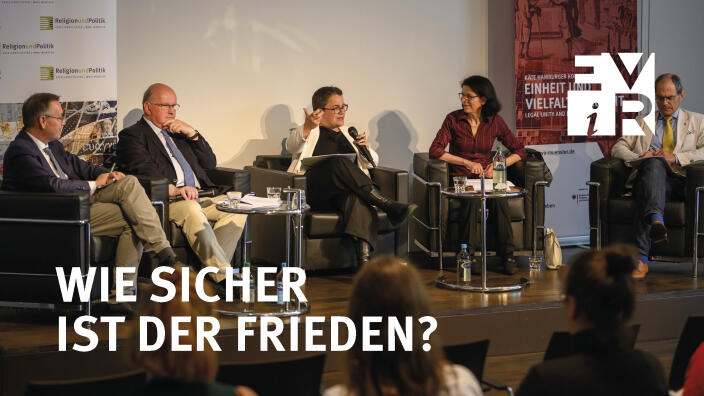
Public panel discussion: Wie sicher ist der Frieden? Der Westfälische Friede als völkerrechtlicher Vertrag
The panel discussion "Wie sicher ist der Frieden? Der Westfälische Friede als völkerrechtlicher Vertrag" (How secure is the peace? The Peace of Westphalia as a treaty under international law) was organised by the Käte Hamburger Kolleg "Legal Unity and Pluralism" (EViR) and the Cluster of Excellence "Religion and Politics" at the University of Münster on 22 June 2023 at the LWL Museum of Art and Culture in Münster. Discussants: Prof. Dr. Claire Gantet (Université de Fribourg), Prof. Dr. Christian Hillgruber (University of Bonn), Prof. Dr. Christoph Kampmann (University of Marburg), Prof. Dr. Peter Oestmann (University of Münster), Moderation: Prof. Dr. Ulrike Ludwig (University of Münster)
Recording of the event:

To play the video, it will be loaded from a Webserver of Google™ LLC. Therefore data will be transmitted to Google™ LLC.
EViR Summer School "Gesellschaftliche Diversität und Recht im Alten Reich 1500-1800"
Video about the first EViR Summer School, which took place from 24 to 28 July 2023 at the Käte Hamburger Kolleg under the motto of social diversity and law in the Holy Roman Empire 1500-1800. In the video, participants of the Summer School and the organiser Dr Benjamin Seebröker give their views.
To play the video, it will be loaded from a Webserver of Google™ LLC. Therefore data will be transmitted to Google™ LLC.
Ulrike Ludwig and Peter Oestmann on research at the Käte Hamburger Kolleg "Legal Unity and Pluralism"
Interview with the directors of the Käte Hamburger Kolleg EViR, historian Prof Dr Ulrike Ludwig and legal historian Prof Dr Peter Oestmann. In the interview, they explain how legal plurality and unity are researched at the Kolleg and why this is important.