Sino-German Institute of Law
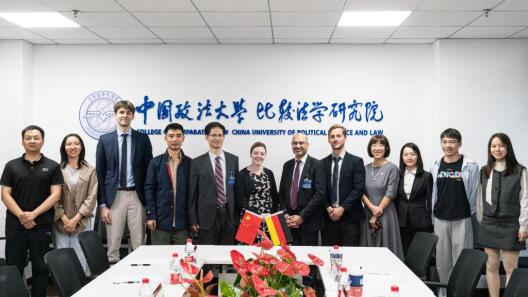
The Sino-German Institute of Law at the China University of Political Science and Law (CUPL) in Beijing was founded in 2002 in cooperation with the DAAD and several German partner universities. The participating universities are Freiburg, Frankfurt am Main, Hamburg, Cologne, Ludwig Maximilian University of Munich and, since 2014, the University of Münster and Humboldt University of Berlin. The aim of the institute is to promote academic exchange between German and Chinese legal scholars and to facilitate joint study and research programmes. A central element is the LL.M. programme in German Law in Comparative Law, as well as exchange programmes for students and researchers from both countries. The Institutes Website
Which project are we discussing today?
We are discussing the long-standing cooperation between the Faculty of Law at the University of Münster and the China University of Political Science and Law (CUPL) in Beijing. In addition to traditional student exchanges, this collaboration forms part of a broader institutional framework: together with six other German universities, we have established the Sino-German Institute for Law. Numerous academic activities take place within the framework of this institute, such as joint seminars, lectures and research meetings. Another key component is a structured study programme that enables Chinese students to obtain a Master’s degree (LL.M.) in German law at our faculty.
Who are you and what is your role in the project?
I have been working for three years as the Internationalisation Officer and Academic Advisor for international students at the Faculty of Law, and in this role I oversee more than 120 international partnerships worldwide, most of them in Europe. Each partnership is also supported by a professor from the relevant subject area. In the case of the partnership with CUPL, I primarily coordinate the student exchange programmes as well as the organisational processes relating to the Master’s programme for Chinese students. Prof. Dr Sebastian Lohsse from the Institute of Legal History is responsible for the academic content.
How did the partnership come about?
The partnership with the China University of Political Science and Law (CUPL) has been in place for more than 20 years. As we had been actively collaborating with CUPL on student exchanges since 2006, we received an invitation in 2014 from the management of the Sino-German Institute of Law to join the institute, which we were happy to accept. In addition to Münster, the Institute includes the Universities of Cologne, Hamburg and Freiburg, Ludwig Maximilian University of Munich and Humboldt University of Berlin. It provides a solid platform for academic exchange between Germany and China in the field of law, which is truly exceptional and does not exist in this form in any of our other partnerships.
Who is this partnership aimed at?
The partnership is primarily aimed at students, but also at academics. Chinese students can undertake a structured study programme through the institute and obtain a Master of Laws (LL.M.) in German law in Münster. At the same time, students from Münster have the opportunity to attend courses on Chinese law at CUPL and improve their language skills. This expertise is in high demand, particularly in view of the economic relations between Germany and China: many companies invest in both countries, and knowledge of the respective legal systems opens up excellent career prospects, for example in international law firms or companies with operations in China.
What do you hope to achieve through this partnership?
A key objective is to give students a deeper insight into different legal systems. Comparative law between Germany and China is particularly fascinating from an academic perspective and is also becoming increasingly important in practice. Furthermore, the partnership fosters long-term academic networks and facilitates personal exchanges between students and researchers from both countries.
What does the collaboration involve in practice?
The collaboration takes several forms. Firstly, there is the traditional student exchange: each semester, a number of places are available for students from Münster to study at CUPL, usually for one semester. There, they can familiarise themselves with the Chinese legal system and attend language courses. In addition, there is also the option of completing a full-year programme, which, alongside lectures, includes language courses, an introduction to Chinese law and a wide range of networking opportunities. This year, a student from Münster is taking part in precisely this comprehensive programme and will remain at CUPL for a full year. We are delighted about this, not least because these students often remain connected to the programme as alumni even after their stay.
Conversely, Chinese students study in Münster for around one and a half years through the Institute and obtain a Master of Laws (LL.M.) in German law here. At the end of the programme, you will write a Master’s thesis and will have the option of either entering the German job market directly or proceeding to a PhD. The exchange programme is complemented by academic seminars, lectures and opportunities for staff mobility for professors and research assistants; however, these are taken up to a much lesser extent. Currently, three people at the Faculty of Law in Münster are directly involved in the partnership.
What sets this partnership apart from others?
What makes it special is, above all, the institutional structure – that’s a real luxury for us. The Sino-German Institute of Law has established structures in both Germany and China and organises the exchange programme very reliably. This institutional framework makes many organisational processes much easier for us, such as planning the course of study, dealing with administrative matters, or supporting the students. For instance, I can contact Mr Stamer, the Institute’s representative in Germany, at any time with queries; that is quite exceptional. We also hold a consortium meeting with all the universities at least twice a year, where we discuss the status of the Institute and the partnership. Communication between us therefore runs smoothly as well.
How much interest is there in student exchange programmes?
Interest has risen sharply in recent years. Whereas previously around 150 students were interested in our exchange programmes, we now receive over 500 applications a year for all partner universities combined, which makes our allocation system correspondingly complex. We have certainly noticed that CUPL is regularly among our students’ most popular destinations and is definitely ahead of all other Chinese partner universities in terms of popularity. The tense political situation there hardly affects us. Students wishing to go to CUPL have a good chance if they meet the profile and requirements – you can read about this on our website or discuss it with me during a consultation. But the exchange programme to Münster is also very popular from CUPL’s perspective; it is not uncommon for us to accept more students from there than the programme actually provides for. The high level of interest is due not only to the good reputation of our Master’s programme but also to the favourable conditions: Chinese students are guaranteed a place, pay no tuition fees and have never had any difficulty obtaining a visa.
What have been the key milestones in this collaboration?
A key milestone was undoubtedly the establishment of the Sino-German Institute of Law, which has permanently institutionalised the exchange; collaboration with other universities has also proved to be a great advantage for us. Furthermore, the LL.M. programme for Chinese students in particular has become firmly established and is proving very successful. Every year, around two to three students come to Münster to complete their Master’s degree in German law.
Have there been any particularly memorable moments?
What I particularly enjoy is the close relationship I have with the students. Many of the Chinese students are exceptionally committed and very grateful for the opportunity to study here. During the seminars I supervise, I also notice time and again how enriching their perspectives are for us here. As I am also the coordinator of the Master’s programme, I support them throughout their studies. This often leads to very personal encounters and long-term relationships.
Unfortunately, I have not yet managed to accept any of the numerous warm invitations to China, mainly for budgetary reasons at faculty level. I hope to be able to make up for this in the future. We are all the more delighted that the feedback from Chinese students regarding the Master’s programme in Münster has been consistently very positive. As a result, the University of Münster now enjoys a very good reputation within the institute.
What challenges arise in this collaboration?
The biggest challenge is often the German language. Law is a subject that relies heavily on language, and the subtleties of legal argumentation in particular are not easy to grasp. Many Chinese students initially arrive in Münster with a B2 language level and achieve C1 during their studies. This is also a distinctive feature of the programme, as a C1 level is normally required for a law degree; here, the requirement has been deliberately lowered slightly to make access more accessible. In terms of content, the academic standard is usually very high, but oral presentations or discussions can be linguistically challenging at first. Conversely, the language barrier for students from Münster at CUPL is somewhat lower, as courses are also offered there in English and, in some cases, in German.
What prospects do you see for the future?
The collaboration is already very stable and works extremely well thanks to the institute’s institutional structure. Looking ahead, it would be desirable to enable even more students to take part in exchanges. Given the high level of interest, we hope to be able to further expand the number of exchange places in the future. At the same time, the programme is constantly evolving on the institute’s side: in addition to the exchange, new conferences, meetings and formats are organised on a regular basis. Last year, too, there were numerous invitations to additional events outside the regular study programme, which further deepen academic exchange.
What recommendations would you give to others looking to establish international collaborations?
I know it is not always possible, but those who can should consider setting up an institute. This structure makes my day-to-day work much easier; ideally, responsibilities should be clearly defined in a contract so that expectations and competences are transparent. We have also found that there should be at least one person who maintains an overview and can actively coordinate the partnership, and if necessary, do so independently.
Diego Nuñez Bosmans works at the Faculty of Law at the University of Münster and has been the faculty’s Internationalisation Officer for the past three years. In this role, he coordinates a global network of over 120 partner universities and oversees the international exchange programmes in collaboration with the relevant professors. In addition, he is the coordinator of the Master’s programme in German Law (LL.M.) and supports international students during their studies in Münster. Contact (de)