International Summer School in Uzbekistan
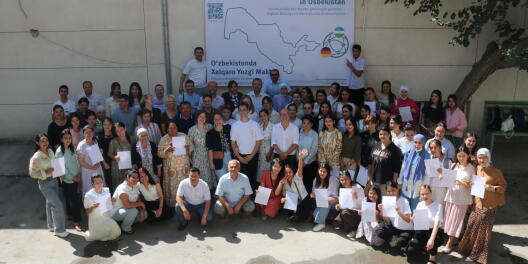
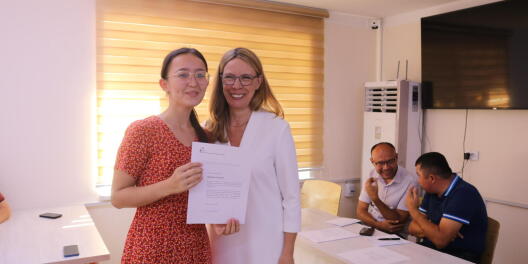
In August 2024, a summer school jointly organised by the German-Uzbek University Network InGeZa took place at Bukhara State University. The event was aimed at students, university lecturers and teachers in the field of German as a foreign language and focused on the future of teaching and learning in a digitalised and intercultural university landscape. Around 100 students and 25 teachers took part, including experts from Bukhara, Chirchiq, Termez, Urgench and Münster, who taught and advised on over 20 topics in team teaching workshops. The Summer School serves as a platform for international educational dialogue and strengthens cooperation between German and Uzbek German studies departments within the network. The next edition is planned for this year and is to be continued every two years in order to further expand professional exchange and networking. Website
What kind of project are we talking about today?
Today we are talking about the long-standing cooperation between the German Studies Department at the University of Münster and five partner universities in Uzbekistan, which form a German-Uzbek university network. This cooperation has been in place for almost 15 years and is one of the university's few ongoing partnerships in Central Asia. This is precisely why it is of particular importance to us as the German Studies Department. In the future, we would like to expand the cooperation to other countries in the region, such as Tajikistan and Kazakhstan, with the aim of establishing a more closely networked Central Asian German Studies programme. A key concern here is that research should not simply be ‘adopted’ from a European perspective. It is important to us that local researchers develop their own questions, perspectives and approaches – whether in the field of German as a foreign language or in literary and cultural contexts. At the same time, we are working together to strengthen students and doctoral candidates in their academic work. The aim is to enable all participating (young) researchers to connect with the global knowledge and research community.
Who are you and what is your role in the project?
My role in the project is primarily one of coordination. This means that I implement the strategic and organisational goals and ensure that the network can work together. The academic work is carried out by the project management in Münster, Prof. Dr. Silvia Reuvekamp, and by our Uzbek partners in Nukus, Urgench, Bukhara, Termez and Chirchiq. I also supervise and advise students, tutors and researchers from both countries during guest semesters or internships. Within the network, we have resources for comprehensive support, which means that we can provide very close supervision for Uzbek students in Münster and German tutors at the partner universities in Uzbekistan, for example. This distinguishes the cooperation from traditional exchange formats such as Erasmus+.
How is the project organised?
There is a core group at the cooperation level: besides myself, there is another colleague and three doctoral students from Uzbekistan. They are not funded by the University of Münster, but by state funding programmes from Uzbekistan in combination with funding from the German Academic Exchange Service (DAAD). The doctoral phase usually lasts three to four years. An important part of the programme is that the doctoral students are introduced to scientific working methods at a very early stage and can in turn pass on their knowledge in Uzbekistan – for example, through training courses on scientific work. This creates low-threshold multiplier structures. In addition, there are tutors from Münster who try to involve the student level more closely. There are currently four tutors working in the field of German as a foreign language at four different universities. To ensure the sustainability of the project work, it is important to retain these individuals in the project for the long term – for example, through master's theses or research stays.
How many institutions are involved?
We are currently working with five partner universities from different regions of Uzbekistan: Nukus State University in the Autonomous Republic of Karakalpakstan, Urgench State University in the Khorezm region, Bukhara State University in the Bukhara region, Termez University and Chirchik Pedagogical University in the Tashkent region. It is also important to us that cooperation is not concentrated in the capital, where there are already many international players such as the Goethe-Institut, the Pedagogical Exchange Service (PAD) and the DAAD. We deliberately work with universities in structurally disadvantaged regions, as the network focuses on regional networking between partner universities and the sustainable joint use and further development of (digital) research and teaching resources. A concrete example is a collaborative project between the participating partner universities to develop a modern textbook on intercultural communication, which will be integrated into the curricula of the partner universities. In addition, our Uzbek colleagues are working together on German-Uzbek translation issues and innovative digital approaches to teaching German as a foreign language (including the design of self-study programmes).
Who is the project aimed at?
The cooperation is aimed at both students and researchers at the Uzbek partner universities and the University of Münster. This includes students studying German as a foreign language/German studies, doctoral candidates, early-career researchers and lecturers in the field of German studies/cultural studies. In addition, synergy effects with other disciplines could arise on both sides of the network, for example with Islamic theology, philology or history.
What specifically do you hope to achieve with the project?
A key objective is to enable all participants to act internationally – both institutionally and individually. For students from Münster, for example those studying German as a Foreign Language and Second Language (DaFZ), the cooperation offers concrete and practical teaching experience in the field of German as a foreign language. They teach in a different cultural environment and gain international teaching experience at an early stage. In the process, they develop intercultural skills, become sensitised to the multilingualism practised in Uzbekistan and get to know other academic and educational institutional structures.
The cooperation is also very beneficial for researchers on both sides. It opens up new discourses on German studies issues. Particularly important here is the perspective from a non-European region such as Central Asia, which is also facing current global challenges. For the German Studies Institute, the cooperation with Uzbekistan clearly strengthens its international profile and increases the visibility of German studies in Münster.
What exchange opportunities are available for students and researchers?
There are various exchange formats: study visits, internships, research visits and summer schools. For example, four students from Münster are planned for internships in spring 2026 and two more in the winter semester 2026-27. In the summer semester of 2026, three Uzbek students will complete a four-month study visit at the University of Münster. In addition, a summer school will take place in Urgench in western Uzbekistan from 17 to 22 August 2026. The first summer school in 2024 in Bukhara with around 120 participants was very successful. Five lecturers from Münster travelled there and, together with their Uzbek colleagues, offered workshops and consultations. Topics included self-organisation in studies, digital education and intercultural communication.
What have been the important milestones so far?
One great success was that the Summer School led to the formation of local student councils, which are not yet fully developed but are well on their way. The last Summer School also gave rise to a doctoral project that brings an exciting Central Asian perspective to research on heroic epics. In addition, two doctoral projects already supervised in Münster in the fields of contrastive narratology and digital education are contributing to the strengthening and sustainable establishment of interculturally oriented German studies.
Were there any particularly memorable or personal moments for you?
Many. Supporting young people is particularly important to me. I have met many Uzbek students for whom a stay in Münster was their first encounter with Europe. For women in particular, this was often a very formative moment in terms of independence and emancipation. Years later, I saw a former exchange student on television, translating for a delegation from the German Foreign Office. Moments like these show that every investment in young people is worthwhile. The exchange programme also has a formative effect on our own students from Münster: they often report that they were able to try their hand at teaching in an international context, were allowed to make mistakes and gained self-confidence.
What challenges did you face in your collaboration?
For a long time, the political situation was a major challenge. The academic sector in Uzbekistan was heavily regulated by the state, contracts had to be reviewed by several ministries, and freedom of research was restricted. Since the change of government in 2016, much has improved: educational institutions are more independent, visas have become much easier to obtain, and mobility is possible. Nevertheless, there are still challenges and potential for development, for example with regard to research quality and institutional routines. This cannot be remedied in just a few years.
What prospects do you see for the future?
A key objective is to consolidate the structures that have been established in the long term. In future, the summer school is to take place every two years and become an integral part of the cooperation. It has already proven to be a very effective format. In addition, we would like to implement the online publication platform and, in the future, open it up to other disciplines. In the long term, we see great potential in stronger regional and interdisciplinary networking, for example with theology, history, political science and archaeology. The cooperation offers many points of contact, especially for researchers working on transregional areas such as Central Asia, the New Silk Road or post-Soviet contexts.
I would like to express my sincere thanks to Mrs Haas for the exciting and open discussion!
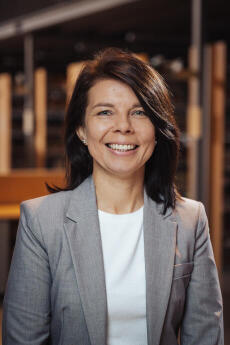
Albina Haas (M.A.) coordinates international exchange and Erasmus cooperation at the German Studies Department of the University of Münster. She herself comes from Uzbekistan and brings her own transcultural experiences to bear in her work with students and partner institutions. She is deeply committed to low-threshold exchange formats and providing intensive support to participants. In addition to Central Asia, she also oversees partnerships with Georgia and Armenia, among others. Contact