Jun- Prof. Dr. Philip Bockholt is a junior professor of the history of the Turko-Persian region at the Institute of Arabic and Islamic Studies at the University of Münster. His research focuses on translation processes, manuscript cultures and the circulation of knowledge in the Ottoman context. Language plays a central role in his work: many of his projects are closely linked to original sources and regularly take him to archives and research partners around the world. Contact
In conversation with: Jun-Prof. Dr. Philip Bockholt
What project are we talking about today?
We are talking about a research collaboration with partners in Turkey that deals with intra-Islamic translation processes. Specifically, it concerns which texts from Arabic and Persian literature were translated into Ottoman Turkish – especially before the 1928 script reform. This is a field of research that is very closely linked to language: anyone who wants to work on these topics must be proficient in Turkish. Outside Turkey, there are very few specialists in this field. In addition, most of the primary material – manuscripts, translations, commentaries – is located in Istanbul, and some of it in Cairo. It was not until the first half of the 19th century that printing became fully established in the Middle East; before that, almost everything was handed down in manuscript form. Anyone wishing to conduct research in this area should therefore ideally work on site and cooperate with colleagues there.
What role do you play in this cooperation?
I am a junior professor of the history of the Turkic-Persian region and, in this context, I primarily act as an organiser and contact person. I coordinate joint events such as lecture series, workshops and conferences, and I am responsible for international exchange. Many of my Turkish contacts work at a very high level, but speak little English or other foreign languages. This makes it all the more important that we work together on an equal footing and also raise their international profile. In my experience, writing emails is not enough for serious cooperation – you have to meet in person, discuss things together and spend time with each other.
How did the collaboration come about?
Personal contacts were the deciding factor: one of my doctoral students has ties to 29 Mayıs University in Istanbul, and a close collaborator works at Boğaziçi University. At the same time, I helped establish a book series in Berlin, with the colleague from Turkey involved as co-editor. Over the years, this has developed into a robust network. Since around 2024, these activities have intensified significantly, with the junior research group I have been leading since 2022 providing an important organisational umbrella.
What was your personal motivation for promoting this cooperation?
On the one hand, it is simply part of my job. On the other hand, I also see it as a kind of duty. Research in our field is often very strongly influenced by Europe or North America, although it would actually make sense to involve colleagues from the regions themselves much more closely. However, establishing larger joint formats is not easy – it takes time, patience and money. My junior research group is a good outlet for this. It will run for six years, and I very much hope that something sustainable will develop from it. Even small things, such as being able to reimburse travel expenses, make a big difference. Many Turkish universities have significantly less access to funding, and this is precisely where the collaboration can make a real difference.
Who is this collaboration aimed at in particular?
Primarily researchers and young academics in the fields of Islamic studies and Turkology/Ottoman studies. Very few people are actually able to do this work because the language requirements are so specific. At the same time, it is also about promoting young talent: master's students, doctoral candidates and young academics who need to learn how to work with manuscripts, build networks and establish themselves internationally.
What distinguishes this collaboration from others?
A key factor is language. Turkish is both a hurdle and an opportunity here. It is challenging because it is not my native language and some colleagues do not speak any other languages. At the same time, this opens up a space for exchange that would otherwise hardly take place – many of my Turkish partners are part of their own scientific world. They mainly read Turkish and Arabic-language research and have little contact with the European debate. This collaboration creates connections between research cultures that otherwise often exist side by side.
What challenges arise in the collaboration?
The collaboration is intensive and involves a lot of effort. It is demanding in terms of language and organisation. Added to this are cultural differences: many of my partners work in a religious environment, which has practical implications – for example, when choosing restaurants or interacting with each other. At the same time, the subject area is relatively uncontroversial. We are dealing with the period before 1800, in the context of the Ottoman Empire. Politically or socially sensitive issues hardly play a role here, which makes collaboration easier overall.
Were there any important milestones in the cooperation?
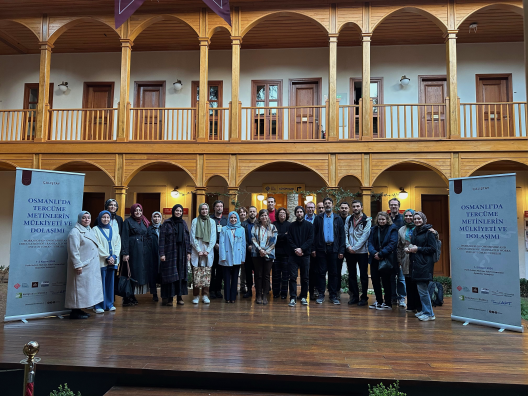
One important step was certainly to visit the site several times. You don't overcome unfamiliarity on your first visit. But when it becomes normal to see each other regularly, trust develops. That is precisely what is crucial for this type of cooperation.
What impact has the collaboration had so far?
It has been extremely valuable for my own work and that of my group. We are more closely connected to the current state of research in Turkey and can raise the profile of our work there. Conversely, we bring an international perspective and help to ensure that projects are also noticed outside the Turkish-speaking world.
What prospects do you see for the future?
Next year, we would like to organise a manuscript school in Istanbul specifically aimed at young academics. We also plan to further expand cooperation in both research and teaching, for example through research-based teaching at partner universities. Of course, it would also be ideal to invite more colleagues from Turkey to Münster in the future. However, it is crucial that the exchange remains continuous.
What recommendations would you give to others who want to establish a similar collaboration?
You should be on site as much as possible. Nothing can replace personal encounters. You also need patience and a willingness to engage with other scientific cultures. Language is not only an obstacle, but also a key. And last but not least, you should remain realistic. Such collaborations are labour-intensive, but they are worthwhile – both professionally and personally.
I would like to express my sincere thanks to Mr. Bockholt for the interesting and pleasant conversation!
Endowment Notes Lecture Series (2025–2026)
A concrete example of the growing cooperation with partner institutions in Turkey is the Endowment Notes Lecture Series, which will take place from October 2025 to March 2026 at Fatih Sultan Mehmet Vakıf Üniversitesi in Istanbul. The 17-week series is jointly organised by the Centre for Manuscript Studies at FSMVÜ and TRANSLAPT and is aimed at early-career researchers and scholars with an interest in manuscripts and archival material. In addition to a public kick-off event, the programme includes several in-depth sessions for registered participants and a student workshop at the end. Jun-Prof. Dr. Philip Bockholt is also involved in the series and will moderate individual events. Further information