The joint degree programme with Soochow University
Since 1995, there has been an integrated degree programme between the Language Centre at the University of Münster and Soochow University in Taipei. As part of their four-year Bachelor’s degree in ‘German Language & Culture’, the Taiwanese students spend their entire second year of study in Münster to deepen their knowledge of German and get to know the country and its people. In addition to the international German as a Foreign Language (DaF) courses offered by the department, they also receive tuition in English as well as regional and cultural studies, complemented by an extensive cultural and social programme.
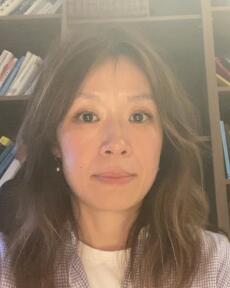
In conversation with: Anna-Luisa Eich & Assoc. Prof. Hsu Yu-Fang
What exactly is the partnership with Soochow University about?
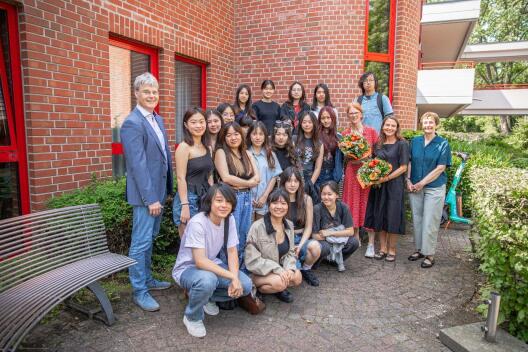
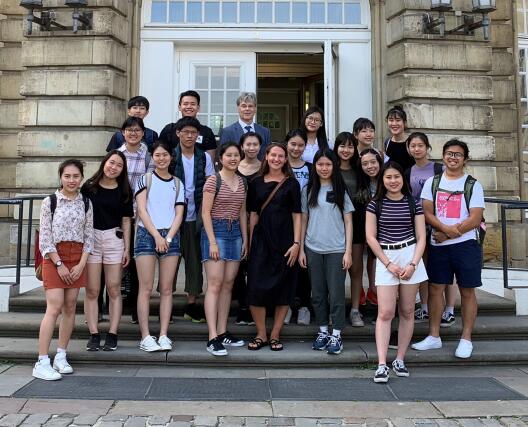
Ms Eich: Every August, an entire cohort of young people from Taipei arrives in Münster – around 20 students, roughly a third of the German department's annual intake at Soochow University. They spend their second undergraduate year in Münster until mid-July of the following year: intensive German language courses, optional English classes for those who want them, and in the end, the entire year counts fully towards their degree back in Taipei. The exchange also works the other way around, although not through our German as a Foreign Language section; students from Münster who want to study in Taiwan arrange this through the standard mobility schemes within their department. As far as our section is concerned, this connection with Taiwan has been unique since 1995.
How did you both become involved in the partnership, and what is your role today?
Ms Eich: I coordinated the programme from 2019 to 2025 and have since moved into the leadership of the German as a Foreign Language section. Eka Chakvetadze now coordinates it. As we're speaking, she's on the final trip to Wangerooge with the current group, which gives a good sense of how much the role involves: planning the academic year, organising exams and excursions, and helping whenever everyday problems arise. Our student coordinator supports her with these tasks. Ms Hsu: I teach at Soochow University's Department of German Language and Culture. As mentors for first-year students, we decide, based on their academic performance, who has the opportunity to go to Germany. Their German proficiency is the key factor – students need to have reached A2 level before they can join the programme. Every year, a member of our department also travels to Münster with the group for a week. This year it's me, for the second time – my first visit was in 2023. We actively promote the programme at Soochow because, after many years of experience, we know how much our students gain from it.
How did the partnership come about?
Ms Eich: On our side, Renate Otte, who is now retired, helped initiate the programme in 1995 – almost by chance, as I've been told. There was an enquiry from Taiwan asking whether we might build something together. Ms Hsu: At the time, another university in Taiwan already had an exchange programme with a German university. We found that inspiring, so we contacted the University of Münster through Taiwan's Ministry of Education and the Taiwanese representative office in Germany. What began as an external suggestion eventually developed into our own partnership.
How has the programme changed over the years?
Ms Eich: To judge all thirty years properly, I would have had to be there from the beginning – I only know part of the story. But the programme has constantly evolved, both in teaching and in the supporting activities. I think the biggest change has been in the students themselves. Colleagues who have been involved much longer than I have often describe students from twenty years ago as rather shy and hesitant. Today's students are much more independent: they travel across Europe at weekends and shape their year abroad very much on their own terms. Ms Hsu: I actually double-checked this with our departmental secretary: originally, the programme only lasted six months. It has only been the full twelve months since 1999. Ms Eich: Exactly – and that change came from practical experience. After six months, students are only just reaching the point where the language really starts to click. A full year is far more worthwhile. Just when they've settled in, figured out the buses and got used to everyday life here, they'd otherwise have to go home again – and we'd think that would be a shame.
What does a typical year look like for the students in practice?
Ms Eich: From May to August, we're particularly busy because that's when all the preparations for the August arrival happen. The programme coordinator and student coordinator deal with residence permits, bank accounts and health insurance, arrange accommodation and even make sure the bedding is ready. All students live in student halls. Once the group arrives, they have classes four days a week, and every month we organise a shared activity – whether that's a day trip, a guided tour or an evening of bowling. In winter we bake Christmas biscuits together or make Christmas decorations, and of course we celebrate as well. Many students make the most of their three free days each week to explore as many cities and countries as possible. Sometimes they know Münster surprisingly little but have already visited several European capitals. Ms Hsu: To put that into perspective, our Department of German Language and Culture has just over 200 students in total. Every year we admit nearly 60 new students, and around 20 of them come to the University of Münster during their second year. In theory, they could also take other university courses while they're here, but in practice hardly anyone does.
How do the students' language skills develop over the course of the year?
Ms Eich: Very differently, to be honest. Most stay at B1 level or only become confident at B1 during the year. Only a few reach B2, and no one has reached C1 within a year for quite some time. This year, for example, only two of the twenty students attended the B2 course – that used to be different. Every year, though, one or two students decide to stay in Münster after the exchange year. They leave Soochow University, continue studying German here, and later move into a degree programme at the University of Münster. Others finish their bachelor's degree in Taiwan first and return later for a master's degree.
Have there been any particular milestones or memorable moments? Ms Eich: The 30th anniversary celebration last summer was certainly a special moment, bringing together current students, former programme coordinators and lecturers in one place. What struck me most was seeing how many people have contributed to making the programme possible over the years. Ms Hsu: I haven't been at Soochow University for very long, but I'm impressed by how carefully the exchange programme is organised. When I was an exchange student myself, we had to arrange many practical things on our own. Here, the students receive much more support in that respect. Ms Eich: Speaking of support – once, a student wrote to us asking for help because there was a spider in her room! Stories like that illustrate the kinds of expectations students sometimes have of us. We don't usually encounter that with German students of the same age. It makes us smile, but of course we still take the concern behind it seriously.
What challenges does the partnership bring? Ms Eich: One very practical challenge is language proficiency. Supporting students who haven't quite reached B1 yet is demanding both for our teachers and for the students themselves. Another recurring issue is the parents. They worry a great deal and sometimes see the university almost as a substitute parent who should take care of everything. That felt unfamiliar to us at first, but we've learned how to deal with it. Ms Hsu: I think that's actually one reason why parents are so happy to send their children to Germany through our programme. Everything is organised down to the smallest detail, especially the guaranteed accommodation in student halls. Münster also has an excellent reputation with us because it's considered such a safe city. Ms Eich: Accommodation is something we still worry about every year. Our students have to apply for rooms just like everyone else, and formally there's no guarantee that they'll have one ready by the day they arrive. So far, though, it's always worked out, and we're very grateful to the Student Services organisation for that.
What do you see for the future of the partnership?
Ms Hsu: One of our students will organise a Taiwanese tea ceremony together with the Department of Chinese Studies at the University of Münster this August. The initiative came from the student herself and is supported by Taiwan's Ministry of Education. What makes me especially happy is seeing that, after so many years of partnership, our students themselves take the initiative to approach the University of Münster and launch their own projects. I hope we'll see many more initiatives like this in the future – and that more students from Münster will come to Soochow University as well.
What advice would you give to others hoping to build a similar partnership? Ms Eich: The most important thing is to be well organised and to deal with practical matters early, because many things are outside your control. The deadlines still exist, regardless. Regular contact with Soochow University is essential – even just sending a quick message now and then to say that the group is doing well. With the students themselves, it helps to repeat important information – twice or even three times is better than once – and to put key information in writing rather than relying only on verbal explanations. Ms Hsu: From our perspective, I'd say it's a truly exceptional partnership because Ms Eich and her colleagues consistently manage to secure accommodation in student halls for the students. Very few German universities still offer that. I know many other exchange programmes with German universities that aren't nearly as carefully organised, and that's exactly what makes this programme so attractive for both students and their parents.
Thank you very much to Ms Eich and Ms Hsu for this lovely conversation!
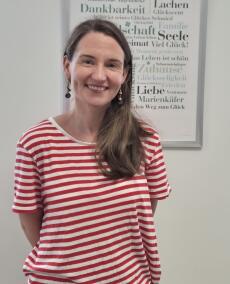
Anna-Luisa Eich heads the Department of German as a Foreign Language (LDaF) at the University of Münster’s Language Centre and was the coordinator of the exchange programme with Soochow University from 2019 to 2025. Contact
Hsu Yu-Fang is an associate professor at the Institute of German Language and Culture at Soochow University in Taipei. She has been working at the university for six years and is accompanying the group of students to Münster in person for the second time this year. Contact